
YieldMax's GMEY ETF and the Potential for High Option Income in a Volatile Retail Sector
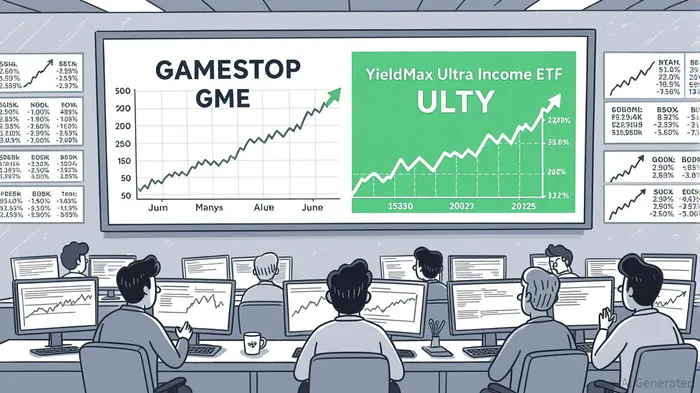
In an era of low interest rates and fragmented market sentiment, options-based income strategies have emerged as a compelling tool for investors seeking yield. The YieldMax GMEGME-- Option Income Strategy ETF (GMEY) epitomizes this trend, targeting high-conviction retail stocks like GameStopGME-- (GME) to generate monthly income through synthetic covered call strategies. However, the fund's structure and the inherent volatility of its underlying asset demand a nuanced evaluation of risk and reward.
Strategic Mechanics of GMEY
GMEY operates by selling call options on GameStop shares without directly owning the stock, deriving exposure through derivatives. This synthetic approach allows the fund to capture option premiums while indirectly tracking GME's price movements. The strategy's allure lies in its potential to deliver elevated yields—GMEY's 0.99% management fee is offset by its focus on income generation—but it comes with critical trade-offs. For instance, the fund's returns are capped during upward price swings in GME, as the sold call options obligate GMEY to cede gains beyond the strike price. Conversely, downward movements in GME's stock price expose the fund to losses, as it does not hold the underlying equity to benefit from long-term appreciation.
This structure mirrors that of the YieldMax Ultra Income ETF (ULTY), which has delivered an annualized total return of +5.3% since inception despite a -68.6% drop in share price. Such outcomes underscore a key dynamic: while reinvested dividends can enhance returns, the erosion of principal remains a significant risk. For GMEY, this tension is amplified by GME's historical volatility, which has been driven by retail sentiment, speculative trading, and unconventional corporate strategies like GameStop's BitcoinBTC-- investments.
Volatility as a Double-Edged Sword
The retail sector's susceptibility to speculative fervor creates both opportunities and challenges for options-based strategies. GameStop, a poster child for retail-driven volatility, has seen its stock price swing dramatically in 2025. Despite a year-to-date decline of -13.10%, GME surged 56.44% annually as of May 28, 2025, fueled by technical bullish signals and strategic Bitcoin purchases. Such movements attract income-focused strategies like GMEY, which thrive in environments with high implied volatility—where option premiums are elevated.
However, this volatility introduces unpredictability. For example, GME's recent 10.9% price drop following its Bitcoin investment highlighted how corporate decisions can decouple stock performance from traditional retail metrics. Retail-driven options strategies, particularly those relying on short-dated contracts, are especially vulnerable to such shocks. The Bitwise GME Option Income ETF (IGME), a peer to GMEY, exemplifies this risk: while it leverages GME's volatility for income, its synthetic structure may imperfectly track the stock's price, compounding uncertainty.
Broader Market Context and Strategic Considerations
The current macroeconomic backdrop further complicates the outlook. U.S. equities have experienced a period of low volatility, with 30-day realized volatility on major indices hitting multi-year lows. In such an environment, options-based strategies rely heavily on the idiosyncratic volatility of individual stocks like GME. While this can enhance premium income, it also concentrates risk. For instance, GMEY's focus on a single stock contrasts with diversified options strategies, exposing it to company-specific events rather than broader market trends.
Moreover, the tax implications of GMEY's distributions warrant scrutiny. A portion of its payouts may qualify as return of capital (ROC), which reduces the fund's net asset value (NAV) rather than reflecting true income. This dynamic was evident in ULTY's recent distribution, where 12.82% of the payout was classified as ROC. Investors must therefore distinguish between sustainable yield and principal erosion when evaluating the fund's appeal.
Conclusion: Balancing Yield and Resilience
GMEY represents a bold experiment in harnessing retail stock volatility for income generation. Its synthetic covered call strategy offers the potential for high yields in a low-rate world, but the fund's structural limitations—capped upside, exposure to principal loss, and tax complexities—demand careful consideration. For investors with a high risk tolerance and a conviction in GME's long-term trajectory, GMEY could serve as a speculative complement to a diversified portfolio. However, the broader retail sector's susceptibility to retail-driven speculation and corporate experimentation suggests that such strategies are best approached with caution and a clear understanding of their asymmetric risk profile.







Comentarios
Aún no hay comentarios