
YieldMax ETFs: Evaluating the Strategic Value of a $0.512 Dividend in a Volatile Crypto Market
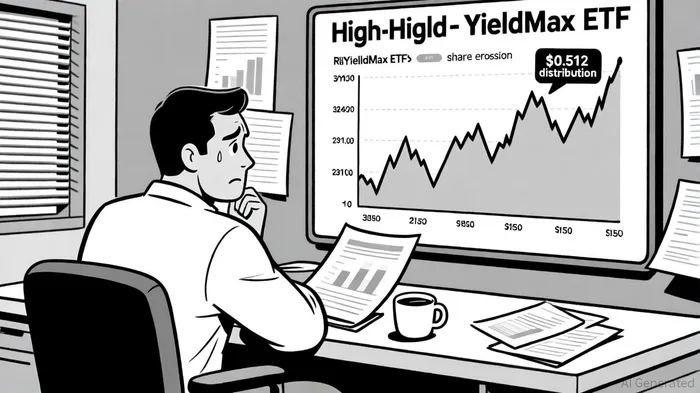
In the current landscape of income-starved investors, high-yield ETFs have emerged as a double-edged sword—offering tantalizing returns while demanding a nuanced understanding of risk. Among these, YieldMax ETFs, particularly the LFGYLFGY-- YieldMax® Crypto Industry & Tech Portfolio Option Income ETF, have drawn attention for their aggressive income strategies. A recent $0.512 per share dividend[1], announced on September 24, 2025, underscores the allure of these funds but also raises critical questions about sustainability and volatility management.
The Mechanics of YieldMax's High-Yield Strategy
YieldMax ETFs employ synthetic covered call strategies, selling options on high-volatility assets like crypto-related stocks and tech equities to generate regular income[2]. For instance, LFGY's $0.512 distribution—part of its weekly payout schedule—reflects a 66.78% distribution rate as of September 8, 2025[3]. This approach, however, comes with inherent trade-offs. By capping upside potential through options, these ETFs sacrifice capital appreciation for consistent income, a dynamic that becomes particularly relevant in the crypto sector, where price swings are par for the course[1].
The underlying asset allocation further complicates the picture. Funds like YMAX, which holds 69% U.S. Treasuries and 20% cash, aim to balance stability with income generation[1]. Yet, the remainder of the portfolio is exposed to options-driven ETFs tied to volatile names like Tesla and Nvidia. This duality—shielding against downside while chasing yield—creates a unique risk profile. As of August 2025, LFGY's 30-Day SEC Yield of 0.43% contrasts sharply with its 66.78% distribution rate, a discrepancy largely explained by return of capital distributions[3].
Risk-Adjusted Returns: A Mixed Bag
While YieldMax ETFs dazzle with high yields, their risk-adjusted performance tells a more complex story. Data from PortfoliosLab reveals that LFGY has a daily standard deviation of 42.29%, while MSTY (YieldMax II ETF) exhibits even higher volatility at 71.28%[1]. These figures highlight the inherent instability of options-based strategies in a crypto-linked context. For example, MSTY's 90.2% forward yield in 2025 coincided with a 24.8% share price decline, illustrating the tension between income generation and capital preservation[1].
Sharpe ratios, a key metric for risk-adjusted returns, offer further insight. MSTY's Sharpe Ratio of 2.14 (as of July 25, 2025) suggests strong performance relative to its volatility[3]. However, this metric must be contextualized against the fund's maximum drawdown of -40.82%, a stark reminder of the crypto sector's volatility[1]. Similarly, LFGY's 34.73% drawdown in April 2025 underscores the fragility of its income model during market downturns[3].
Strategic Value for Income-Focused Portfolios
Despite these risks, YieldMax ETFs can play a strategic role in diversified crypto portfolios. For investors prioritizing income over capital gains, the $0.512 dividend from LFGY represents a compelling opportunity to supplement returns in a low-yield environment. The fund's exposure to crypto-related tech stocks aligns with broader trends in AI and digital transformation, sectors expected to drive growth in 2025[1].
However, the double-fee structure—YMAX charges 0.29% in management fees, while underlying ETFs average 0.99%—demands careful scrutiny[1]. These costs can erode returns, particularly in funds reporting negative dollar-weighted returns despite high nominal yields[2]. Investors must also weigh the potential for return of capital distributions, which, while boosting yield metrics, do not represent true income[3].
Conclusion: Balancing Yield and Volatility
The $0.512 dividend from LFGY exemplifies the high-stakes nature of YieldMax ETFs. While these funds offer a unique blend of income generation and market exposure, their sustainability hinges on disciplined risk management. For income-focused investors, the key lies in diversifying across asset classes and hedging against the inherent volatility of crypto-linked options strategies. As the market evolves, YieldMax ETFs may continue to serve as a niche tool for those willing to navigate their complexities.





Comentarios
Aún no hay comentarios