
Yield Volatility Ahead: How GOP Fiscal Gridlock Could Shake Bond Markets
The U.S. Treasury market, long a haven of stability, now faces a perfect storm of political uncertainty, ballooning deficits, and partisan brinkmanship. The GOP's One Big Beautiful Bill Act (OBBBA), set to redefine fiscal policy through 2034, has ignited a firestorm of debate over spending cuts, debt ceiling mechanics, and the long-term solvency of the U.S. government. For investors, this clash isn't just a political spectacle—it's a roadmap to navigate credit risk and seize opportunities in fixed-income markets before the storm breaks.
The Fiscal Tightrope: Debt Dynamics Under OBBBA
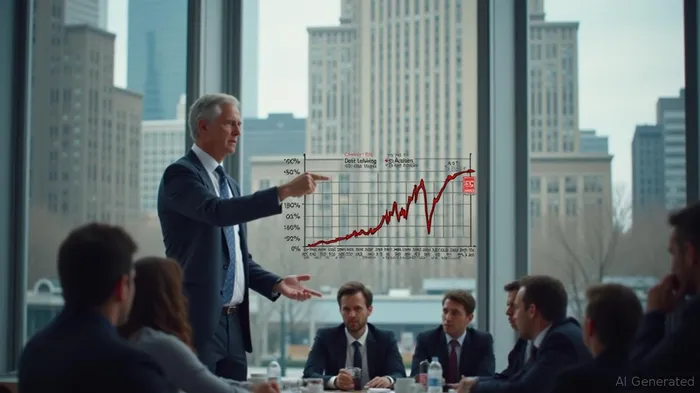
The OBBBA's core promise—$4.1 trillion in tax cuts and a $4 trillion debt ceiling hike—comes at a steep cost. Congressional Budget Office (CBO) projections show the bill would push the federal deficit to $2.6 trillion annually by 2034 (conventional scoring), with the debt-to-GDP ratio soaring to 172% by 2059. Even dynamic scoring, which assumes economic growth offsets some losses, projects a 167% debt-to-GDP ratio by mid-century.
This trajectory raises a critical question: Can bond markets remain complacent as fiscal discipline unravels? The answer lies in the partisan gridlock baked into the OBBBA's architecture. Senate Republicans like RandRAND-- Paul and Ron Johnson demand deeper spending cuts, while moderates and the White House resist touching entitlements. With only a three-vote margin for passage, the bill's survival hinges on a fragile political equilibrium. Should negotiations collapse, the U.S. could face a debt ceiling breach by late 2025—a scenario that would send Treasury yields soaring and credit spreads spiraling.
Credit Risk in the Crosshairs: Why Short-Term Plays Win
The market's current complacency is misplaced. Consider the bill's structural flaws:1. Entitlement Off-Limits: The OBBBA avoids reforms to Medicare, Medicaid, or Social Security, leaving the bulk of spending growth unaddressed. The CBO estimates mandatory spending (excluding interest) will rise by 4.5% annually through 2034.2. Dynamic Scoring Mirage: The Tax Foundation's rosy economic growth projections (0.8% long-run GDP boost) ignore the drag of higher debt servicing costs. By 2034, interest payments alone could consume 20% of federal revenue.3. Political Time Bombs: Senate holdouts like Paul threaten to block the debt ceiling hike unless cuts to Medicaid/Medicare are added—a demand that could trigger a government shutdown or default.
For investors, these risks create two actionable strategies:- Short-Duration Treasury Play: Shift allocations to 1–3 year Treasuries (). As gridlock drags on, short-term rates will remain anchored by Federal Reserve caution, while long-end yields spike on default fears.- Credit Spread Opportunity: Corporate bonds () could widen as market participants reassess U.S. fiscal credibility. Firms with strong balance sheets (e.g., industrials with海外 operations) offer asymmetric upside.
The Gridlock Premium: Pricing in Political Chaos
History shows markets punish fiscal recklessness. During the 2011 debt ceiling crisis, the 10-year Treasury yield dropped 60 basis points as investors fled equities—but the S&P 500 lost 18%. A repeat scenario would compress duration spreads while boosting demand for safe havens. However, this time, the stakes are higher. The OBBBA's $4 trillion debt hike could push the U.S. closer to “selective default” ratings downgrades, triggering automatic margin calls on Treasury-backed derivatives—a potential systemic shock.
Conclusion: Act Now Before the Fiscal Ceiling Drops
The OBBBA isn't just a legislative battle—it's a stress test for U.S. fiscal credibility. Investors ignoring political risk are gambling with borrowed time. Positioning for near-term volatility via short-duration Treasuries and credit spreads offers a high-conviction trade. Monitor Senate negotiations closely; if Paul's demands force a scaled-back debt ceiling hike or deeper cuts, yields could react violently. In this environment, the safest bet is to bet against complacency. The writing is on the wall: fiscal gridlock is the new normal, and bond markets won't stay silent for long.







Comentarios
Aún no hay comentarios