
Yield Curve Compression and JGB Futures: What Traders Should Watch Now
Yield Curve Compression and JGB Futures: What Traders Should Watch Now
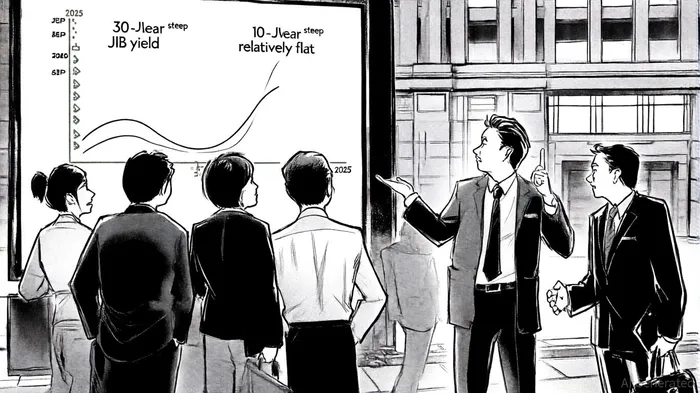
The Japanese government bond (JGB) market has entered a pivotal phase as the Bank of Japan (BoJ) transitions from decades of ultra-easy monetary policy to a normalization framework. This shift, marked by the termination of yield curve control (YCC) in March 2024 and the initiation of quantitative tightening (QT), has unleashed a surge in JGB yields, particularly in long-term maturities. By May 2025, the 30-year JGB yield hit an intraday high of 3.2%, more than double the 1.59% level of the 10-year JGB yield, according to an OANDA analysis. However, recent developments in September 2025 reveal a "twist flattening" in the yield curve, where long-term rates fell while short-term rates rose, signaling evolving market expectations and policy uncertainties, as reported by Reuters.
The BoJ's Balancing Act: Policy Normalization and Inflationary Pressures
The BoJ's cautious approach to rate hikes reflects a delicate balancing act. After its first rate increase in 17 years in Q3 2025-raising the short-term policy rate to 0.50%-the central bank has signaled reluctance to pursue further tightening, despite stubborn inflation. Core CPI reached 3.7% year-on-year in May 2025, driven by wage growth, U.S. tariffs, and domestic supply shocks, according to an Equiti outlook. This inflationary backdrop contrasts with the BoJ's political constraints, including the looming prime ministerial election, which has dampened its willingness to adopt aggressive policy moves (the Equiti outlook also highlights the political sensitivity around aggressive tightening).
The BoJ's reduced role in the JGB market has also reshaped dynamics. Japanese life insurers, the second-largest holders of JGBs, cut their holdings by 1.35 trillion yen in Q1 2025, exacerbating upward pressure on yields (noted in the OANDA analysis). Meanwhile, the BoJ's QT program, which aims to halve monthly JGB purchases by March 2026, has further normalized market conditions, a development also discussed in the OANDA analysis. These shifts have created a hybrid environment where JGB yields are increasingly influenced by market fundamentals rather than central bank interventions.
JGB Futures Positioning: A Barometer of Market Sentiment
The JGB futures market has become a critical barometer of positioning and sentiment. Open interest in mini 20-year JGB Futures reached 1,565 contracts (JPY 15.65 billion in face value) in July 2025, the highest level since the product's relaunch in 2014, according to a JPX release. This surge reflects heightened demand for hedging tools as investors navigate volatile yield environments. However, specific net long/short positions remain opaque, underscoring the need for traders to monitor broader positioning trends.
The flattening yield curve in September 2025-marked by a 1.5-basis-point rise in the 10-year yield to 1.59% and a decline in the 30-year yield to 3.21%-suggests traders are squaring positions ahead of key policy and political developments, as covered by the Economic Times. This divergence highlights the interplay between short-term rate expectations (driven by BoJ hawkishness) and long-term yield compression (reflecting reduced inflationary risks).
Central Bank Signals and Global Spillovers
The BoJ's policy trajectory is inextricably linked to global monetary conditions. U.S. Federal Reserve rate cuts, anticipated to total 75 basis points by year-end, contrast with Japan's cautious normalization, creating cross-border yield differentials, as noted in LiveMint. This dynamic has implications for carry trade strategies, which historically relied on the yen's low rates. As the 30-year JGB yield approaches 3.2%, the yield spread with U.S. Treasuries has narrowed, potentially triggering a reversal of capital flows (an outcome analyzed by OANDA).
Moreover, the BoJ's exit from YCC has synchronized JGB yields with global sovereign bond markets. The 30-year U.S. Treasury yield and German bond yields have risen in tandem with JGBs, reflecting shared inflationary pressures and policy normalization (the OANDA analysis discusses this convergence). This interconnectedness amplifies the importance of monitoring U.S. inflation data and Fed policy signals, which could influence BoJ decisions through spillover effects.
What Traders Should Watch
- BoJ Policy Flexibility: The BoJ's reluctance to hike rates further, despite inflation, suggests a focus on credibility over aggressive tightening. Traders should watch for hints of policy pivots in minutes or forward guidance.
- Yield Curve Dynamics: The September 2025 flattening indicates a tug-of-war between short-term rate expectations and long-term yield compression. A steeper curve could signal renewed inflation risks, while a flatter curve might reflect BoJ intervention.
- Global Inflation Data: U.S. CPI and PPI reports will be critical in shaping Fed-BoJ policy divergences, with implications for JGB futures positioning.
- Political Uncertainty: The prime ministerial race and fiscal policy debates could force the BoJ into a more dovish stance, adding volatility to JGB markets.
Conclusion
The JGB market's evolution in 2025 underscores the transition from a BoJ-dominated landscape to one shaped by market forces and global macroeconomic trends. Traders must navigate this complexity by closely monitoring yield curve compression, central bank signals, and cross-border spillovers. As the BoJ walks the tightrope between inflation control and political constraints, the JGB futures market will remain a key battleground for positioning and strategy shifts.







Comentarios
Aún no hay comentarios