
Yext's Q2 Earnings Signal Stabilization Amid Strategic Uncertainty
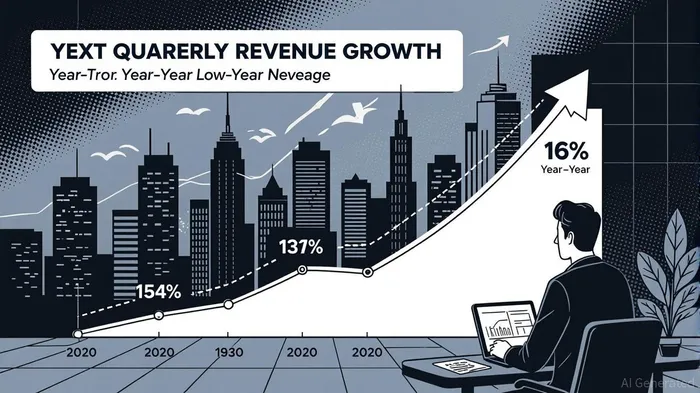
Yext’s Q2 2025 earnings report delivered a mixed bag for investors, showcasing strong financial performance while underscoring lingering strategic ambiguity. The company reported non-GAAP earnings per share (EPS) of $0.13, a 160% year-over-year increase, and revenue of $113.1 million, up 16% year-over-year [1]. Adjusted EBITDA surged 169.4% to $26.4 million, and Annual Recurring Revenue (ARR) grew to $444.4 million, reflecting a 14.7% year-over-year rise [1]. These figures, while impressive, mask a critical nuance: much of the growth was driven by acquisitions, such as Hearsay Systems and Places Scout, rather than organic momentum [1].
The stabilization in Yext’s growth metrics appears to stem from its recent strategic shifts. A 95% dollar-based net retention rate for total customers—a 4-point improvement from the prior year—suggests improved customer satisfaction [1]. However, this metric remains below the 100%+ benchmark common in the software sector, indicating room for improvement in upselling or cross-selling [1]. Meanwhile, the integration of acquired businesses has temporarily masked underlying challenges in scaling organic revenue streams.
A deeper look at the earnings report reveals a company at a crossroads. While Yext’s financials demonstrate operational efficiency—evidenced by the sharp rise in adjusted EBITDA—the lack of forward guidance has left investors in limbo [1]. The company cited a pending CEO-led take-private proposal as the reason for withholding projections, a move that raises questions about long-term transparency and strategic direction [1]. This ambiguity contrasts with the clarity seen in peers who regularly update market expectations, potentially deterring risk-averse investors.
From a market position standpoint, Yext’s performance highlights both strengths and vulnerabilities. The company’s focus on AI-driven search and knowledge management has positioned it as a niche player in the enterprise software space. However, the reliance on acquisitions to fuel growth signals a departure from the organic scalability that typically drives high multiples in the sector. As noted by analysts, “Yext’s ability to sustain this trajectory will depend on its capacity to integrate new assets into a cohesive product suite while maintaining customer retention” [1].
Investors should also consider the broader macroeconomic context. With interest rates stabilizing and enterprise software budgets tightening, Yext’s ability to demonstrate predictable revenue streams—via its $444.4 million ARR—becomes a critical differentiator. Yet, the absence of guidance complicates efforts to model future cash flows, a factor that could weigh on valuation multiples.
In conclusion, Yext’s Q2 results reflect a stabilization in its growth trajectory, driven by strategic acquisitions and improved operational metrics. However, the lack of transparency around its long-term vision and the pending take-private proposal introduce significant uncertainty. For investors, the key question is whether the company’s current trajectory—reliant on inorganic growth—can evolve into a self-sustaining model capable of delivering consistent value. Until then, Yext’s stock may remain a speculative bet rather than a core holding.
Source:
[1] YextYEXT-- Earnings Jump 160% in Fiscal Q2 [https://www.nasdaq.com/articles/yext-earnings-jump-160-fiscal-q2]





Comentarios
Aún no hay comentarios