
The Year-End Rally: Is Now the Time to Position for 2026?
As 2025 draws to a close, investors are grappling with a paradox: a resilient equity market rally amid persistent inflationary signals. With U.S. headline inflation hitting 3.1% in November 2025-the highest since May 2024-and core inflation stubbornly stuck at 3.0%, the question looms: Should investors double down on current gains or pivot to safeguard against a 2026 landscape shaped by sticky price pressures and shifting macroeconomic dynamics? The answer lies in a strategic reallocation of assets, balancing growth opportunities with inflationary resilience.
The Inflationary Tightrope
The inflationary environment in 2026 is unlikely to resemble the "Goldilocks" scenarios of previous years. Tariffs, a weaker dollar, and fiscal stimulus are cementing higher-for-longer price pressures. Deloitte projects that high tariffs alone could push the core PCE price index up by 3% in 2026, keeping inflation above the Federal Reserve's 2% target until 2028. Meanwhile, an immigration crackdown is tightening labor supply, sustaining wage growth at 3.9% and further fueling demand-side inflation. These structural forces suggest that investors must abandon the assumption of a swift return to pre-pandemic price stability.
Growth: A Mixed Outlook
While inflation remains a concern, economic growth is not entirely bleak. The Philadelphia Federal Reserve's Fourth Quarter 2025 Survey of Professional Forecasters anticipates real GDP growth of 1.9% in 2025 and 1.8% in 2026. However, this optimism is contingent on sustained AI investment and global demand. A pullback in tech spending could trigger a sharp slowdown, with Deloitte's downside scenario projecting real GDP growth of just 0.8% by 2028. This uncertainty underscores the need for portfolios to hedge against both inflation and growth volatility.
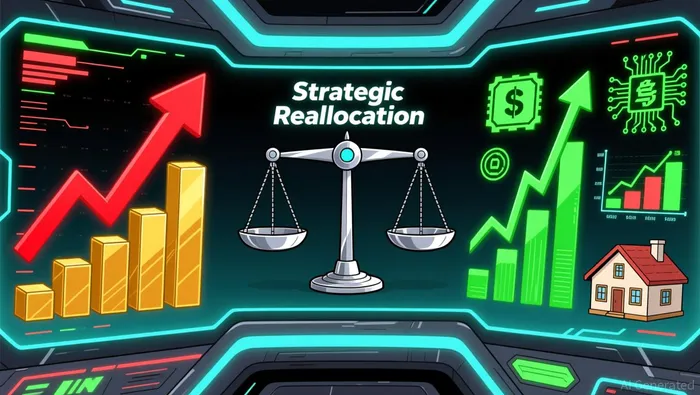
Strategic Reallocation: Diversification as a Shield
Against this backdrop, asset allocators are increasingly favoring diversified, multi-asset strategies. Goldman Sachs Asset Management advocates for a blend of active cross-asset positioning and granular security selection, emphasizing global equity diversification in sectors like defense, technology, consumer, and healthcare. Small-cap stocks in these sectors, though more volatile, offer growth potential in an environment where large-cap dominance may wane.
Fixed-income investors, meanwhile, are turning to securitized assets, high-yield credit, and emerging market bonds, as highlighted by PIMCO. With central banks diverging in policy trajectories, locking in yields via high-quality bonds with 2–5-year maturities becomes critical as rates trend lower. Gold, too, is regaining favor as an inflation hedge, with record prices reflecting its role as a geopolitical and macroeconomic safe haven.
Real Assets and Alternatives: Capturing Secular Trends
Wellington Management argues that real assets-particularly those tied to digitalization and decarbonization-will outperform in 2026. Infrastructure investments, for instance, offer high internal rates of return and align with global efforts to modernize energy grids and data networks. Cambridge Associates further recommends equity long/short (ELS) hedge fund strategies to navigate sector dispersion and policy uncertainty. These strategies historically capture equity gains while mitigating downside risk, making them ideal for a year marked by regulatory shifts and technological disruption.
Risks and the Road Ahead
Despite these opportunities, risks remain. A slowdown in AI adoption or a sudden policy reversal could disrupt growth trajectories. Additionally, the reliability of inflation data itself is under scrutiny, with economists questioning methodological assumptions in the delayed November CPI report. Investors must remain agile, adjusting allocations as new data emerges.
Conclusion
The year-end rally of 2025 reflects optimism about near-term growth, but 2026 demands a more nuanced approach. By reallocating toward inflation-protected assets, diversified equities, and real-world secular trends, investors can position themselves to thrive in a world where inflation and uncertainty are the new normal. As the old adage goes, "He who plans ahead doesn't get tripped up"-and in 2026, foresight may be the most valuable asset of all.







Comentarios
Aún no hay comentarios