
Yamaha Motor's Strategic Pivot to E-Mobility and Hydrogen: A Pathway to Reinvigorate Investment Potential
Yamaha Motor Co., Ltd. has long been a stalwart in the global two- and three-wheeler market, but its recent stock decline has prompted scrutiny of its long-term viability. However, a closer examination of its strategic pivot toward next-generation mobility and sustainability reveals a compelling case for renewed investor confidence. By leveraging its engineering heritage, diversifying into electrification and hydrogen technologies, and aligning with global decarbonization trends, Yamaha is positioning itself to capitalize on the rapidly evolving transportation landscape.
Innovation Pipeline: Diversifying Beyond Electrification
Yamaha's 2025 innovation pipeline underscores its commitment to a multi-pathway approach to sustainability. In India, the company launched two electric scooters-the AEROX E and EC-06, marking its first in-house electric sport scooter and a collaborative effort with River Mobility Private Limited, respectively. These models are part of a broader environmental initiative to achieve carbon neutrality in Scope 3 emissions (emissions from product use) by 2050.
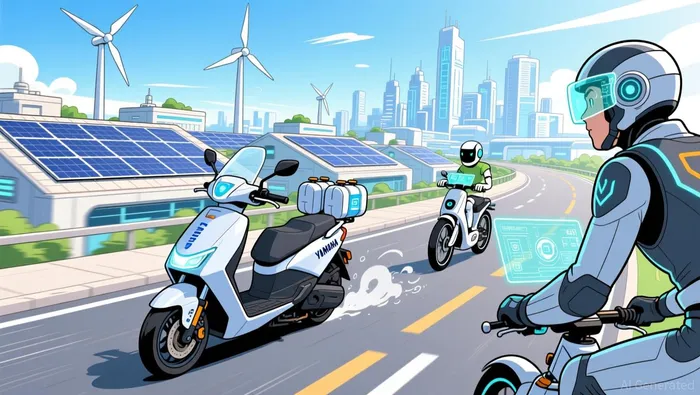
Simultaneously, Yamaha unveiled hydrogen-powered and AI-driven prototypes at the Japan Mobility Show 2025, including the H2 Buddy Porter Concept, developed in collaboration with Toyota. This hydrogen-powered motorcycle features compact tanks compliant with UN regulations and offers over 100 km of range, signaling a tangible step toward commercialization. The company also showcased the MOTOROiD:Λ and the PROTO BEV, an AI-driven self-learning bike and a pure-electric supersport, reflecting its ambition to integrate electrification, hydrogen, and AI into future mobility solutions.
Market Positioning: Navigating a Fragmented E-Mobility Landscape
Yamaha's strategy to diversify its energy sources-electric, hydrogen, and biofuels-positions it to adapt to varying regional infrastructures. For instance, it plans to launch electric products in Europe, where renewable energy adoption is high, before expanding to ASEAN markets. This phased approach mitigates risks associated with uneven global electrification readiness.
The hydrogen-powered motorcycle market, in particular, is poised for explosive growth. According to industry forecasts, the global hydrogen-powered electric two-wheeler market is projected to expand from $500 million in 2025 to $5 billion by 2033, driven by environmental regulations and technological advancements. Yamaha's collaboration with Toyota on hydrogen storage solutions and its participation in hydrogen fuel cell research further solidify its competitive edge.
Financial Resilience Amid Challenges
While Yamaha's Q3 2025 earnings revealed a decline in operating income to ¥112.4 billion (56% of the previous year's figure), the company maintained stability in its core motorcycle business, particularly in emerging markets like Indonesia, Thailand, and the Philippines. This resilience, coupled with cost management initiatives, has allowed Yamaha to sustain its investment in mid- to long-term growth strategies, including R&D for electrification and hydrogen technologies.
Credit risk assessments, though fluctuating between 2021 and 2025, indicate a pattern of resilience. Despite a brief downgrade to B3 in April 2025, Yamaha's default probability decreased to 0.118 by November 2024, reflecting its ability to navigate macroeconomic headwinds. Analysts note that strategic investments in innovation and sustainability have cushioned the company against industry-wide challenges such as supply chain disruptions and inflationary pressures.
Long-Term Growth Drivers: Aligning with Global Trends
Yamaha's multi-pathway strategy aligns with global decarbonization goals and technological trends. The company's focus on hydrogen and biofuels complements its electric vehicle (EV) initiatives, ensuring it remains relevant in markets where battery infrastructure lags. For example, its hybrid electric scooter prototype, integrating a 3 kW PEM fuel cell and lithium-ion battery, highlights the potential of hydrogen as a range extension solution in urban mobility.
Moreover, Yamaha's collaboration with Gogoro in urban Asia underscores its commitment to enhancing e-mobility adoption through battery-swapping networks and smart connectivity. These partnerships not only accelerate technology deployment but also reduce customer acquisition costs, a critical factor in price-sensitive markets.
Conclusion: A Calculated Bet on the Future
Yamaha Motor's stock decline may present an opportunity for investors willing to bet on its long-term vision. While short-term financial metrics remain mixed, the company's strategic pivot toward electrification, hydrogen, and AI-driven mobility positions it to benefit from the $5 billion hydrogen two-wheeler market and the $3.4 billion connected motorcycle market by 2032. By diversifying its energy sources and leveraging collaborations with industry leaders like Toyota, Yamaha is mitigating risks associated with a single-technology bet.
For investors, the key question is whether Yamaha can scale its innovations quickly enough to outpace competitors. Given its engineering expertise, global footprint, and alignment with decarbonization trends, the company appears well-positioned to do so. As the transportation sector transitions toward sustainability, Yamaha's multi-pathway approach may prove to be its most enduring strength.







Comentarios
Aún no hay comentarios