
XRPL's Institutional Readiness and Privacy-Enhanced DeFi Growth
The XRPXRP-- Ledger (XRPL) is undergoing a transformative phase in 2025, positioning itself as a formidable contender in the institutional blockchain space. With regulatory clarity, technical innovation, and privacy-enhanced DeFi infrastructure converging, XRPL is capturing market share through a strategic alignment with institutional-grade requirements. This analysis evaluates how XRPL's unique value proposition-combining compliance, scalability, and privacy-enables it to outperform competitors like EthereumETH-- and privacy coins in the institutional arena.
Regulatory Clarity: A Catalyst for Institutional Adoption
The resolution of the SEC's legal case against Ripple in August 2025 marked a watershed moment. By classifying XRP as a utility token, the ruling removed a critical barrier for institutional participation. This regulatory clarity directly enabled the launch of the first U.S. spot XRP ETF, the REX-Osprey XRP ETF (XRPR), which recorded $37.7 million in trading volume on its debut, according to a Currency Analytics report. Additional ETFs from Grayscale, Franklin Templeton, and Bitwise are projected to inject up to $2 billion into the market, creating a "soft floor" for XRP prices and enhancing liquidity, the report noted.
Regulatory support has also accelerated XRPL's integration into traditional finance. Ripple's On-Demand Liquidity (ODL) service processed $1.3 trillion in Q2 2025 alone, demonstrating XRP's utility as a bridge currency for cross-border transactions, per the Currency Analytics piece. Partnerships with Santander and SBI Holdings further solidify XRPL's role in institutional corridors, where speed and cost-efficiency are paramount.
Technical Upgrades: Scalable DeFi Infrastructure
XRPL's 2025 roadmap has prioritized scalability and institutional-grade functionality. The launch of an Ethereum Virtual Machine (EVM)-compatible sidechain in June 2025 allowed over 1,400 smart contracts to be deployed, with total value locked (TVL) reaching $120 million, as the Currency Analytics analysis observed. This development bridges XRPL with Ethereum's DeFi ecosystem while leveraging XRPL's inherent advantages: sub-second finality, $0.00001 transaction fees, and a 7x surge in daily interacting addresses, as reported by CoinCentral.
Institutional DeFi on XRPL is further bolstered by features like a permissioned decentralized exchange (DEX), credit-based lending protocols, and multi-purpose tokens (MPTs). These tools enable compliance-oriented asset management, allowing institutions to tokenize real-world assets (RWAs) such as U.S. treasuries and commercial paper. By Q2 2025, XRPL's RWA market cap had reached $131.6 million, driven by tokenized securities and stablecoins like Ripple's RLUSD, which grew 49.4% quarter-over-quarter to $65.9 million, according to a CCN report.
Privacy-Enhanced DeFi: Compliance Meets Confidentiality
Privacy is a cornerstone of institutional adoption, and XRPL is addressing this through protocol-level innovations. Ripple has introduced compliance tools like Credentials (KYC verification), Deep Freeze (blocking sanctioned accounts), and Simulate (transaction simulation for risk assessment), as the Currency Analytics report details. These tools ensure that institutions can meet regulatory obligations while maintaining operational efficiency.
Looking ahead, XRPL is integrating zero-knowledge proofs (ZKPs) to enable private transactions without compromising transparency for regulators. Ripple cryptographer J. Ayo Akinyele emphasizes embedding ZKPs into the protocol layer, allowing sensitive data (e.g., transaction amounts, identities) to remain confidential while proving validity, as reported by CoinDesk. This approach contrasts with Ethereum's modular compliance solutions, which rely on off-chain services, and privacy coins like Monero and ZcashZEC--, which prioritize anonymity at the expense of regulatory compatibility, according to an OnChain Standard analysis.
Competitive Advantage: XRPL vs. Ethereum and Privacy Coins
While Ethereum dominates the DeFi TVL and dApp ecosystem, its decentralized structure and high gas fees make it less attractive for institutional use. XRPL's centralized validator model (150 Ripple-selected nodes) and low-cost, high-speed transactions position it as a more scalable solution for cross-border payments and tokenized assets, the OnChain Standard analysis argues.
Privacy coins like Monero (XMR) and Zcash (ZEC) face existential challenges in 2025 due to regulatory scrutiny. Monero's ring signatures and Zcash's zk-SNARKs obscure transaction details, but delistings from major exchanges and regional bans have stifled adoption, the analysis notes. In contrast, XRPL's privacy features are designed to coexist with compliance, making it a more viable option for institutions navigating regulatory frameworks.
Data Visualization: XRPL's Institutional Growth
Conclusion: A New Era for Institutional DeFi
The XRP Ledger's 2025 trajectory underscores its potential to capture institutional market share through a unique blend of regulatory alignment, technical scalability, and privacy-enhanced infrastructure. By addressing institutional pain points-liquidity, compliance, and confidentiality-XRPL is transitioning from a speculative asset to a foundational layer for global finance. As Ethereum grapples with scalability and privacy coins face regulatory headwinds, XRPL's institutional readiness positions it as a compelling long-term investment.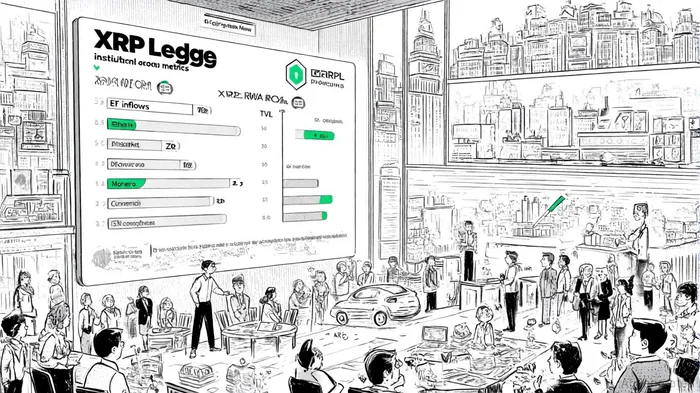






Comentarios
Aún no hay comentarios