
XRP Whale Activity and ETF Dynamics: A Contrarian Case for Accumulation in Early 2026
The cryptocurrency market in late 2025 has been a study in contradictions. While macroeconomic headwinds and year-end liquidity constraints have dragged on broader crypto prices, XRPXRP-- has quietly built a foundation for a potential supply-driven breakout in early 2026. This divergence between short-term price action and structural on-chain dynamics presents a compelling case for contrarian accumulation, particularly for investors attuned to the interplay between whale behavior, ETF flows, and supply mechanics.
Whale Accumulation: A Tale of Two Camps
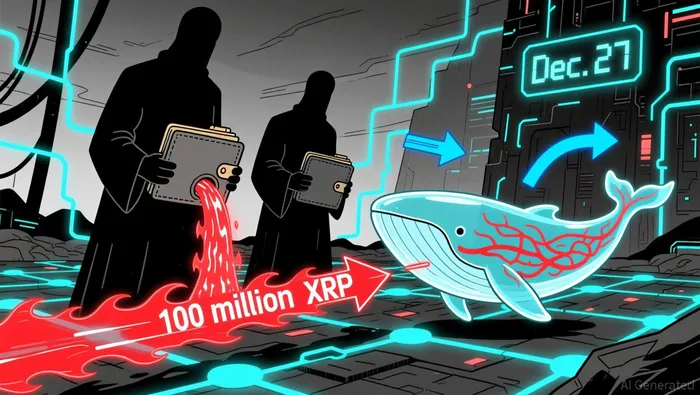
XRP's whale activity in Q4 2025 reveals a nuanced narrative. Long-term holders (LTHs) have been aggressively accumulating, with large wallets absorbing over 9 million XRP on December 27 and nearly doubling that to 15.9 million XRP within two days. This contrasts sharply with the actions of the largest whale addresses (holding 100 million to 1 billion XRP), which reduced their holdings by 100 million XRP in late December-a move valued at $185–190 million at the time.
This duality underscores a critical market dynamic: while top-tier whales are offloading, mid-term holders and institutional investors are stepping in. Mid-term holders (1–3 month timeframes) increased their ownership from 9.58% to 12.32% of the total XRP supply over a month. Such a shift suggests a transition in market sentiment, where speculative selling by large whales is being counterbalanced by strategic accumulation by a broader cohort of investors.
ETF Dynamics: XRP's Institutional Edge
The U.S. spot XRP ETFs have emerged as a linchpin of this structural shift. By late 2025, these funds had absorbed $1.1–1.2 billion in net inflows within weeks of trading, with daily inflows peaking at $43.9 million. This performance outpaced BitcoinBTC-- and EthereumETH-- ETFs, which faced outflows of $1.09 billion and $564 million, respectively, in December.
The institutional demand for XRP is rooted in its unique positioning. Unlike Bitcoin's store-of-value narrative, XRP's utility as a cross-border payment asset-bolstered by Ripple's SEC settlement and regulatory clarity-has made it an attractive allocation for institutions seeking real-world infrastructure exposure. As stated by a report from Yahoo Finance, "XRP ETFs absorbed $483 million in December alone, highlighting a divergence in institutional appetite between XRP and its peers." This trend suggests that XRP is being reclassified from a speculative asset to a utility-driven investment, a shift that often precedes sustained price appreciation.
Supply Lockups: A Structural Tailwind
On-chain data further reinforces the case for XRP's long-term potential. Exchange-held balances, a critical indicator of liquidity and selling pressure, have been declining. By early 2026, exchange holdings stood at approximately 15.4 billion XRP, with platforms like Upbit, Binance, and Bithumb holding significant portions. Meanwhile, initiatives such as Midas and Axelar's mXRP DeFi product aim to lock up $10 billion worth of XRP, while the Flare Network plans to lock 5 billion XRP in 2026.
These lockups, combined with ETF holdings of over 650 million XRP, are tightening the circulating supply. The result is a market structure where tokens are increasingly held in long-term, non-circulating positions-a scenario historically associated with supply-driven breakouts. As noted in a MEXC analysis, "the combination of institutional lockups and ETF accumulation is creating a supply crunch that could amplify XRP's price elasticity in early 2026."
Price Divergence: A Contrarian Opportunity
Despite these bullish fundamentals, XRP's price remains subdued. By December 30, 2025, XRP-USD traded around $1.85–$1.88, down 11–12% year-on-year and 47% below its 2025 high. This underperformance is largely attributable to macroeconomic factors, including thin year-end liquidity and Federal Reserve rate uncertainty. However, the disconnect between price and fundamentals is not uncommon in asset markets.
History shows that such divergences often resolve in favor of the underlying fundamentals, particularly when structural supply dynamics are at play. For XRP, the combination of whale accumulation, ETF inflows, and supply lockups creates a scenario where price correction is more likely than a continuation of the current underperformance.
Conclusion: Positioning for the Breakout
The case for XRP in early 2026 hinges on its ability to capitalize on structural supply-side advantages while navigating macroeconomic noise. Whale activity and ETF dynamics suggest a market in transition, where institutional demand and utility-driven narratives are beginning to outweigh speculative selling. For investors with a medium-term horizon, the current price dislocation offers a compelling entry point into an asset poised for a supply-driven breakout.
As the first quarter of 2026 unfolds, the key will be monitoring whether the ETF inflows and on-chain accumulation translate into a sustained price re-rating. For now, the data points to a market primed for a correction-and potentially a significant one.





Comentarios
Aún no hay comentarios