
XRP's Vulnerability Amid Macroeconomic Headwinds and Institutional Setbacks: A Risk Assessment in a Bearish Crypto Environment
In 2025, XRP's journey has been a study in contrasts. Despite a landmark legal victory with the U.S. Securities and Exchange Commission (SEC) and the approval of spot XRPXRP-- ETFs, the token has underperformed expectations, closing the year down 13%. This divergence between regulatory clarity and price action underscores a broader truth: in a bearish crypto environment, macroeconomic headwinds and institutional setbacks can eclipse even the most significant legal wins. For investors, understanding these dynamics is critical to assessing XRP's risk profile and positioning portfolios accordingly.
Macroeconomic Headwinds: Fed Policies and Liquidity Shifts
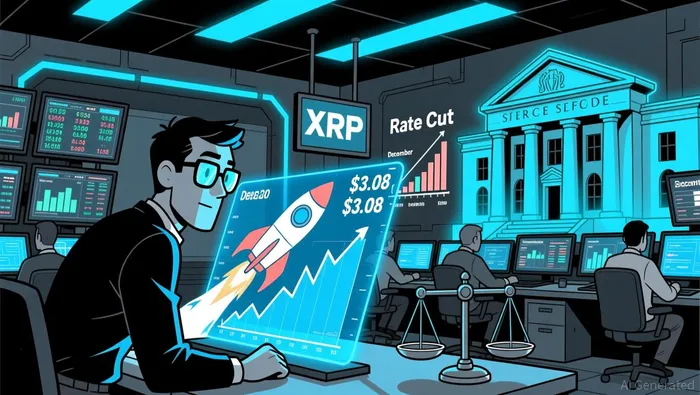
The Federal Reserve's actions in 2025 created a volatile backdrop for XRP. A 25-basis-point rate cut in September 2025 initially drove XRP to $3.08, a 1.5% surge, as institutional capital flowed into risk assets. However, this optimism was short-lived. The Fed's ongoing balance sheet contraction-a year-long effort to reduce its $9 trillion holdings-created liquidity shifts that pressured crypto markets. Investors, seeking higher-yielding assets, rotated into cryptocurrencies but remained cautious. By December 2025, XRP's price had stabilized within a $1.60–$2.20 range, constrained by inflation concerns and geopolitical tensions.
The approval of spot XRP ETFs in November 2025 initially seemed to offer a lifeline. These products attracted $1.32 billion in institutional inflows, yet price appreciation failed to materialize. Heavy profit-taking and whale selling eroded gains, illustrating a key risk: institutional adoption does not always translate to price resilience.
Institutional Setbacks: Regulatory Clarity vs. Market Realities
XRP's legal victory with the SEC in August 2025-settling the decade-long lawsuit for $125 million-was a watershed moment. The ruling affirmed that XRP is not a security in secondary markets, yet the token fell 13% for the year. This disconnect highlights the limitations of regulatory clarity in a bearish environment. While the settlement reduced legal uncertainty, it did not eliminate broader institutional skepticism.
Ripple's efforts to bolster institutional adoption, such as acquiring Hidden Road to form Ripple Prime, have yet to yield widespread traction. Meanwhile, the SEC's ongoing appeal and enforcement actions against peers like Coinbase and Binance have kept regulatory risk alive according to regulatory analysis. Ripple's On-Demand Liquidity service, intended to drive real-world demand for XRP, also underperformed, failing to justify the token's valuation.
Strategic Positioning: Navigating a Bearish Crypto Environment
For investors, XRP's 2025 trajectory offers a cautionary tale. In a bearish market, macroeconomic factors and institutional behavior often outweigh fundamental progress. Here's how to position strategically:
- Diversify Exposure: XRP's price sensitivity to Fed policy and geopolitical events means diversifying across asset classes-particularly those less correlated to macroeconomic cycles-can mitigate risk.
- Hedge Against Liquidity Shifts: Given the Fed's balance sheet contraction, maintaining liquidity through cash reserves or short-term instruments can protect against sudden market corrections.
- Monitor Regulatory Developments: While the SEC's appeal is a known risk, broader enforcement trends (e.g., actions against exchanges) could create cascading effects. Investors should prioritize assets with clearer regulatory pathways.
Conclusion
XRP's 2025 performance underscores a harsh reality: in a bearish crypto environment, even major legal and institutional milestones may not be enough to offset macroeconomic and regulatory headwinds. For investors, the lesson is clear-strategic positioning must account for both the token's fundamentals and the broader ecosystem's vulnerabilities. As 2026 approaches, those who hedge against liquidity shifts and regulatory uncertainty may find themselves better prepared for whatever comes next.






Comentarios
Aún no hay comentarios