
XRP's Volatility and the Strategic Position of Ripple-Backed Firms: Assessing Institutional Risk and Long-Term Upside
The cryptocurrency market in 2025 has been defined by a delicate interplay between regulatory clarity and institutional adoption, with XRPXRP-- emerging as a unique case study. Despite a 13% decline in price year-to-date, XRP outperformed Bitcoin (-18%) and Ethereum (-27%), underscoring its resilience amid macroeconomic headwinds. This performance, coupled with transformative regulatory developments in the U.S. and Japan, has positioned XRP as a focal point for institutional investors seeking to balance risk and long-term upside.
Regulatory Clarity: A Double-Edged Sword
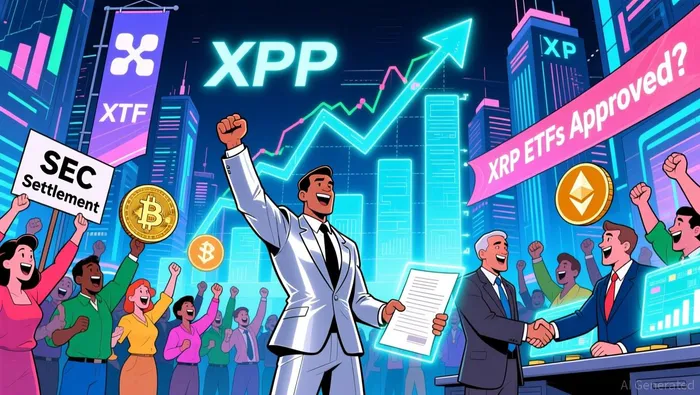
The August 2025 U.S. SEC settlement with Ripple, which affirmed that XRP is not a security in secondary market transactions, marked a watershed moment. This ruling not only relisted XRP on major exchanges but also triggered a wave of profit-taking by early investors, temporarily dampening bullish momentum. However, the regulatory clarity provided by this settlement has since catalyzed institutional confidence. For instance, the launch of U.S. spot XRP ETFs in November 2025 attracted over $1 billion in inflows within four weeks, despite flat price action due to sustained selling by large holders.
In Japan, Ripple's collaboration with SBI Holdings to launch RLUSD-a U.S. dollar-backed stablecoin-by Q1 2026 represents another critical milestone. RLUSD, fully collateralized by U.S. Treasuries and subject to monthly third-party audits, is designed to leverage Japan's robust financial infrastructure for cross-border payments according to industry analysis. This initiative aligns with Japan's FSA signaling potential interest rate hikes and stricter currency market interventions, creating a regulatory environment where XRP's utility as a bridge currency could thrive as reported by financial analysts.
Institutional Strategies: Risk Management and ETF Momentum
Institutional investment strategies in XRP have evolved to prioritize risk mitigation amid regulatory uncertainty. The U.S. GENIUS Act and the Digital Asset Market Clarity Act of 2025 have provided a legal framework for stablecoins and digital assets, enabling institutions to integrate XRP into portfolios with clearer risk parameters. On-chain data further supports this trend: 1.35 billion XRP were removed from exchanges in under two months, signaling a shift toward long-term holding strategies.
The launch of XRP spot ETFs, including the first pure XRP ETFXRPI-- by Canary Capital, has also reshaped institutional dynamics. These products, now tied to a fully regulated token, have attracted over $1 billion in cumulative inflows without a single day of net outflows since their debut. Analysts like Sam Daodu highlight that the potential entry of BlackRock into the XRP ETF market could replicate the "ETF effect" seen in BitcoinBTC-- in 2024, driving massive capital reallocation.
Ripple-Backed Firms: Strategic Positioning and Utility Expansion
Ripple's strategic alliances, particularly with SBI Holdings, underscore its ambition to dominate institutional-grade blockchain solutions. SBI VC Trade, a subsidiary of SBI Holdings, has secured regulatory approvals to distribute RLUSD, positioning the firm to capture significant transaction fees in Asia's digital banking sector. Meanwhile, Ripple's acquisition of a U.S. national trust bank charter allows it to manage RLUSD directly through the Federal Reserve, bypassing third-party intermediaries and reducing counterparty risk.
The XRP Ledger's (XRPL) expanding utility further enhances its strategic value. Partnerships with Archax-a regulated digital securities exchange aim to tokenize real-world assets like equities and debt, enabling real-time settlements on the XRPL. This innovation threatens traditional correspondent banking models and could drive institutional adoption by reducing settlement costs and time.
Risk-Rebalance and Long-Term Upside
While XRP's regulatory and institutional tailwinds are compelling, risks remain. Macroeconomic factors, such as potential Federal Reserve rate cuts, could influence investor sentiment, while regulatory reversals or macroeconomic slowdowns pose threats to price targets like $5. Additionally, whale distribution-exemplified by SBI Holdings' $10 billion XRP position introduces volatility if large holders decide to liquidate.
However, the long-term upside for institutional holders is anchored in XRP's growing utility. The anticipated launch of RLUSD in Japan and its potential expansion into the UAE and Europe could solidify XRP's role in global finance. Furthermore, the tokenization of real-world assets on the XRPL and the proliferation of XRP ETFs create a self-reinforcing cycle of demand and institutional legitimacy.
Conclusion
XRP's 2025 journey reflects a market in transition, where regulatory clarity and institutional adoption are reshaping risk profiles and upside potential. For institutional investors, the key lies in balancing short-term volatility with long-term strategic positioning. As Ripple-backed firms like SBI Holdings and Archax continue to innovate, XRP's role as a bridge currency and settlement asset could redefine global financial infrastructure-provided regulatory and macroeconomic headwinds are navigated effectively.





Comentarios
Aún no hay comentarios