
XRP's Volatility and the Role of Institutional Mining Platforms in Stabilizing Crypto Exposure
The XRPXRP-- Flash Crash: A Perfect Storm of Macro and Micro Forces
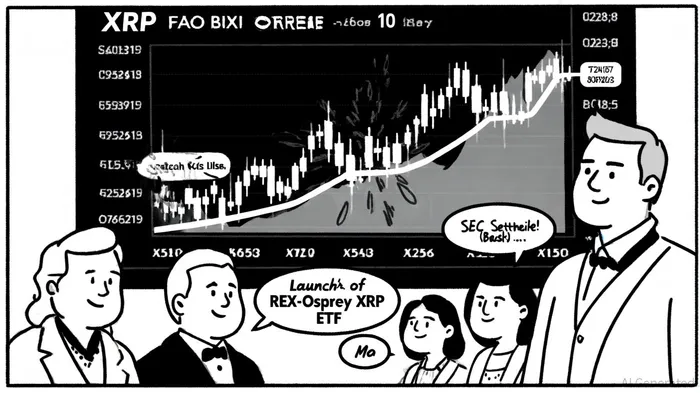
XRP's 40% flash crash on October 10, 2025, was a textbook example of how macroeconomic shocks and concentrated selling pressure can collide to destabilize even the most liquid crypto assets. According to a report by The Financial Analyst, the price plummeted from $2.82 to $1.64 within hours, driven by mass liquidations of long positions and stop-loss triggers on exchanges. On-chain data revealed that whales were offloading $50 million of XRP daily, with one whale alone dumping 160 million XRP ($480 million) in early October, according to on-chain data. This selling frenzy was compounded by the U.S.-China trade war's 100% tariff announcement, which triggered a 10% drop in Bitcoin's price.
While short-term volatility is par for the course in crypto, the flash crash exposed critical vulnerabilities in XRP's market structure. Analysts like Peter Brandt warned that the token was in a bearish descending triangle pattern, with a breakdown below $2.20 likely. Yet, the broader context-Ripple's August 2025 SEC settlement and the subsequent relisting of XRP on major U.S. exchanges-suggests that the token's long-term fundamentals remain intact, a point detailed in a post-SEC clarity piece.
Institutional Mining Platforms: Engineering Stability in a Volatile Market
In the wake of the crash, institutional mining platforms have emerged as key players in stabilizing XRP exposure. Platforms like JA Mining offer cloud mining contracts denominated in USD, allowing XRP holders to lock in fixed daily earnings in USDTUSDT-- regardless of price fluctuations. This "yield plus growth" model enables investors to hedge against volatility while retaining upside potential if XRP recovers. For example, a user allocating 10 million XRP into a 12-month cloud mining contract could earn $1.2 million in stablecoin yields while avoiding the risk of a further 30% price drop (as described in the JA Mining coverage).
Beyond yield generation, the XRP Ledger (XRPL) itself is being weaponized to enhance liquidity and price stability. Ripple's institutional DeFi tools, including an Automated Market MakerMKR-- (AMM) and native decentralized exchange (DEX), allow for real-time price optimization and deeper order books. Additionally, features like Deep Freeze and Clawback enable token issuers to enforce compliance and prevent misuse, addressing regulatory concerns that previously hindered institutional adoption, as outlined in the Ripple analysis.
Capital Reallocation and the Rise of XRP as a Bridge Currency
The post-SEC settlement environment has catalyzed a surge in institutional capital flows into XRP. The launch of the REX-Osprey XRP ETF (XRPR) on September 18, 2025, marked a watershed moment, attracting $1.2 billion in trading volume within its first week (reported in Ripple's institutional DeFi coverage). Analysts project $5–$11 billion in institutional inflows over the next 12 months, driven by XRP's unique cross-border payment utility and regulatory clarity.
This reallocation is part of a broader trend: a global survey by Coinbase and EY-Parthenon found that 83% of institutional investors plan to increase crypto allocations in 2025, with 59% targeting more than 5% of their AUM. XRP's role as a "bridge currency" for cross-border transactions-processing 1.5 billion payments annually-positions it as a natural beneficiary of this shift (the JA Mining coverage and Ripple analysis both discuss XRP's cross-border use cases).
The Path Forward: Balancing Risk and Reward
While XRP's volatility remains a double-edged sword, the tools now available to investors are reshaping the risk-reward calculus. Institutional mining platforms, regulatory clarity, and DeFi-native infrastructure are creating a multi-layered defense against flash crashes. However, macroeconomic headwinds-such as the U.S. Federal Reserve's hawkish stance and geopolitical tensions-will continue to test market resilience, a point underscored in Ripple's institutional analysis.
For investors, the key takeaway is clear: diversification and structured hedging are no longer optional. Whether through cloud mining contracts, derivatives, or ETFs, the goal is to participate in XRP's long-term growth while mitigating the kind of 40% drops that shook markets in October 2025.
Historical backtesting of XRP's price behavior around support levels from 2022 to 2025 offers further insight. A strategy based on XRP touching 2% above its 200-day SMA (a common support threshold) revealed 45 qualifying events. While short-term outcomes (1–10 days) showed no significant edge, the medium-term horizon (30 days) delivered a 22.9% excess return versus the benchmark's 7.7%, with a hit rate improving from ~40% to ~44% by day 30, as summarized in the XRP support-level backtest. This suggests that disciplined, time-bound strategies around support levels could have historically enhanced risk-adjusted returns.





Comentarios
Aún no hay comentarios