
Why XRP's Volatility Makes It a High-Risk, Short-Term Bet
XRP's journey in 2025 has been defined by a paradox: regulatory clarity and institutional adoption coexisting with acute liquidity challenges and price volatility. While the U.S. Securities and Exchange Commission's (SEC) August 2025 settlement with Ripple Labs reclassified XRPXRP-- as a utility token, unlocking a wave of institutional interest, according to a Currency Analytics report, the token's market dynamics remain fragile. This duality creates a high-risk environment for long-term holders, as liquidity constraints and regulatory uncertainty amplify short-term volatility.
Liquidity Challenges: A Double-Edged Sword
XRP's liquidity profile has improved markedly in 2025, driven by technical upgrades to the XRP Ledger (XRPL) and the introduction of automated market makers (AMMs) in March 2024, according to a Forbes analysis. By April 2025, XRP had achieved the highest average 1% market depth on major exchanges, surpassing SolanaSOL-- (SOL) and CardanoADA-- (ADA), as noted in a Financial Analyst article. However, this progress masks underlying vulnerabilities. For instance, institutional repositioning in early August triggered a 20% price drop, exposing thin liquidity during sell-offs, according to a CoinLive report. Binance's Q2 2025 data further underscores this fragility: while XRP's order book depth reached $20 million, its 24-hour volume fluctuated between $350 million and $1.2 billion, reflecting uneven demand, per Bitget data.
The launch of U.S. spot XRP ETFs in September 2025-most notably the REX-Osprey XRP ETF (XRPR), which generated $37.7 million in first-day trading-has injected optimism. Analysts estimate pending ETFs from Grayscale and Bitwise could inject $1–$2 billion into XRP's market, according to the Currency Analytics report. Yet, these inflows are not a panacea. If the price dips below $2.60, approximately $467 million in leveraged long positions face liquidation, creating a self-fulfilling downward spiral, per an Analytics Insight report. This volatility is exacerbated by XRP's high exchange reserves, particularly on Binance, which signal speculative overexposure (the Analytics Insight report also highlights this).
Regulatory Uncertainty: A Lingering Overhang
The SEC's August 2025 ruling provided critical clarity, but regulatory risks persist. While the approval of XRP ETFs has normalized institutional participation, future decisions-such as the potential approval of additional ETFs from Franklin Templeton or Bitwise-remain unpredictable, as noted in a MarketMinute note. For example, Grayscale's XRP ETF application, though approved, is contingent on ongoing compliance reviews (the Currency Analytics report highlights these contingencies). This uncertainty discourages long-term holders, who fear sudden regulatory shifts could destabilize the market.
Moreover, XRP's utility-driven narrative-bolstered by Ripple's On-Demand Liquidity (ODL) service processing $1.3 trillion in Q2 2025, as reported by Forbes-does not fully offset its speculative nature. Unlike BitcoinBTC-- or EthereumETH--, XRP's value remains tied to Ripple's corporate strategy and real-world adoption in cross-border payments. A slowdown in ODL adoption or regulatory pushback in key markets could erode investor confidence overnight, according to a CryptoManiaks piece.
Investor Confidence: A Tenuous Balance
For long-term holders, XRP's volatility and liquidity risks create a precarious balance. Technical indicators like the Relative Strength Index (RSI) and Moving Average Convergence Divergence (MACD) suggest short-term rebounds are possible if the price holds above $2.80 (the Analytics Insight report observed similar levels). However, bearish momentum-evidenced by the 25% dip from its mid-September peak of $3.65 noted by The Financial Analyst-highlights the token's susceptibility to macroeconomic factors, such as U.S. CPI data releases reported in an Economic Times article.
Institutional investors, while increasingly bullish, remain cautious. The Chicago Mercantile Exchange's (CME) XRP futures contracts, which saw $1 billion in open interest by August 2025 (the Currency Analytics report cited this), reflect growing participation but also heightened leverage. This dynamic amplifies the risk of cascading liquidations during downturns, as seen in September when XRP's price correction triggered a 10% weekly loss noted by The Financial Analyst.
Conclusion: A High-Risk, Short-Term Proposition
XRP's 2025 trajectory underscores its potential as a speculative asset but highlights its limitations as a long-term investment. Regulatory clarity and ETF-driven liquidity have created a "soft floor" for the price, according to the Currency Analytics report, yet liquidity challenges and macroeconomic volatility ensure significant downside risk. For investors, the token's appeal lies in its institutional adoption and utility-driven use cases, but these factors alone cannot mitigate the inherent instability of its market structure.
As XRP approaches year-end 2025, the focus will remain on key catalysts: further ETF approvals, ODL expansion, and macroeconomic stability. Until these uncertainties resolve, XRP remains a high-risk, short-term bet-a digital asset caught between transformative potential and persistent fragility.```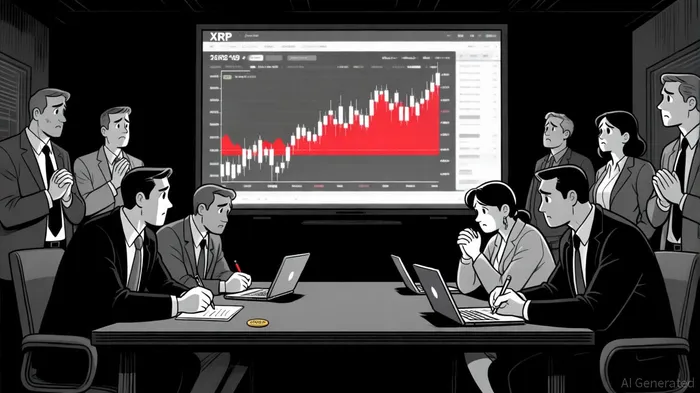






Comentarios
Aún no hay comentarios