
XRP's Recent Volatility and ETF Performance: A Contrarian Case for Undervaluation Amid Market Corrections
The cryptocurrency market in 2025 has been defined by sharp corrections and divergent performances among major assets. XRPXRP--, Ripple's native token, has emerged as a compelling case study in undervaluation during these volatile conditions. While BitcoinBTC-- and EthereumETH-- have seen mixed results amid macroeconomic uncertainty, XRP's price trajectory—shaped by regulatory clarity, institutional adoption, and ETF dynamics—suggests a unique opportunity for contrarian investors.
Regulatory Clarity and Price Resilience
The August 2025 resolution of the SEC-Ripple lawsuit marked a pivotal turning point. With the dismissal of appeals and a $125 million fine settled, XRP's legal status gained clarity, triggering a surge to $3.40 in August 2025[1]. However, the token has since consolidated within a narrow range of $2.10–$2.40 for several months, signaling a potential breakout[3]. This consolidation contrasts with broader market trends: while Bitcoin and Ethereum faced dips in April 2025, XRP's price remained resilient, rising from $2.40 to $2.52 during the same period[4].
Technical indicators further underscore XRP's undervaluation. The Network Value to Transactions (NVT) ratio—a metric comparing market cap to transaction volume—has recently spiked to 1,162, far exceeding historical averages of 15–45[4]. This suggests a temporary overvaluation, but historical context reveals a different story. XRP's NVT ratio of 27.8 in early 2025 is significantly lower than Bitcoin's 123, reflecting its closer alignment with transactional utility[2]. With the XRP Ledger processing 70 million monthly transactions and supporting 1,400 Ethereum-style smart contracts post-EVM upgrade[5], the asset's utility-driven valuation appears more grounded than its peers.
ETF Volatility and Institutional Dynamics
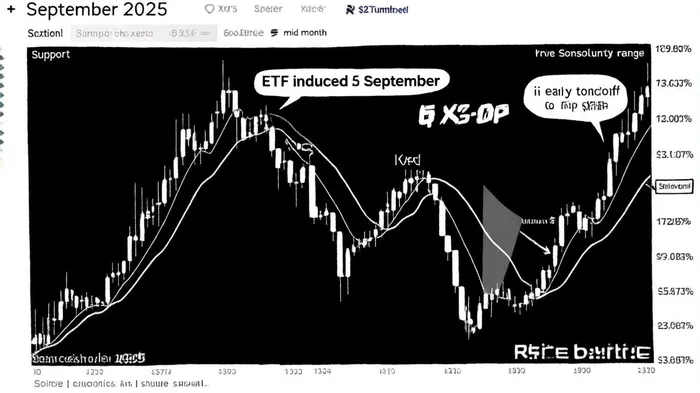
The launch of the REX-Osprey ETF in September 2025 introduced a new layer of volatility. On its debut, XRP dropped nearly 5%, erasing $11 billion in market value as institutions unloaded holdings[6]. Yet this selloff masked underlying strength: XRP rebounded to $3.06 by mid-September, supported by $8.52 million in net inflows and whale accumulation[5]. The ETF's record $37.7 million first-day trading volume highlights growing institutional interest, with firms like Grayscale and WisdomTree also pursuing XRP-based products[6].
This duality—short-term volatility versus long-term institutional adoption—creates a contrarian entry point. While the ETF selloff tested key support levels ($2.75–$2.80), it also demonstrated XRP's ability to recover quickly. Analysts project a potential rally to $5 by year-end if ETF approvals materialize[1], a scenario supported by Ripple's expanding partnerships in emerging markets and the RLUSD stablecoin's integration with BNY Mellon[2].
Relative Undervaluation in a Correction-Prone Market
XRP's performance during 2025 corrections has outpaced Bitcoin and Ethereum. A $10,000 investment in XRP six months prior to September 2025 would have grown to $40,101, far exceeding Bitcoin's $13,275 and Ethereum's $7,516 returns[3]. This outperformance is amplified by XRP's market cap growth: while the combined market caps of Bitcoin, Ethereum, and SolanaSOL-- fell 22% quarter-over-quarter, XRP's rose 1.9% to $121.6 billion[5].
The divergence stems from XRP's unique value proposition. Unlike Bitcoin's energy-intensive proof-of-work model or Ethereum's gas-heavy smart contracts, XRP's consensus mechanism and low-cost transactions position it as a scalable solution for cross-border payments[2]. Institutional adoption in the Middle East and Latin America, coupled with Ripple's $12 billion in cross-border payment contracts[1], further justify its valuation.
Risks and Catalysts
Critics highlight macroeconomic risks, including competition from stablecoins and CBDCs, as well as potential regulatory hurdles for XRP ETFs[2]. However, these risks are mitigated by Ripple's strategic moves: the RLUSD stablecoin's $21% monthly DEX volume growth[5] and the XRP Ledger's EVM compatibility[1] address utility concerns. A major catalyst—SEC approval for additional XRP ETFs—could unlock institutional demand and drive the token toward $3.65–$5.00 by year-end[3].
Conclusion
XRP's recent volatility and ETF performance present a compelling case for contrarian investment. Regulatory clarity, institutional adoption, and a lower NVT ratio relative to Bitcoin suggest the asset is undervalued amid broader market corrections. While risks persist, the interplay of technical strength, utility-driven demand, and favorable macroeconomic conditions positions XRP as a high-conviction opportunity for investors willing to navigate short-term turbulence.






Comentarios
Aún no hay comentarios