
Is XRP a Viable Long-Term Play in 2026? A Technical and Fundamental Deep Dive
The cryptocurrency market in 2025 remains a theater of volatility, with XRPXRP-- (Ripple) occupying a unique position at the intersection of regulatory resolution, institutional adoption, and technical uncertainty. As the dust settles on the SEC vs. Ripple litigation-a case that reshaped the legal landscape for digital assets-the question now is whether XRP can transition from a speculative asset to a foundational pillar of global finance. This analysis evaluates XRP's viability as a long-term investment in 2026 through the lenses of fundamental and technical analysis, while addressing structural challenges that could redefine its trajectory.
Fundamental Analysis: Regulatory Clarity and Real-World Utility
XRP's post-2025 resurgence is anchored in two pillars: regulatory normalization and utility-driven adoption. The resolution of the SEC case in August 2025, culminating in a dismissal of appeals, has restored institutional confidence, enabling U.S. exchanges to relist XRP and ETFs to tokenize it. This legal clarity has catalyzed a surge in institutional inflows, with spot XRP ETFs attracting nearly $1 billion in assets under management by late 2025. Analysts project that additional ETFs and derivatives products could inject $15–25 billion into the asset class by 2026, assuming macroeconomic stability.
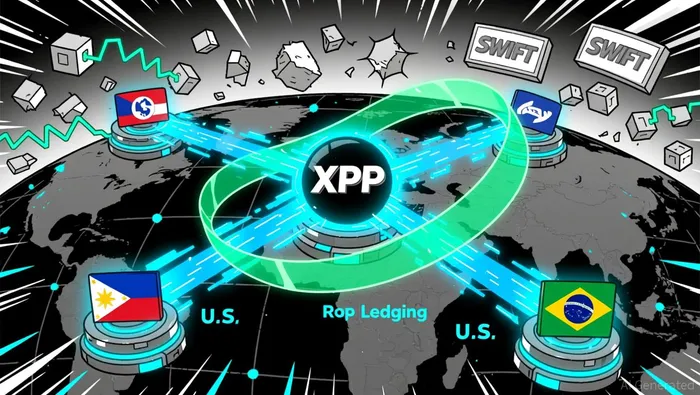
On the utility front, Ripple's XRP Ledger (XRPL) continues to outperform competitors in cross-border payments. With a throughput of 1,500 transactions per second and settlement times of 3–5 seconds, XRPL's efficiency is unmatched in a sector dominated by SWIFT's fragmented, pre-funded liquidity model. RippleNet's partnerships with institutions like UnionBank (Philippines) and Travelex Bank Brazil demonstrate XRP's role as a bridge asset, reducing transaction costs by up to 70% in high-volume corridors. Beyond remittances, tokenized real-world assets (RWAs) on XRPL-such as real estate and commodities-are gaining traction, with Dubai's Land Department piloting XRP-based property settlements.
However, XRP's market cap of $178 billion (as of late 2025) remains disconnected from its real-world transaction volume, which exceeds 2 million daily settlements according to market data. This valuation gap suggests lingering skepticism about XRP's ability to scale utility-driven demand.
Technical Analysis: Bearish Momentum and Structural Breakouts
Technically, XRP's 2025 price action has been a tale of two halves. After trading near $2.40 in early 2025, the token broke below critical support at $2.40, triggering a bearish cascade. Key indicators like the Relative Strength Index (RSI) and Moving Average Convergence Divergence (MACD) confirm this downtrend: RSI fell below 50 to 45, while MACD formed a "death cross," signaling intensified selling pressure. If the $2.20 support level fails, XRP could testTST-- $2.00, where historical on-chain buy orders may provide temporary stability.
Wave count analysis suggests XRP may have completed a long-term A-B-C correction, with bearish divergences in RSI and MACD indicating a continuation phase. Short-term forecasts project a range of $1.30–$3.66 for 2025, with $1.50 as the most likely target according to technical analysis. Yet, longer-term fundamentals-such as Ripple's institutional adoption and ETF inflows-hint at a potential rebound. Analysts like Alex Cobb argue that XRP's 2025 bear market could set up a bullish setup for 2026, mirroring historical rebounds post-2022.
Bullish scenarios require a breakout above key resistance levels ($2.20 and $2.00) to rekindle momentum. Failure to do so may result in lower highs and lower lows, prolonging consolidation.
Structural Challenges: Regulatory Risks and Competitive Pressures
Despite progress, XRP faces three existential risks in 2026:
1. Regulatory Uncertainty: While the SEC case is resolved, Ripple must navigate evolving compliance frameworks in markets like the EU and Japan. A single regulatory misstep could reignite institutional caution.
2. Competition: XRP's dominance in cross-border payments is under threat from Solana's high-speed network and Stellar's open-source ecosystem. Stablecoins like USDCUSDC-- are also encroaching on Ripple's remittance corridors according to market analysis.
3. Adoption Gaps: XRP's utility remains concentrated in niche use cases. For it to achieve mass adoption, Ripple must demonstrate broader applications-such as tokenized securities or decentralized finance (DeFi)-that justify its market cap according to industry experts.
Verdict: A High-Risk, High-Reward Proposition
XRP's long-term viability hinges on its ability to bridge the gap between speculative demand and utility-driven adoption. Fundamentally, Ripple's infrastructure and regulatory clarity position it as a strong candidate for institutional adoption in 2026. However, technical indicators suggest a bearish near-term outlook, with price volatility likely to persist until key resistance levels are tested.
For long-term investors, XRP offers a compelling case:
- Bull Case: If Ripple secures two new banking partnerships in 2026 and ETF inflows accelerate, XRP could reach $5–$8, driven by tokenized RWAs and cross-border volume.
- Bear Case: Regulatory setbacks or macroeconomic headwinds could push XRP below $1.40, eroding institutional confidence.
Investment Strategy: A dollar-cost averaging approach, with stop-losses near $2.00, is recommended. Investors should also monitor Ripple's progress in tokenized asset ecosystems and ETF performance.







Comentarios
Aún no hay comentarios