
Why XRP's Utility and Institutional Adoption Make It a High-Conviction Buy in 2026
In 2026, the cryptocurrency market is witnessing a paradigm shift toward utility-driven assets, with XRPXRP-- (Ripple's native token) emerging as a standout contender. Unlike speculative narratives, XRP's value proposition is anchored in tangible technical advancements and institutional-grade adoption. This article dissects why XRP's evolving utility and institutional traction position it as a high-conviction buy for 2026.
Technical Upgrades: A Foundation for Scalability and DeFi Growth
Ripple's XRP Ledger (XRPL) has undergone transformative upgrades in 2025, addressing critical pain points for developers and institutions. The v3.0.0 upgrade introduced a native lending protocol, enabling decentralized finance (DeFi) applications to tokenize real-world assets (RWAs) and offer yield-generating products directly on the XRPL. This innovation aligns with Ripple's broader strategy to position XRP as a bridge between traditional finance and blockchain, particularly for stablecoins and tokenized assets.
Further, the introduction of the STInt32 data type enhances the ledger's flexibility, allowing developers to build more complex smart contracts and applications according to Ripple's documentation. These improvements are not incremental but foundational, ensuring XRPL can compete with EthereumETH-- and SolanaSOL-- in terms of programmability while retaining its low-cost, high-speed transaction model.
Looking ahead, Ripple's 2026 roadmap includes privacy enhancements via Zero-Knowledge (ZK) proofs and interoperability tools to connect XRPL with other blockchains as part of its 2026 strategy. These upgrades will attract institutional developers seeking scalable, secure infrastructure for cross-chain applications. Additionally, Ripple's partnership with Amazon Bedrock AI to optimize network diagnostics and reliability underscores its commitment to institutional-grade operational efficiency according to Cointelegraph.
Institutional Adoption: From Partnerships to Payment Infrastructure
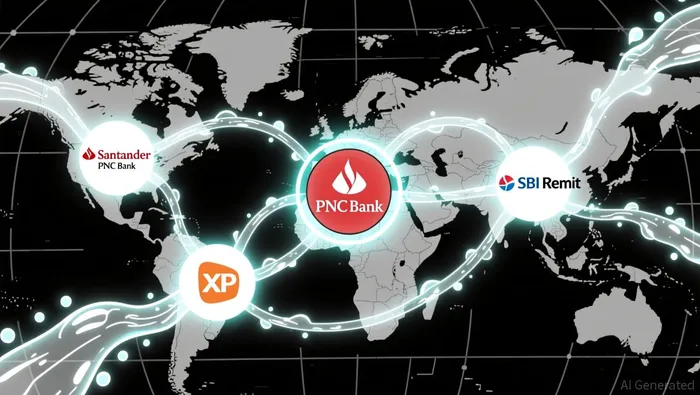
XRP's institutional adoption in 2025 has been nothing short of transformative. RippleNet, Ripple's cross-border payment network, now connects over 300 banks and financial institutions across six continents, including Santander, PNC Bank, and SBI Remit according to 247 Wall Street. These partnerships leverage XRP as a liquidity bridge, enabling real-time currency conversions and settlements at a fraction of traditional costs. For example, Santander reduced cross-border transaction times from days to seconds using XRP, while SBI Holdings expanded remittance services to Southeast Asia as reported by Gate.
The SEC settlement in August 2025-a $125 million resolution-provided critical regulatory clarity, unlocking institutional confidence according to Yahoo Finance. This was followed by a 11% price surge for XRP, signaling renewed interest from asset managers and hedge funds. Ripple further solidified its institutional footprint by acquiring Hidden Road, a prime broker, for $1.25 billion, rebranding it as Ripple Prime as detailed in the report. This move integrated Ripple's RLUSD stablecoin into institutional trading desks, offering instant settlement capabilities for credit card payments via partnerships with Mastercard, WebBank, and Gemini according to the same source.
Moreover, nine asset managers have filed applications for spot XRP ETFs, with analysts projecting $5–7 billion in inflows by 2026 as reported by Yahoo Finance. This trend mirrors Bitcoin's ETF trajectory, suggesting XRP's utility in global payments could soon be as widely recognized as its speculative appeal.
The 2026 Outlook: A Convergence of Utility and Capital
XRP's technical roadmap and institutional adoption create a flywheel effect. The v3.0.0 upgrade and 2026 enhancements will attract developers to build DeFi and RWA applications on XRPL, while Ripple's $500 million funding round at a $40 billion valuation-backed by Citadel Securities-validates its infrastructure as a serious player in global finance according to 247 Wall Street.
Critically, XRP's role as a bridge asset is expanding beyond cross-border payments. With RLUSD facilitating on-chain settlements for credit card transactions and tokenized deposits, XRP is becoming a backbone for institutional-grade financial infrastructure as stated in the analysis. This utility-driven narrative contrasts sharply with speculative altcoins, offering a defensible case for long-term value.
Conclusion
For investors seeking exposure to a blockchain asset with both technical depth and institutional momentum, XRP stands out. Its 2025 upgrades and 2026 roadmap address scalability and privacy, while its institutional partnerships and regulatory clarity position it as a bridge between traditional finance and Web3. As ETFs and DeFi applications gain traction, XRP's utility will likely outpace its price, making it a high-conviction buy for 2026.






Comentarios
Aún no hay comentarios