
XRP's Undervalued Potential in the Evolving Regulatory Landscape
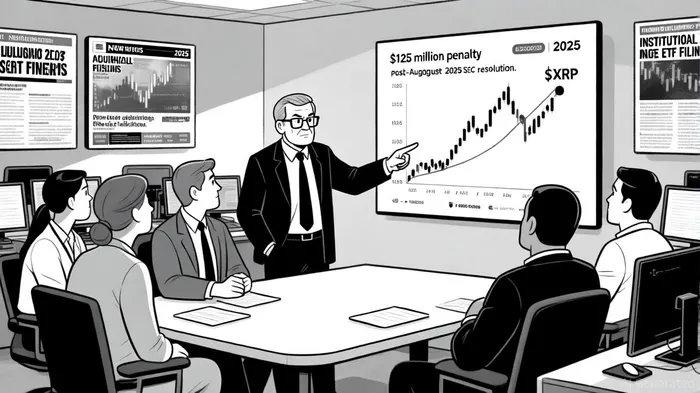
The U.S. Securities and Exchange Commission's (SEC) August 2025 resolution of its multiyear legal battle with Ripple Labs has redefined the regulatory and market dynamics for XRPXRP--. By reclassifying XRP as a commodity in secondary markets and dismissing all appeals, the SEC has effectively removed a major overhang that stifled institutional participation[1]. This shift marks a pivotal inflection pointIPCX-- for XRP, transforming it from a speculative asset into a utility token with clear regulatory boundaries and growing institutional adoption.
Regulatory Clarity and Market Stabilization
The SEC's final judgment in 2023, which ruled that XRP sold on public exchanges is not a security, was a foundational step toward legitimizing the token[4]. However, the August 2025 dismissal of appeals—alongside Ripple's $125 million civil penalty—has solidified this precedent, creating a stable legal framework for investors[1]. This clarity has directly impacted XRP's volatility, which dropped by 60% from 2023 levels to a 30-day volatility of 3.95% by Q1 2025[2]. Such stabilization is critical for institutional onboarding, as it reduces the risk profile of XRP and aligns it with traditional financial instruments.
Institutional Adoption and Strategic Partnerships
Ripple's On-Demand Liquidity (ODL) service has emerged as a cornerstone of XRP's utility. By Q2 2025, ODL had processed $1.3 trillion in cross-border transactions, leveraging XRP's low fees (0.0004%) and ISO 20022 compliance to outperform traditional SWIFT systems[2]. This efficiency has attracted 300+ banks to adopt ODL, creating a flywheel effect of real-world demand. Institutional investors have taken notice: $1.1 billion in institutional XRP purchases were recorded by 2025, with projections suggesting an additional $5–$8 billion in inflows if the ProShares Ultra XRP ETF (UXRP) is approved[2].
Strategic partnerships further amplify XRP's potential. Ripple's collaboration with SBI Group to integrate Ripple USD (RLUSD) in Japan's financial ecosystem is a case in point. RLUSD requires XRP for transaction fees, creating a direct demand channel for the token[1]. Meanwhile, Ripple's roadmap includes launching an EVM-compatible sidechain to attract EthereumETH-- developers and tokenizing real-world assets (RWAs) via Archax, both of which could unlock new use cases and liquidity pools[5].
Technological Advancements and Future Milestones
Ripple's recent upgrades to the XRP Ledger, including native KYC/AML attestations, have aligned the blockchain with traditional financial standards, easing institutional onboarding[5]. The company's Swell 2025 conference in November is expected to unveil new CBDC and banking collaborations, further embedding XRP into the global financial infrastructure[5]. These developments position XRP not just as a payment token but as a foundational asset for decentralized finance (DeFi) and tokenized economies.
Challenges and the Path Forward
Despite these positives, XRP faces headwinds. Volatility remains a concern, and competition from stablecoins and central bank digital currencies (CBDCs) could erode its market share[3]. However, the growing institutional adoption, regulatory clarity, and technological innovation suggest that these challenges are surmountable. Analysts project XRP could reach $5.05 by late 2025[4], with bullish scenarios targeting $5.25 by 2030[2].
For investors, the post-SEC resolution era presents a strategic opportunity. XRP's undervaluation relative to its utility, coupled with the potential for ETF-driven inflows, makes it a compelling case study in regulatory-driven market repositioning. As the crypto industry navigates an increasingly defined legal landscape, XRP's unique position as a utility-first asset with institutional backing could drive long-term value creation.






Comentarios
Aún no hay comentarios