
XRP's Undervalued Potential in the Evolving Digital Asset Ecosystem
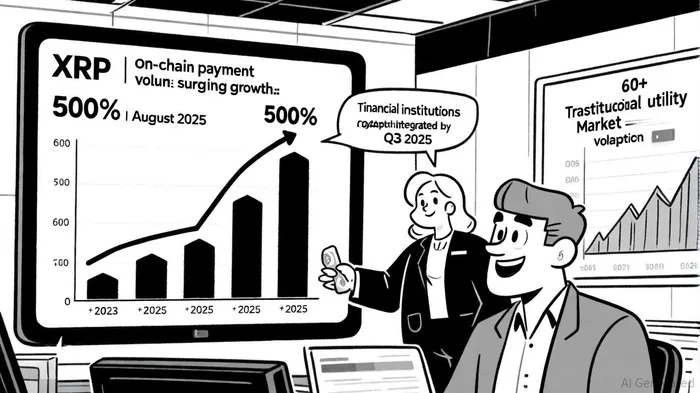
In the ever-shifting landscape of digital assets, XRPXRP-- has emerged as a compelling case study in undervaluation. While its price action has often diverged from its on-chain fundamentals and institutional adoption trends, 2025 has revealed a narrative of resilience and strategic positioning. By dissecting the interplay between network activity and institutional integration, we uncover why XRP remains a compelling long-term investment.
On-Chain Metrics: A Tale of Two Trends
XRP's on-chain activity in 2025 paints a picture of duality. On one hand, payment transactions dominate 60% of the XRP Ledger (XRPL), with weekly payments surging by 430% in less than two years, hitting 8 million transactions in 2025[4]. A dramatic 500% spike in payment volume on August 18, 2025—processing 844 million XRP—underscored growing institutional participation and cross-border demand[6]. This aligns with RippleNet's expansion to 300+ financial institutions, leveraging the XRPL's ultra-low fees and real-time settlement capabilities[3].
Yet, this optimism clashes with recent headwinds. Daily transactions on the XRPL fell by 37.06%, and new wallet creation declined by 40.28% in late 2025[5]. Meanwhile, 470 million XRP sold by whales over ten days pressured the price, erasing 10% of its value[5]. This divergence highlights a critical question: Is XRP's on-chain utility decoupling from its market valuation, or is this a temporary correction in a maturing ecosystem?
Institutional Adoption: The Quiet Revolution
While retail traders grapple with volatility, institutions have quietly rewritten XRP's story. Regulatory clarity post-July 2023 court rulings—affirming XRP is not a security on exchanges—has unlocked a flood of institutional capital[1]. Ripple's $125 million SEC settlement in August 2025 further solidified this shift, enabling custodians to resume XRP support and OTC desks to reactivate liquidity[2].
The results? 60+ financial institutions now integrate XRP for cross-border payments, with Ripple's On-Demand Liquidity (ODL) processing $1.3 trillion in Q2 2025[1]. Singapore's Major Payments Institution (MPI) license and Ripple's $1.25 billion acquisition of Hidden Road signal a strategic push into prime brokerage and derivatives markets[3]. Analysts project $25 million/day in institutional inflows into XRP-linked products, with seven ETF applications under review[1].
The Undervaluation Thesis
XRP's undervaluation stems from its asymmetric risk-reward profile. While trading volume averaged $3.2 billion/day in Q1 2025 (peaking at $16 billion), its price remains anchored to legacy perceptions of regulatory risk[5]. Yet, the data tells a different story:
- Wallet growth outpaced Bitcoin and Ethereum in early 2025, with 58,000 new holders (1% growth) versus Bitcoin's 102,000 (0.5%)[3].
- $40 billion in annualized volume through XRP-based corridors demonstrates its role as a liquidity backbone for global finance[1].
- Analysts like ALLINCRYPTO and Egrag Crypto project $19.27–$27 by year-end 2025, driven by ETF demand and technical patterns[1][2].
The key lies in liquidity timing. As XRP transitions from “uninvestable” to “conditionally integrable,” its value proposition extends beyond payments into tokenized supply chains and stablecoin swaps[1]. With macroeconomic headwinds (e.g., rising U.S. yields) tempering bullish forecasts[5], the current price discount offers a margin of safety for long-term holders.
Conclusion: A Disruptor in the Making
XRP's journey in 2025 reflects the broader tension between speculative trading and foundational utility. While on-chain metrics show temporary stumbles, institutional adoption and regulatory milestones position it as a critical infrastructure asset for global finance. For investors, the challenge is to separate noise from signal—a task XRP's data-driven narrative makes increasingly clear.






Comentarios
Aún no hay comentarios