
XRP's Undervaluation Amid Strategic Institutional Adoption: A Blockchain Infrastructure Play
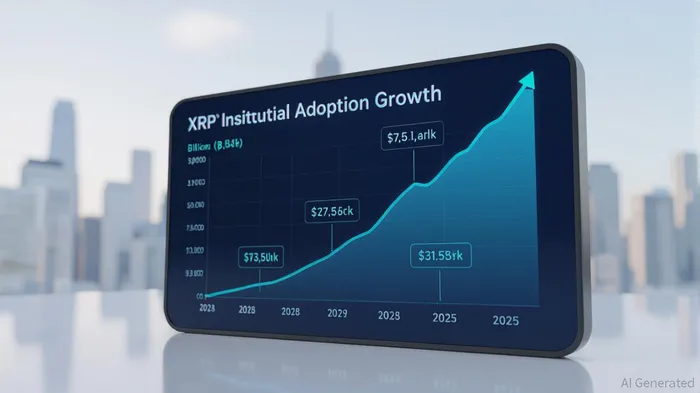
In the evolving landscape of blockchain infrastructure, XRPXRP-- has emerged as a compelling yet undervalued asset, driven by strategic institutional adoption and cost-advantaged mining strategies. As of Q3 2025, XRP's market capitalization stands at $28.4 billion, ranking it among the top 10 cryptocurrencies [1]. However, its valuation metrics—such as a 0.0002% average transaction fee and sub-5-second settlement times for 75% of transactions—suggest a disconnect between its utility and market price [2]. This undervaluation is further amplified by institutional tailwinds, including VivoPower's aggressive XRP acquisition strategy and Ripple's expanding role in cross-border payments and DeFi.
Cost-Advantaged Mining and Institutional Exposure
VivoPower's Caret Digital subsidiary has leveraged a dual-pronged strategy to procure XRP at a 65% discount relative to market prices. By converting mined tokens like BitcoinBTC-- and LitecoinLTC-- into XRP via bulk discounts on mining equipment, the company has reduced acquisition costs while diversifying its exposure through Ripple equity investments [3]. This approach not only underscores XRP's appeal as a reserve asset but also highlights institutional confidence in its long-term utility. For instance, Ripple's On-Demand Liquidity (ODL) service processed $1.3 trillion in Q2 2025, with SantanderSAN-- reporting a 40% increase in cross-border payments via XRP [4]. Such real-world adoption, coupled with VivoPower's cost-efficient scaling, positions XRP as a critical infrastructure asset in the institutional blockchain ecosystem.
Regulatory Clarity and DeFi Integration
The resolution of Ripple's SEC lawsuit in August 2025 has been a pivotal catalyst for institutional adoption. With regulatory uncertainty lifted, over 60 institutions—including JPMorganJPM--, SBI Holdings, and BNY Mellon—have integrated XRP for treasury operations and cross-border settlements [5]. Ripple's XRP Ledger (XRPL) has further enhanced its appeal through innovations like the XLS-30 AMM, which boosted liquidity pools to $1.2 million in June 2025 [6]. Meanwhile, the tokenization of real-world assets (RWAs) on XRPL, such as real estate and carbon credits, has attracted $60 million in Total Value Locked (TVL) in DeFi protocols [7]. While Ethereum's TVL remains dominant at $91.6 billion, XRP's low fees and compliance-ready features position it as a scalable alternative for institutional-grade use cases [8].
Broader Institutional Trends and Market Positioning
The broader blockchain infrastructure sector has seen over $100 billion in institutional investments since 2020, with payments and tokenization leading the charge [9]. XRP's role in this growth is underscored by its integration into Ripple's RLUSD stablecoin and tokenized U.S. Treasuries (OUSG), which provide regulated access to institutional markets [10]. Additionally, Q3 2025 data reveals $25 million in daily inflows into XRP-linked products, with pending ETF applications from firms like REX-Osprey and Bitwise projected to unlock $4.3–$8.4 billion in new capital [11]. Analysts like David Schwartz, Ripple's CTO, argue that 2025 will be defined by XRP's institutional adoption, driven by its compliance tools and interoperability with EthereumETH-- via EVM-compatible sidechains [12].
Undervaluation vs. Competitive Pressures
Despite these positives, XRP faces headwinds from stablecoins and CBDCs, which could erode its market share in low-volatility use cases [13]. However, its controlled supply dynamics—54.4 billion of 100 billion tokens in circulation—and strategic partnerships with BBVA under MiCA compliance suggest a resilient value proposition [14]. Bybit's Q3 2025 Asset Allocation Report further highlights XRP as the third-largest non-stablecoin asset, reflecting a shift in institutional portfolios toward high-yield alternatives [15].
Conclusion
XRP's undervaluation is a function of its underappreciated utility in blockchain infrastructure, where it serves as a bridge between traditional finance and decentralized ecosystems. With VivoPower's cost-advantaged mining, regulatory clarity, and institutional inflows accelerating, XRP is poised to close the gapGAP-- between its current valuation and its potential as a foundational asset. For investors, the combination of real-world adoption, DeFi integration, and macroeconomic tailwinds makes XRP a compelling play in the institutional blockchain narrative.





Comentarios
Aún no hay comentarios