
XRP's Undervaluation Amid Stacked Liquidity Below $3
In the ever-shifting landscape of crypto assets, identifying undervaluation requires a nuanced understanding of both liquidity dynamics and fundamental catalysts. XRPXRP--, the native token of the XRP Ledger, presents a compelling case for strategic entry below $3, supported by robust liquidity metrics, regulatory clarity, and institutional adoption. Below $3, XRP's valuation appears to diverge from its intrinsic utility, offering a risk-rebalanced opportunity for investors seeking exposure to a crypto asset with real-world use cases and structural advantages.
Liquidity: The Foundation of Undervaluation
XRP's liquidity profile in Q3 2025 has strengthened significantly, making it one of the most liquid assets among ETF applicants. According to a report by CoinLaw, XRP's average daily trading volume reached $1.73 billion in Q3 2025, a 22% increase from the same period in 2024 [1]. This liquidity is further reinforced by a bid-ask spread of 0.15% on top-tier exchanges like Binance and CoinbaseCOIN--, indicating efficient price discovery and deep order books [3]. Kaiko's data underscores this trend, noting that XRP's 1% market depth has surged since late 2024, rivaling SolanaSOL-- (SOL) in liquidity resilience [2].
The launch of the 2x XRP ETF by Teucrium in 2025 has added another layer of institutional demand, with the product attracting $33.57 million in assets under management within its first days [6]. Such structured products not only enhance XRP's accessibility but also signal confidence in its ability to withstand volatility—a critical factor for institutional investors.
Fundamental Drivers: Regulatory Clarity and Real-World Utility
The resolution of the SEC's lawsuit against Ripple in August 2025 marked a turning point for XRP's valuation. As Forbes noted, this regulatory clarity removed a major overhang, enabling Ripple to expand cross-border payment corridors and secure partnerships with entities like SBI Remit in Japan and Onafriq in Africa [1]. Ripple's On-Demand Liquidity (ODL) service processed $1.3 trillion in Q2 2025 alone, demonstrating XRP's utility in reducing remittance costs and improving liquidity for financial institutions [4].
Institutional adoption has further accelerated. Ripple's RLUSD stablecoin, now custodied by BNY Mellon, has been integrated into tokenized funds like BlackRock's BUIDL and VanEck's VBLL, while the REX-Osprey XRPR ETF has drawn significant inflows [6]. These developments underscore XRP's transition from a speculative asset to a foundational component of institutional infrastructure.
Price Action and Technical Catalysts
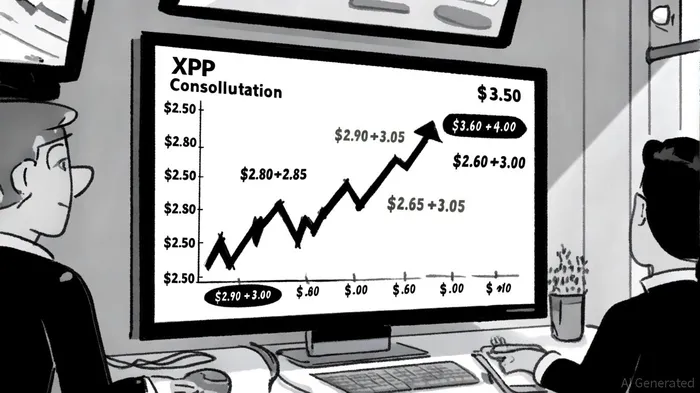
As of September 2025, XRP trades at $2.83–$2.85, consolidating within a $2.50–$3.50 range [4]. This consolidation has created a critical inflection point: a breakout above $2.95 could trigger a rally toward $3.20, with potential extensions to $3.60–$4.00 if macroeconomic conditions and ETF approvals align favorably [5]. Conversely, a breakdown below $2.80 risks a 10% decline to $2.50–$2.60, though whale activity—340 million XRP accumulated at $2.81–$2.82—suggests a floor for further declines [5].
Technical indicators also favor a bullish bias. The token's order-book depth and liquidity improvements have made it resilient to short-term volatility, while on-chain metrics suggest growing institutional confidence [1]. Additionally, the launch of DeFi opportunities via the Flare network (e.g., FXRP v1.2) could enhance XRP's utility, driving further adoption [6].
Strategic Entry Points
For investors seeking to capitalize on XRP's undervaluation, the current price range offers a risk-rebalanced entry. Key levels to monitor include:
- Support: $2.80–$2.85 (whale accumulation zone).
- Resistance: $2.95–$3.05 (initial breakout threshold).
- Target: $3.35–$3.60 (long-term bullish scenario).
A strategic approach would involve dollar-cost averaging into the $2.50–$2.85 range, with stop-loss orders below $2.70 to mitigate downside risk. The potential catalysts—ETF approvals, macroeconomic stability, and further institutional partnerships—could amplify upside, particularly if XRP breaks above $3.60.
Conclusion
XRP's undervaluation below $3 is supported by a confluence of liquidity strength, regulatory clarity, and institutional adoption. While risks such as macroeconomic downturns and competition from stablecoins persist, the token's real-world utility and structural advantages position it as a compelling entry point for investors with a medium-term horizon. As the crypto market continues to mature, XRP's role in cross-border payments and institutional infrastructure may prove to be a defining narrative for its next phase of growth.





Comentarios
Aún no hay comentarios