
XRP's Undervaluation and Bollinger Band Signals: A Contrarian Play on Mean Reversion Potential
In the ever-shifting landscape of cryptocurrency, contrarian traders thrive by identifying mispricings and leveraging technical signals that others overlook. XRPXRP--, Ripple's native token, has emerged as a compelling case study in undervaluation and mean reversion potential, particularly as Bollinger Band dynamics and regulatory clarity converge to create asymmetric risk-reward scenarios.
Bollinger Band Signals: A Contrarian Lens
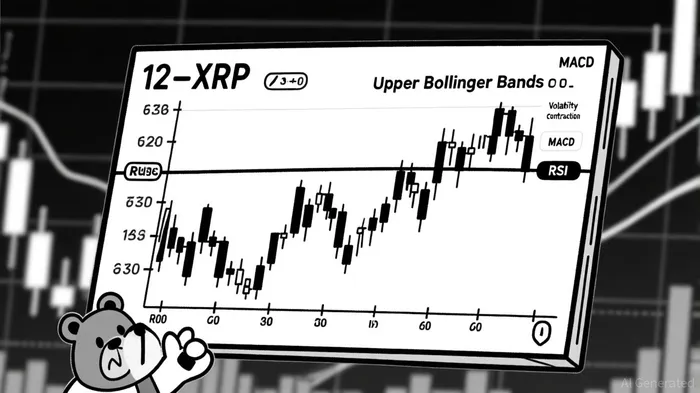
Bollinger Bands, a volatility-based indicator, have long served as a barometer for contrarian opportunities. Recent data reveals a tightening of the 12-hour Bollinger Bands for XRP, a pattern historically preceding significant price moves[1]. This contraction suggests a period of consolidation, often followed by a breakout or breakdown. On the daily chart, XRP's price currently hovers near the upper band, signaling overbought conditions and a potential short-term correction[3]. However, the widening bands also hint at increased volatility, a precursor to upward momentum if institutional adoption and regulatory tailwinds materialize[3].
Historical precedents reinforce this narrative. A similar Bollinger Band contraction in late 2024 led to a 490% price surge[1], suggesting that XRP's current positioning—trading below the midpoint of $2.91—places it in a “discount zone” with room for mean reversion[4]. For contrarian traders, this represents a low-risk entry point, as the price's deviation from the 20-period moving average (a core component of Bollinger Bands) implies a statistical likelihood of reverting to the mean[4].
Undervaluation Metrics: Beyond Technicals
While technical indicators provide a roadmap, XRP's intrinsic value proposition strengthens its case for undervaluation. The token's role in cross-border payments, bolstered by Ripple's On-Demand Liquidity (ODL) solution, positions it as a bridge between traditional finance and blockchain innovation[5]. Institutional adoption, including partnerships with Standard Chartered and the recent resolution of the SEC lawsuit in August 2025[2], has removed a key regulatory overhang, spurring renewed investor confidence.
Fundamentally, XRP's utility in reducing transaction costs and settlement times for global remittances creates a defensible moat. Analysts project that institutional inflows and potential ETF approvals could drive the price to $3.65–$4.50 in the medium term[4], with long-term targets extending into the $5–$10 range by 2030[5]. Yet, at $2.83, XRP remains below these benchmarks, suggesting a disconnect between its current price and its long-term utility.
Contrarian Strategies and Mean Reversion Potential
For traders adopting a contrarian stance, XRP's Bollinger Band dynamics and undervaluation metrics align with a mean reversion strategy. Key entry points include:
1. Breakout Above $3.10: A sustained move above the middle band (currently $2.91) could trigger a rally toward the upper resistance of $3.46[3].
2. Oversold Rebound: XRP's recent dip to $2.158—a touch of the lower Bollinger Band—was followed by an 8% recovery[6], reinforcing its resilience in oversold territory.
3. Legal Tailwinds: A favorable regulatory environment, combined with bullish on-chain sentiment (a 2.1:1 bullish-to-bearish ratio[3]), creates a catalyst for upward momentum.
However, risks persist. A descending triangle pattern and overbought RSI levels could lead to a 50% drawdown to $1.14[4], particularly if macroeconomic headwinds or renewed regulatory scrutiny emerge. Diversification and strict stop-loss orders remain critical for risk management.
Conclusion: A High-Conviction Play
XRP's confluence of tightening Bollinger Bands, regulatory clarity, and undervaluation metrics presents a compelling case for contrarian investors. While the path to $3.84 (XRP's all-time high) is not without obstacles, the technical and fundamental catalysts suggest a strong mean reversion potential. For those willing to bet against short-term pessimism, XRP offers a rare combination of volatility-driven opportunities and long-term utility-driven growth.






Comentarios
Aún no hay comentarios