
XRP and the Transformation of U.S. Payments Infrastructure: Strategic Positioning for Cross-Border Payment Innovation
XRP and the Transformation of U.S. Payments Infrastructure: Strategic Positioning for Cross-Border Payment Innovation
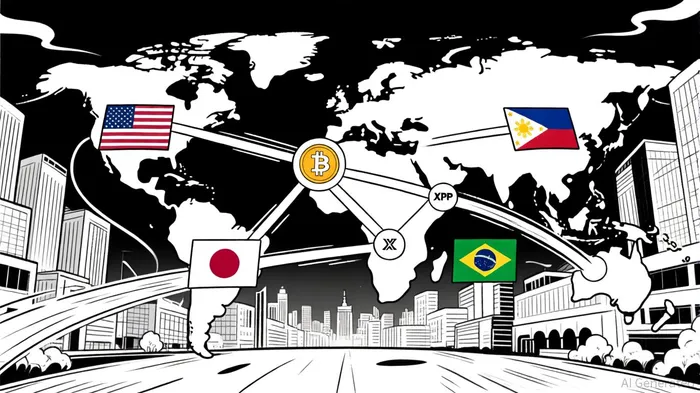
The U.S. payments infrastructure is undergoing a seismic shift, driven by the convergence of regulatory clarity, technological innovation, and strategic partnerships. At the forefront of this transformation is XRPXRP--, the native asset of the XRP Ledger (XRPL), which is redefining cross-border payment systems through its speed, cost efficiency, and institutional-grade infrastructure. As the U.S. Securities and Exchange Commission (SEC) reclassified XRP as a commodity in August 2025, according to a FinancialContent article, the asset has shed regulatory ambiguity, unlocking new avenues for institutional adoption and integration into mainstream financial systems. This development, coupled with Ripple's On-Demand Liquidity (ODL) product and advancements in blockchain interoperability, positions XRP as a pivotal player in the future of global paymentsGPN--.
Regulatory Clarity: A Catalyst for Institutional Adoption
The SEC's reclassification of XRP as a commodity, noted in a Technology Innovators analysis, has been a watershed moment. By removing the cloud of securities law enforcement, the decision has enabled financial institutions to deploy XRP-based solutions without fear of regulatory reprisal. This clarity is already translating into tangible outcomes: reports indicate that XRP-based Exchange-Traded Funds (ETFs) are in advanced development, according to a CryptoAlert report, with major asset managers preparing to launch products that could democratize access to XRP for retail and institutional investors alike.
Technological Advancements: Speed, Scalability, and Programmability
Ripple's ODL product leverages XRP to facilitate cross-border transactions in seconds, with fees averaging less than $0.01 per transfer, as reported in a CryptoPulpit article. This contrasts sharply with traditional systems like SWIFT, which often require 3–5 business days and incur fees exceeding $30 per transaction. The XRP Ledger's recent integration of an EthereumETH-- Virtual Machine (EVM)-compatible sidechain is described in a Webopedia article, further enhancing its appeal by enabling smart contracts and batch transactions. This innovation allows the XRPL to compete directly with Ethereum and SolanaSOL-- in the decentralized finance (DeFi) and real-world asset (RWA) tokenization spaces.
Strategic Partnerships: Expanding the XRP Ecosystem
Ripple's partnerships with over 300 financial institutions, detailed in a CCN article, including Santander, American Express, and SBI Holdings, underscore its strategic positioning. These collaborations are not merely symbolic; they are operational. For instance, SBI Remit's ODL service processed $3.7 billion in cross-border transactions in Q1 2025 alone, according to a OneSafe blog post, primarily between Japan and key Asian markets. Similarly, Tranglo, a Malaysian remittance provider, reported a large surge in transaction volume via XRP, highlighting the asset's scalability in high-volume corridors. In Latin America, Travelex Bank Brazil became the first institution to fully integrate ODL, enabling real-time transactions between Brazil and Mexico.
Case Studies: Real-World Impact
The Philippines, Vietnam, and Indonesia serve as case studies for XRP's utility. SBI Remit's ODL service converts Japanese yen to XRP, transmits it via the XRP Ledger in under 10 seconds, and then converts it into local currency-bypassing traditional correspondent banking layers, reducing costs by up to 70% and settlement times from days to seconds. Meanwhile, Tranglo's long-term growth in partnerships demonstrates XRP's viability in addressing remittance gaps for migrant workers.
Integration with CBDCs: The Next Frontier
Ripple's work with central banks is another strategic pillar. By integrating XRP with Central Bank Digital Currencies (CBDCs), Ripple is facilitating cross-border interoperability. This is critical as global CBDC adoption accelerates; XRP's role as a bridge currency could enable seamless value transfer between disparate digital currencies, reducing friction in international trade and finance.
Conclusion: A Full-Spectrum Ecosystem
XRP's strategic positioning is not accidental but the result of deliberate innovation and regulatory alignment. As the XRP Ledger evolves into a full-spectrum ecosystem capable of supporting DeFi, RWA tokenization, and CBDC interoperability, its role in U.S. payments infrastructure will only deepen. For investors, the confluence of regulatory tailwinds, technological differentiation, and institutional adoption presents a compelling case for XRP as a cornerstone of the next-generation payment landscape.





Comentarios
Aún no hay comentarios