
Why XRP Can Thrive Pre-CLARITY Act: Institutional Infrastructure vs. Retail Legislation
The cryptocurrency market is often framed as a race to regulatory clarity, with the U.S. CLARITY Act (H.R.3633) frequently cited as a potential catalyst for institutional adoption. However, XRP's trajectory in 2025 demonstrates that regulatory progress is not solely dependent on legislative action. Instead, XRP's integration into regulated systems-such as the Office of the Comptroller of the Currency (OCC) and CMECME-- Group-has already established a robust institutional infrastructure, enabling it to thrive independently of retail-focused legislation. This analysis explores how XRP's real-world utility, scalability, and regulatory alignment position it to outperform expectations, even before the CLARITY Act's passage.
Institutional Infrastructure: XRPXRP-- as a Regulated Settlement Layer
Ripple's conditional approval from the OCC to establish the Ripple National Trust Bank marks a pivotal milestone in its integration into the traditional financial system. This approval allows Ripple to operate as a federally regulated entity, focusing on digital asset custody and management. By aligning with the same compliance standards as traditional banks, Ripple has removed a critical barrier to institutional trust. Notably, this approval does not directly regulate XRP but positions the company to leverage XRP as a settlement asset within a federally sanctioned framework.
The CME Group's launch of XRP futures in May 2025 further underscores XRP's institutional legitimacy according to CME announcements. These cash-settled futures, available in both micro (2,500 XRP) and standard (50,000 XRP) sizes, reflect growing demand for XRP as a tradable asset. By September 2025, CME also introduced options on XRP futures, providing traders with advanced risk management tools according to CME press releases. These developments indicate that XRP is no longer a speculative asset but a core component of institutional-grade financial products.
Beyond derivatives, Ripple's On-Demand Liquidity (ODL) service has demonstrated XRP's utility in real-world cross-border transactions. A partnership with AMINA Bank, a Swiss FINMA-regulated institution, enables near-real-time settlements using XRP and Ripple's stablecoin RLUSD as reported by CoinDesk. This collaboration bridges blockchain-based systems with traditional banking, addressing long-standing challenges like pre-funded nostro accounts and settlement delays. Such integrations highlight XRP's role as a liquidity bridge, bypassing the need for retail-focused legislation to unlock value.
Regulatory Layer Differentiation: Why Retail Legislation Is Redundant
The CLARITY Act aims to clarify jurisdictional divides between the SEC and CFTC, categorizing digital assets into "digital commodities," "investment contracts," and "permitted payment stablecoins". While this framework could reduce ambiguity, XRP's existing regulatory alignment renders such legislation less critical. A 2023 judicial ruling by Judge Analisa Torres concluded that XRP is not a security when sold programmatically on exchanges a precedent that has already enabled institutional adoption. Ripple's pursuit of a Federal Reserve master account further illustrates its commitment to operating within traditional financial systems as previously reported, a strategy that circumvents the need for new retail laws.
Critics like SonOfaRichard and X Finance Bull argue that the CLARITY Act's focus on retail investors overlooks XRP's institutional scalability. As X Finance Bull notes, XRP's deflationary design-where transaction fees permanently remove tokens from circulation-creates scarcity and long-term value according to research by Yellow. This mechanism, combined with Ripple's strategic coin burns, enhances XRP's appeal to institutions seeking stable, high-throughput assets as detailed in Yellow's analysis. Meanwhile, Stellar Rippler emphasizes XRP's energy efficiency and low transaction costs, which make it ideal for cross-border settlements compared to energy-intensive alternatives as highlighted in a LinkedIn post.
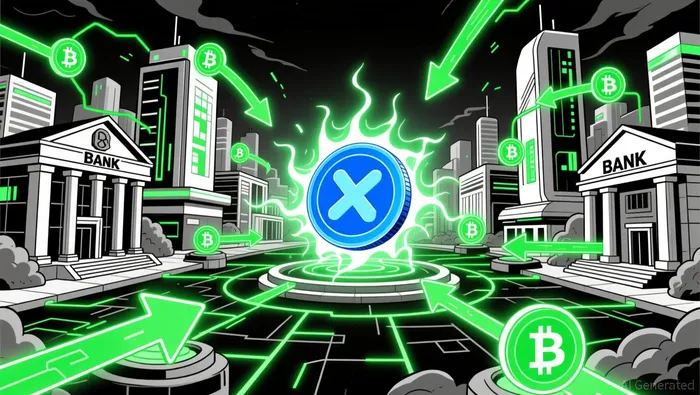
Market Readiness: XRP's Scalability and Real-World Adoption
XRP's market readiness is evident in its $127 billion market cap and expanding use cases. The XRP Ledger (XRPL) now supports decentralized finance (DeFi), NFTs, and central bank digital currency (CBDC) projects as reported by Project Evaluators, diversifying its utility beyond payments. Ripple's collaboration with Volante Technologies to enable U.S. banks to use RippleNet corridors as noted in Project Evaluators' analysis further demonstrates its ability to scale without legislative intervention.
Moreover, XRP's fully diluted valuation (FDV) reached $302 billion in early 2025, positioning it as the third-largest cryptocurrency according to Bagster's analysis. This growth is driven by institutional demand for XRP's role in automated market makers (AMMs) and stablecoin ecosystems as detailed in Yellow's research. Analysts project XRP could surge to $3–$5 in 2025, with bullish forecasts reaching $10–$20, fueled by scarcity dynamics and real-world adoption as reported by Project Evaluators.
Conclusion: XRP's Path to Institutional Dominance
XRP's success in 2025 is a testament to the power of regulatory alignment and institutional infrastructure over retail-focused legislation. By securing OCC approval, CME listings, and real-world partnerships, XRP has established itself as a settlement asset within regulated systems. The CLARITY Act, while potentially beneficial, is not a prerequisite for XRP's growth. Instead, its scalability and value are unlocked through technical innovation, institutional trust, and real-world utility-factors that will continue to drive its adoption in 2026 and beyond.





Comentarios
Aún no hay comentarios