
XRP's Near-Term Vulnerability and Institutional Support Divergence
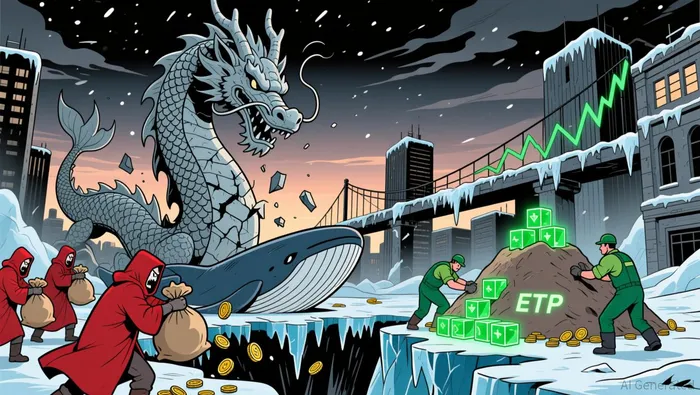
The XRPXRP-- market in Q4 2025 has unfolded as a textbook case of conflicting forces: a capitulation-driven sell-off among retail and long-term holders juxtaposed with robust institutional demand fueled by ETF inflows. This divergence creates a precarious equilibrium, where the asset's near-term vulnerability is amplified by distribution dynamics, yet tempered by a surge in institutional adoption. Understanding this tension is critical for investors navigating XRP's volatile trajectory ahead.
Distribution Dynamics: A Recipe for Near-Term Weakness
XRP's Q4 performance has been defined by a sharp rise in realized losses, with the realized profit/loss ratio plummeting below 0.5-a stark indicator that losses now dominate gains among holders according to data. This capitulation is evident in the exodus of retail investors, who have sold below their purchase price, and the cautious behavior of long-term holders, who began distributing their holdings as prices fell according to analysis. By late December, whale wallets (those holding 1 million+ XRP) were actively reducing risk, signaling a shift from confidence to caution according to market reports.
On-chain data further underscores this fragility. While mid-December saw a surge in interacting addresses peaking at 295,000 daily, the network's momentum faltered by month-end, with newly created addresses averaging just 3,440-a sign of suppressed activity according to network analysis. Exchange inflows, particularly into Binance, spiked to 116 million XRP on December 19, reflecting heightened sell-side pressure according to chain data. These trends suggest a market grappling with liquidity challenges and a lack of conviction among key participants.
ETF-Driven Demand: A Shield Against the Downturn
Despite these headwinds, XRP has attracted unprecedented institutional interest. ETF inflows have been a lifeline, with $1.1 billion in net inflows recorded within four weeks of their launch according to financial reports. This demand is not merely speculative: institutional flows added $70.2 million in the week ending December 27, the largest weekly inflow among crypto assets according to whale data. Standard Chartered's bullish forecast-projecting XRP to reach $8 by 2026-cites these ETF-driven flows and regulatory clarity as key drivers according to market analysis.
The institutional narrative is further bolstered by long-term accumulation. In late December, large wallet holders increased their XRP holdings by 76% in 48 hours according to trading data, signaling a contrarian bet on the asset's discounted valuation. This behavior mirrors historical patterns where institutional buyers step in during market troughs, laying the groundwork for eventual rebounds.
Technical and Market Sentiment: A Bearish Bias with Long-Term Hope
Technically, XRP faces a daunting landscape. A descending channel and a death cross pattern suggest extended downside momentum, with analysts warning of a potential plunge to $0.80 amid network slowdowns according to price predictions. The price, which closed Q4 at $1.87-a 38% decline from earlier in the year-now trades near critical support levels according to market analysis.
Yet, the market is not devoid of optimism. The XRP Ledger's integration into Solana's DeFi ecosystem according to project data and the historical precedent of 2017-style recoveries according to financial reports offer a counter-narrative. These developments hint at a broader utility narrative for XRP, which could catalyze renewed demand if macro conditions improve.
Conclusion: A Divergence to Watch
XRP's near-term vulnerability is undeniable, with distribution dynamics pointing to further downside risks into 2026. However, the divergence between retail capitulation and institutional accumulation creates a unique inflection point. While the bearish technicals and whale activity suggest a potential test of $1.25 according to price forecasts, the ETF-driven demand and strategic accumulation by large holders provide a floor. Investors must weigh these conflicting signals carefully: the path forward for XRP will likely hinge on whether institutional confidence can outweigh the selling pressure from a fatigued retail base.






Comentarios
Aún no hay comentarios