
XRP and SWIFT: A New Era for Cross-Border Payments? Assessing Institutional Adoption and Disruption Potential
In Q3 2025, SWIFT's exploration of blockchain-based cross-border payment solutions has intensified, with Ripple's XRPXRP-- Ledger emerging as a key contender. An AI analysis suggests SWIFT is testing XRP alongside Hedera's Hashgraph (HBAR) to evaluate how distributed ledger technology (DLT) can enhance efficiency and interoperability under ISO 20022 standards. These trials, involving over 30 major banks including Bank of AmericaBAC--, JPMorgan ChaseJPM--, and TD Bank, according to The Motley Fool, signal a pivotal shift in how institutions approach cross-border payments. For investors, the implications are profound: XRP's technical advantages and growing institutional adoption could position it as a disruptive force in a $150 trillion market, per CoinLaw.
XRP's Technical Edge and Strategic Positioning
Ripple's XRP Ledger offers near-instant settlement times (3–5 seconds) and negligible fees (~$0.0002 per transaction), starkly contrasting with SWIFT's 1–5 business days and $26–$50 per transfer costs, according to BeInCrypto. According to a report by The Currency Analytics, XRP-based transactions in 2025 reduced infrastructure costs by 42% for institutions, with RippleNet users reporting $550 million in annual savings. These metrics align with SWIFT's modernization goals, particularly its push for 24/7/365 real-time payments and tokenized asset interoperability, as outlined by Daily Hodl.
SWIFT's neutrality in these trials-testing multiple blockchains without favoring any single asset-reflects its role as a facilitator rather than a competitor, according to a SWIFT press release. However, XRP's ISO 20022 compatibility and its use in Ripple's On-Demand Liquidity (ODL) service, which acts as a bridge currency, give it a distinct edge. For instance, a €10 million test transfer via XRP settled in under six seconds, while the same via SWIFT took 30 hours, as shown in The Currency Analytics test. This efficiency is critical for institutions seeking to reduce liquidity costs and operational friction.
Institutional Adoption and Regulatory Clarity
XRP's institutional adoption has accelerated post-2025, driven by regulatory clarity and strategic partnerships. The resolution of Ripple's SEC litigation in August 2025, which affirmed XRP is not a security, has bolstered confidence among banks and asset managers, according to The Standard. Major custodians like BNY Mellon now support Ripple's RLUSD stablecoin, while partnerships with SBI Holdings and Franklin Templeton have integrated XRP into tokenized money market funds, per Coinpedia.
Data from Technology Innovators reveals that XRP usage in cross-border remittances grew by 41% year-over-year in 2025, particularly in Southeast Asia and Latin America. Ripple CEO Brad Garlinghouse has projected that XRP could capture 14% of SWIFT's liquidity by 2030, a claim underpinned by its expanding ecosystem and the launch of the REX-Osprey XRPR ETF, which now holds $33.57 million in assets, according to a Coinpedia analysis.
Challenges and the Path Forward
Despite its strengths, XRP faces hurdles. Regulatory uncertainty in jurisdictions like the EU and Japan, where it's still classified as a high-risk asset, limits broader adoption, as noted by BeInCrypto. Additionally, SWIFT's multi-rail strategy-allowing banks to choose from multiple settlement options-means XRP is unlikely to become the sole solution, according to 24Crypto. However, its role as a complementary rail, particularly for smaller institutions and underbanked regions, is well within reach.
SWIFT's November 2025 blockchain integration, which includes support for wallet addresses and smart contract oracles, further validates DLT's potential, per Genfinity. While XRP is one of several candidates, its technical compatibility and institutional backing make it a strong contender. Analysts at BeInCrypto suggest that pilot integrations involving XRP could emerge between 2026 and 2027, and AI predictions on Pintu indicate similar timelines.
Conclusion: A Hybrid Future for Global Payments
The coexistence of SWIFT and XRP-based solutions appears inevitable. SWIFT will likely retain dominance in high-value, traditional interbank transfers, while XRP's speed and cost efficiency will cater to real-time, lower-cost transactions. For investors, this hybrid model presents opportunities in both infrastructure modernization and tokenized liquidity. As SWIFT's trials progress, XRP's ability to navigate regulatory landscapes and scale institutional partnerships will determine its long-term impact.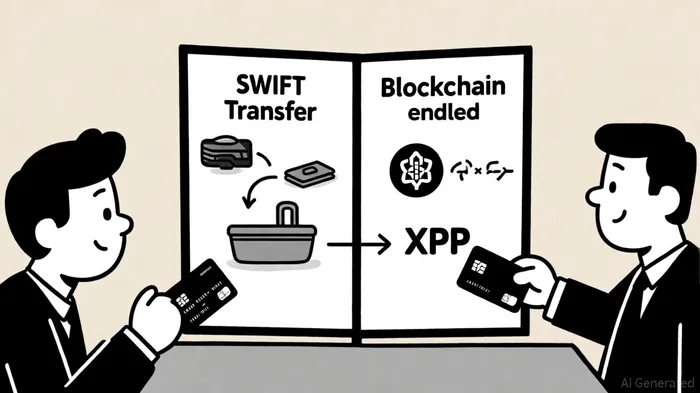





Comentarios
Aún no hay comentarios