
XRP's Surpassing of BNB as 4th Largest Crypto: A Structural Shift in Market Dynamics
The cryptocurrency market has long been a theater of volatility and rapid shifts in dominance. Yet, the December 2025–January 2026 period marked a pivotal moment as XRPXRP-- briefly overtook BNBBNB-- to claim the fourth-largest market capitalization, a position previously held by the Binance Coin. This shift was not merely a statistical anomaly but a reflection of deeper structural changes in institutional adoption, regulatory clarity, and supply-side dynamics.
The ETF-Driven Bull Run
The surge in XRP's market cap was catalyzed by a wave of institutional-grade ETF inflows. By late 2025, U.S. spot XRP ETFs had attracted over $1.3 billion in cumulative inflows within 50 days, with products like Canary Capital's XRPC and Grayscale's GXRPGXRP-- leading the charge according to reports. These ETFs, by locking 746 million XRP tokens into custody, effectively reduced the circulating supply, creating a bullish supply-side narrative. Franklin Templeton's XRPZ, with its 0.19% expense ratio, further underscored the asset's growing appeal to cost-conscious institutional investors according to analysis.
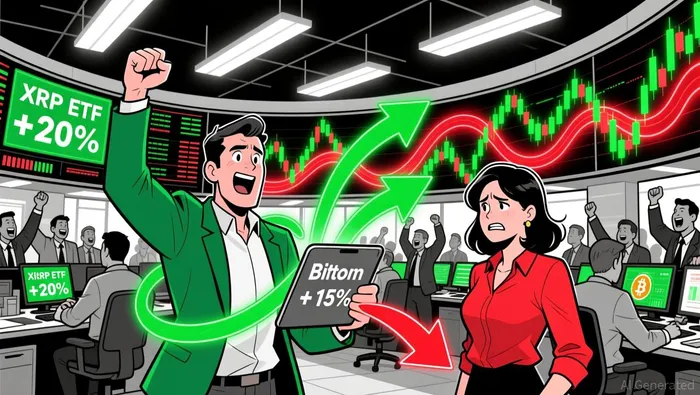
This structural absorption of liquidity by ETFs contrasts sharply with BNB's trajectory. While BitcoinBTC-- and EthereumETH-- ETFs faced record outflows in late 2025-totaling $4.57 billion over two months-XRP ETFs continued to outperform according to market data. This divergence highlights a critical shift: XRP is increasingly viewed as a regulated, institutional-grade asset, whereas BNB remains tethered to the broader volatility of the altcoin market according to analysts.
Regulatory Clarity and Institutional Confidence
Regulatory developments in early 2026 further amplified XRP's momentum. The Senate markup of the CLARITY Act in January 2026 provided a legal framework for institutional participation in digital assets, reducing uncertainty for ETF providers and investors according to financial reports. Additionally, the departure of SEC Commissioner Caroline Crenshaw-a vocal critic of crypto ETFs-was interpreted as a precursor to a more favorable regulatory environment according to market analysis. These factors, combined with Ripple's expanding DeFi integrations and Ethereum blockchain partnerships, positioned XRP as a bridge between traditional finance and decentralized ecosystems according to Nasdaq analysis.
BNB, by contrast, faces a more fragmented institutional landscape. While Binance's ecosystem remains robust, its token's market cap stagnation reflects a lack of ETF-driven demand and regulatory ambiguity. The absence of BNB-specific ETFs during this period underscores the asymmetry in institutional adoption between the two assets according to market analysis.
Technical and Sentiment Dynamics
Despite ETF-driven optimism, XRP's price action in late 2025 painted a mixed picture. A death cross pattern-where the 50-day EMA crossed below the 200-day EMA-signaled bearish momentum, with the token trading near $1.85 as of December 31 according to technical analysis. Social sentiment also hit an "extreme fear" reading of 24, historically preceding major reversals according to sentiment data. However, institutional accumulation persisted, with long-term holders buying dips and ETF inflows tightening liquidity. Analysts at Standard Chartered projected XRP could reach $8 by year-end 2026 if ETF inflows hit $10 billion according to market projections, a scenario contingent on macroeconomic stability and further regulatory progress.
BNB's technical outlook was equally uncertain. While its December 2025 market cap of $118 billion placed it fourth according to market data, its price lacked the structural support of ETF-driven demand. This vulnerability was evident during the late-2025 Bitcoin ETF outflows, which exposed broader market fragility according to market reports.
Implications for Market Dynamics
XRP's ascent to fourth-largest crypto signals a broader reconfiguration of market dynamics. The asset's transition from a utility token to an institutional-grade security reflects the maturation of the crypto market. ETFs have not only reshaped XRP's supply-demand balance but also repositioned it as a liquidity infrastructure component for traditional investors according to market analysis. This contrasts with BNB's reliance on Binance's ecosystem and speculative retail demand.
Looking ahead, the trajectory of XRP will depend on macroeconomic conditions and regulatory outcomes. If BlackRock or other major institutions launch XRP ETFs in 2026, the asset could see further inflows and price appreciation according to market analysis. However, technical indicators and macroeconomic headwinds-such as Federal Reserve policy uncertainty-remain risks according to market analysis.
Conclusion
XRP's brief surpassing of BNB in late 2025 was not an isolated event but a symptom of a larger structural shift. ETF-driven demand, regulatory clarity, and institutional adoption have redefined XRP's role in the crypto market, distinguishing it from altcoins like BNB. While challenges remain, the asset's trajectory underscores a critical lesson: in an increasingly institutionalized market, regulatory alignment and liquidity infrastructure will outweigh speculative momentum.





Comentarios
Aún no hay comentarios