
XRP's Surging Whale Activity and Mixed On-Chain Signals: A Contrarian Opportunity?
The cryptocurrency market has long been a theater of contradictions, where institutional confidence and retail panic often collide. XRPXRP--, Ripple's native token, is no exception. As we approach the end of 2025, the asset is caught in a tug-of-war between surging whale accumulation and mixed signals from ETF flows and on-chain metrics. For investors, this divergence presents a compelling case study in market psychology and structural dynamics.
Whale Accumulation: A Bullish Undercurrent
Whale activity has been a defining feature of XRP's recent narrative. According to a report by Yahoo Finance, XRP whales accumulated 340 million tokens between September and November 2025, pushing total large wallet holdings above 7.8 billion XRP. This accumulation occurred as retail panic selling intensified following XRP's failure to maintain its July high of $3.67. Whales strategically targeted high-value support zones between $1.90 and $2.20, absorbing supply while retail traders exited. On-chain data confirmed the trend, with consistent inflows into large wallets and outflows from smaller retail-sized wallets.
The pattern is not isolated. In early January 2026, whale transactions on the XRP Ledger hit 2,802, the highest level in three months. This surge in activity often precedes heightened volatility and is historically associated with major price rallies. Additionally, XRP reserves on South Korean exchanges declined sharply, echoing patterns seen before previous rallies. These movements suggest investors are moving assets into long-term private storage, reducing short-term selling pressure and potentially setting the stage for a future price rebound.
ETF Inflows and Outflows: A Tale of Two Markets
While whale activity tells a bullish story, the ETF landscape paints a more nuanced picture. U.S. spot XRP ETFs saw significant inflows in late 2025, totaling $483 million in December alone and $1.3 billion since their November launch. However, the spot price of XRP declined by 15%, falling from $2.22 to $1.77 during the same period. This divergence reflects a scenario where institutional accumulation supports the asset's structure, but broader macroeconomic pressures-such as higher interest rates and weak risk appetite-suppress short-term price momentum.
The ETF narrative took a twist in early January 2026, when U.S. spot XRP ETFs recorded their first net outflow of about $41 million on January 7, breaking a streak of inflows since their mid-November launch. This outflow was attributed to short-term profit-taking after a 25% price rally in early January. Despite this, whale activity on the XRP Ledger continued to reflect strong underlying demand and long-term holding strategies.
The Interplay: Accumulation vs. Volatility
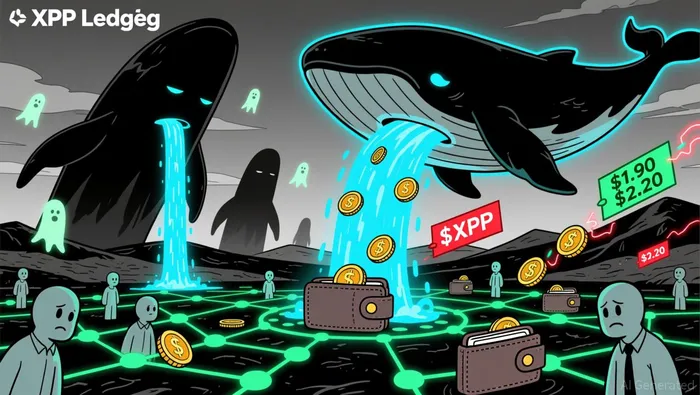
The tension between whale accumulation and ETF dynamics creates a complex market structure. On one hand, large holders are building positions at key support levels, signaling confidence in XRP's long-term value. On the other, ETF outflows and macroeconomic headwinds have kept the spot price under pressure.
highlights this contradiction: XRP's price in early 2026 showed signs of firmness near resistance levels, trading in the $2.33–$2.37 range after rebounding from a $1.53 year low. On-chain indicators like RSI and ADX confirmed strong momentum and directional trends. However, technical analysis from other sources suggested a death cross formation and bearish momentum indicators pointing to a potential decline toward $1.25 before any reversal could occur.
The divergence between institutional price targets and technical indicators reflects uncertainty. Standard Chartered projected a 330% increase in XRP to $8 by the end of 2026, based on sustained ETF inflows and regulatory clarity. Meanwhile, others caution that a supply shock narrative faces doubt.
A Contrarian Opportunity?
For contrarian investors, the current setup in XRP is intriguing. Whale accumulation suggests a bottoming process, with large holders absorbing supply at discounted prices. The decline in exchange reserves to a seven-year low of 1.6 billion tokens further tightens liquidity, increasing sensitivity to demand shifts. If ETF inflows continue to absorb whale selling and macroeconomic conditions improve, XRP could see a breakout above the $1.98–$2.00 resistance level, neutralizing the bearish structure.
However, the path to a reversal is not without risks. Open interest has cooled after a prior spike, indicating a more balanced market structure, but this also means there's less immediate pressure for a violent liquidation. For XRP to align with the ETF-driven bullish narrative, price must hold above $1.79, and ETF inflows must absorb whale selling. Without these conditions, the market is likely to remain range-bound within the $1.58–$3.50 band, with a stronger bias toward the lower end.
Conclusion
XRP's current market dynamics reflect a classic tug-of-war between institutional confidence and retail skepticism. Whale accumulation and declining exchange reserves suggest a long-term bullish setup, while ETF outflows and macroeconomic headwinds keep the short-term outlook uncertain. For investors with a contrarian mindset, the key lies in monitoring price action around critical support and resistance levels. If whales continue to build positions and ETF inflows gain momentum, XRP could surprise to the upside in 2026. But patience and discipline will be essential in navigating this volatile landscape.






Comentarios
Aún no hay comentarios