
XRP's Supply Dynamics and Market Impact: Assessing the Potential for a Supply Shock to Drive Undervaluation or Volatility
The Unique Tokenomics of XRP: A Controlled Supply Model
XRP, the digital asset issued by Ripple, operates under a distinct supply model compared to BitcoinBTC-- or EthereumETH--. Unlike proof-of-work or proof-of-stake protocols, XRP's total supply is capped at 100 billion tokens, with 80% initially allocated to Ripple Labs and placed in escrow. This escrow system releases 1 billion XRPXRP-- monthly, with unused tokens returned to reserves, ensuring a predictable and controlled supply release[1]. Additionally, XRP's deflationary mechanism—where a small portion of tokens is burned with each transaction—further reduces the total supply over time[2]. These dynamics create a unique interplay between scarcity and liquidity, which could amplify price volatility or undervaluation under certain conditions.
Historical Supply Shocks and Price Volatility
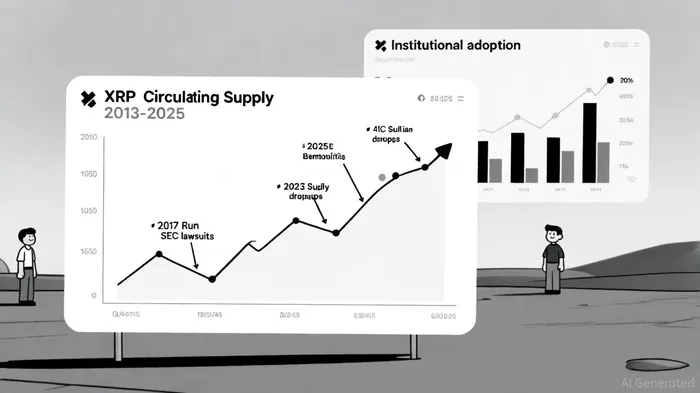
XRP's history is marked by dramatic price swings tied to supply dynamics. The 2017 bull run, which saw XRP surge from $0.006 to $3.84, was fueled by speculative retail demand and growing adoption of Ripple's cross-border payment solutions[3]. However, this was followed by a prolonged downtrend exacerbated by regulatory uncertainty, particularly the SEC's 2020 lawsuit against Ripple[4]. Fast forward to 2025, and XRP appears to be entering a similar inflection pointIPCX--. Technical indicators, such as a symmetrical triangle pattern and rising open interest in futures markets, suggest a potential breakout beyond $2[5].
A critical factor driving this narrative is the tightening liquidity in major exchanges. For instance, Binance's XRP reserves dropped by 82 million tokens in a few months, while Upbit saw a massive withdrawal of 4.989 billion XRP[6]. This exodus to cold storage reduces the liquid supply, increasing the likelihood of a supply shock if demand surges. Analysts speculate that if nine major global banks—such as China Construction Bank, JP Morgan, and Bank of America—allocated just 0.5% of their $29.74 trillion in assets to XRP, it could inject $148.7 billion into the market, removing approximately 64.66 billion XRP from circulation[1]. Such a scenario could drive prices to $10, $20, or even $50, depending on institutional adoption rates.
Institutional Adoption and Regulatory Clarity: Catalysts for Demand
The potential for a supply shock is further amplified by Ripple's strategic moves and regulatory developments. The SEC lawsuit, which has long been a market overhang, is nearing resolution, potentially unlocking institutional investment. Ripple's XRP Ledger is also gaining traction in real-world applications, such as tokenized money market funds and cross-border payment systems[5]. These developments could boost demand, especially if XRP ETFs—expected to be approved by 2025—gain traction[1].
Moreover, the concentration of XRP holdings adds to market uncertainty. Approximately 71% of XRP is held by the top 1% of wallets[3], meaning a small group of entities could influence supply dynamics. If these large holders begin selling or locking up their tokens, it could create artificial scarcity or volatility. Conversely, if they continue moving XRP to private wallets, as seen in the 90% drop on Coinbase[5], it could signal a shift toward long-term value retention rather than speculative trading.
The Path to a Supply Shock: Undervaluation or Volatility?
The question remains: Will a supply shock lead to undervaluation or volatility? Historical precedents suggest both outcomes are possible. In 2017, XRP's price surged due to speculative demand but collapsed after CoinMarketCap removed Asian exchange data, highlighting concerns about market manipulation[3]. Today, however, the landscape is different. Institutional adoption, regulatory clarity, and deflationary mechanics provide a more robust foundation for sustained demand.
If the supply shock materializes—driven by institutional allocations, ETF approvals, or token burns—XRP could experience a parabolic rise similar to 2017. However, this depends on whether demand outpaces the controlled release of 1 billion XRP monthly. Analysts like Edward Farina argue that by 2030, XRP may become nearly untradeable on exchanges due to a combination of token burns, escrow releases, and withdrawal activity[6]. This scenario could drive prices upward as demand outstrips supply, but it also risks creating a liquidity crisis if exchanges cannot meet sudden demand spikes.
Conclusion: A High-Stakes Scenario for XRP Investors
XRP's supply dynamics present a high-stakes scenario for investors. The controlled release mechanism and deflationary burns create a unique balance between scarcity and liquidity, but this equilibrium is fragile. Historical supply shocks, coupled with current trends like exchange withdrawals and institutional interest, suggest that XRP is on the cusp of a major price movement. While a supply shock could drive undervaluation in the short term, the long-term outlook hinges on whether demand—fueled by regulatory clarity, ETF approvals, and real-world adoption—can outpace the shrinking liquid supply. For investors, the key will be monitoring on-chain data, institutional activity, and regulatory developments to position for either a volatility-driven rally or a sustained bull run.







Comentarios
Aún no hay comentarios