
XRP's Supply Dynamics and Institutional Adoption: Is a 2026 Price Surge Imminent?
The cryptocurrency market in 2026 is witnessing a paradigm shift, with XRPXRP-- emerging as a focal point for institutional capital. This analysis examines XRP's supply dynamics and institutional adoption trends to assess whether a price surge is on the horizon, focusing on market structure and institutional buying pressure.
Supply Dynamics: A Controlled Release Framework
XRP's supply mechanism is a cornerstone of its market structure. Ripple Labs' monthly unlocks of 1 billion XRP tokens are part of a meticulously designed framework, with historical data showing that 60–80% of unlocked tokens are re-locked into escrow, leaving only a fraction in liquid supply. For instance, in December 2025, 70% of the unlocked tokens were re-escrowed, resulting in less than 300–400 million XRP entering the market. This controlled release mitigates sudden supply shocks and creates a predictable environment for price stability.
Exchange-held XRP balances have also plummeted, dropping from 4 billion to 1.6–1.7 billion tokens by late 2025-a 57% reduction. This decline reflects a shift toward self-custody, institutional accumulation, and over-the-counter (OTC) transactions. With fewer tokens available on exchanges, the market becomes more sensitive to demand shifts, amplifying price volatility.
Institutional Adoption: ETFs and OTC Transactions Drive Demand
Institutional buying pressure has surged, particularly through XRP ETFs. From mid-November 2025 to January 2026, XRP ETFs absorbed $1.3 billion in assets, with 43 consecutive days of inflows and zero outflows. These inflows, driven by firms like Franklin Templeton, Grayscale, and Bitwise, reflect strategic, long-term allocations rather than speculative retail interest. By January 2026, ETFs held over 793 million XRP tokens, effectively removing a significant portion of supply from the open market.
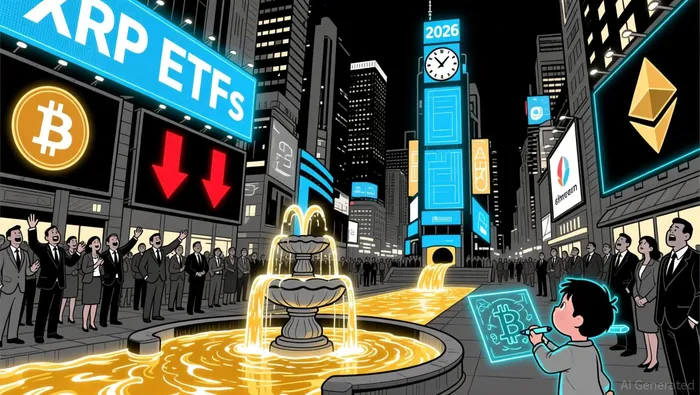
December 2025 saw XRP ETFs attract $483 million in fresh capital, outpacing BitcoinBTC-- and EthereumETH-- ETFs, which lost $1.09 billion and $564 million, respectively, during the same period. This trend underscores institutional confidence in XRP, even amid a 15% price drop for the token that month. The regulatory resolution of Ripple's legal case in August 2025 further legitimized XRP as an institutional asset, enabling its re-listing on major exchanges and unlocking previously sidelined capital.
OTC transactions and direct investments have also fueled institutional demand. Heavyweight issuers, including pension funds and sovereign wealth entities have increasingly allocated capital to XRP through OTC channels, bypassing public market volatility.
Regulatory and Macroeconomic Catalysts
Regulatory clarity is a critical enabler of XRP's institutional adoption. The CLARITY Act, scheduled for Senate markup in January 2026, aims to define the legal framework for bankBANK-- participation in digital assets, reducing compliance risks and encouraging broader adoption. Additionally, Ripple's RLUSD stablecoin expansion in Japan under new stablecoin regulations could create recurring demand for XRP as a bridge asset in cross-border payments.
Macroeconomic conditions further support XRP's case. Federal Reserve rate cuts in late 2026 are expected to reduce the appeal of cash and fixed-income assets, pushing capital toward higher-risk, higher-return assets like XRP. However, supply-side challenges persist, including the release of 300 million XRP in early 2026, which could exert downward pressure despite institutional demand.
Challenges and Headwinds
While the demand-side fundamentals are robust, XRP's large circulating supply remains a headwind. Even with controlled unlocks, periodic releases of 300 million XRP could strain price stability if not fully absorbed by ETFs or OTC buyers. Additionally, XRP's utility in Ripple's payment infrastructure does not always require long-term token holding, limiting its economic value absorption.
Conclusion: A Convergence of Forces
XRP's path to a 2026 price surge hinges on the sustainability of ETF inflows, regulatory progress, and macroeconomic tailwinds. If ETFs continue to attract $300–500 million monthly inflows, they could lock an additional 750 million–1.25 billion XRP by mid-2026, compounding the already reduced exchange supply. The expansion of RLUSD in Asia-Pacific banking corridors could further drive recurring demand for XRP as a bridge asset.
However, investors must remain cautious about supply-side risks and macroeconomic volatility. For XRP to reach $4–$8 by year-end, institutional demand must outpace periodic unlocks and macroeconomic headwinds. The convergence of controlled supply dynamics, regulatory clarity, and institutional adoption suggests a compelling case for XRP, but execution will determine whether the 2026 price surge materializes.






Comentarios
Aún no hay comentarios