
XRP's Supply-Demand Imbalance and Institutional Buying Pressure: A Catalyst for Explosive Price Potential
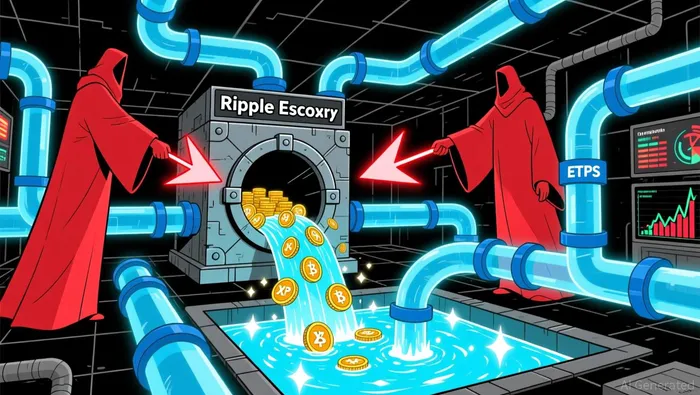
The cryptocurrency market has long been a theater of volatility, but XRP's unique interplay of supply constraints, institutional adoption, and liquidity dynamics positions it as a standout case study in explosive price potential. As of November 2025, XRP's circulating supply stands at approximately 60.02 billion tokens, with a maximum supply cap of 100 billion according to Blockworks. Ripple's controlled release of 1 billion XRPXRP-- monthly from escrow accounts according to Bitget creates a predictable inflationary mechanism, yet the token's utility in cross-border payments and institutional-grade infrastructure has begun to outpace this supply growth. This imbalance, combined with surging institutional demand, is setting the stage for a paradigm shift in XRP's valuation.
Supply Constraints: A Controlled Inflationary Model
XRP's supply dynamics are engineered for stability. Ripple's escrow mechanism ensures that only 1% of the total supply is released monthly, with a significant portion of tokens held in reserve or returned to escrow according to Reddit discussion. This controlled inflationary model contrasts sharply with the deflationary narratives of other cryptocurrencies, yet it provides a critical advantage: market predictability. By 2025, the circulating supply had grown to 60.02 billion tokens according to Blockworks, but the gradual release schedule limits sudden market saturation. However, this controlled supply faces a growing challenge: institutional demand.
Institutional Buying Pressure: ETFs and Regulatory Clarity
The 2023 SEC v. Ripple ruling was a watershed moment. By deeming secondary XRP transactions non-securities, the court provided regulatory clarity that unlocked institutional access according to Skadden. This paved the way for the launch of spot XRP ETFs, including Grayscale's GXRP and Franklin Templeton's XRPZ, which debuted on NYSE Arca. By late 2025, at least nine asset managers had filed for XRP ETFs, with estimates suggesting $5–$7 billion in inflows by 2026. These ETFs not only democratize access but also inject liquidity into a market that, until recently, struggled with order-book fragility.
Ripple's strategic acquisitions further amplified institutional adoption. The $1.25 billion purchase of Hidden Road to create Ripple Prime-a crypto-owned global prime brokerage-expanded institutional access to XRP and other digital assets according to Kenson Investments. Meanwhile, Ripple's On-Demand Liquidity (ODL) processed $1.3 trillion in cross-border transactions in Q2 2025 according to MarketChameleon, demonstrating XRP's utility beyond speculative trading. The IMF's recognition of XRP as a potential cross-border settlement framework according to The Crypto Basic underscores its growing legitimacy in traditional finance.
Liquidity Constraints: A Double-Edged Sword
Despite these tailwinds, XRP's liquidity remains a double-edged sword. In November 2025, the token's order-book depth thinned to near-zero during a sharp price correction, allowing modest market orders to trigger significant price swings according to FastBull. The trading volume-to-market cap ratio of 6.9% during this period according to Economic Times highlighted both robust demand and structural fragility. While ETF inflows and ODL's utility have bolstered liquidity, the market's response to volatility events reveals vulnerabilities.
However, these constraints could catalyze explosive price movements. High institutional buying pressure, combined with a limited supply of tradable XRP, creates a scenario where demand outpaces supply. For instance, the launch of the XRPC ETF in 2025 saw $59 million in trading volume on its debut according to CCN, signaling unprecedented institutional appetite. If macroeconomic conditions remain favorable, the influx of capital into XRP ETFs could compress bid-ask spreads and stabilize order-book depth over time according to FastBull.
The Path to Explosive Price Potential
The convergence of supply constraints, institutional adoption, and liquidity dynamics paints a compelling case for XRP's explosive potential. Ripple's controlled supply release ensures scarcity, while ETF-driven demand creates upward pressure. Regulatory clarity and utility in cross-border payments further solidify XRP's role in institutional portfolios.
Critics may argue that liquidity constraints pose a risk, but history shows that assets with strong fundamentals often experience parabolic moves when demand outpaces supply. XRP's unique position-as both a utility token and a regulated investment vehicle-positions it to benefit from this dynamic. As institutional inflows accelerate and Ripple's infrastructure expands, the market may soon witness a re-rating of XRP's value.







Comentarios
Aún no hay comentarios