
XRP's Sudden $19 Billion Market Cap Drop: A Buying Opportunity or a Systemic Warning?
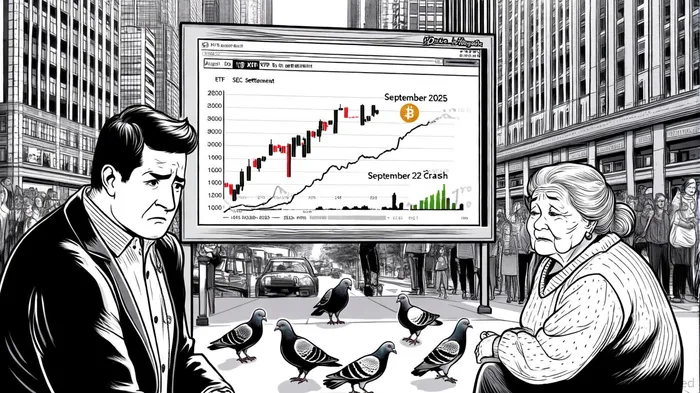
In September 2025, XRP's market cap plummeted by $19 billion amid a broader crypto market downturn, raising critical questions for investors: Is this a systemic warning of deeper industry instability, or a buying opportunity for a crypto asset with growing institutional traction? The answer lies in dissecting the interplay between regulatory risk and XRP's long-term fundamentals.
Regulatory Clarity: A Double-Edged Sword
The U.S. Securities and Exchange Commission's (SEC) August 2025 settlement with Ripple, which affirmed XRP's non-security status, initially spurred a 4% price surge and $1.2 billion in inflows for the ProShares Ultra XRPXRP-- ETF [3]. This regulatory clarity removed a decade-long overhang, enabling institutional adoption and fueling speculation about XRP ETF approvals. However, the same regulatory environment that catalyzed optimism also introduced volatility. The debut of the inaugural U.S. XRP ETF (REX-Osprey) in early September triggered a selloff, as institutional selling overwhelmed early optimism, pushing XRP below $3.00 [5].
The paradox here is clear: while regulatory resolution has unlocked new avenues for XRP, it has also exposed the asset to the same market forces that govern traditional financial instruments. As noted by CoinPedia, “The ETF approval process remains a wildcard—either a tailwind for institutional demand or a catalyst for short-term profit-taking” [1].
Market Dynamics: Systemic Risk or Cyclical Correction?
The September 2025 crash was not unique to XRP. Over $1.7 billion in leveraged positions were liquidated as the total crypto market cap fell below $4 trillion, with BitcoinBTC-- dropping from $100,000 to $85,000 [3]. XRP's 5.84% single-day decline mirrored broader trends, driven by macroeconomic jitters and a shift in capital toward Bitcoin, which saw its dominance rise to 57.7% [5].
Whale activity and profit-taking further exacerbated the sell-off. Large holders reportedly added 340 million XRP to their portfolios around the $2.81–$2.82 level, yet this accumulation failed to offset the broader selloff [1]. Meanwhile, new wallet growth remained muted, suggesting the rally post-SEC settlement was driven by existing holders rather than organic adoption [4].
Long-Term Fundamentals: Structural Support Amid Volatility
Despite the short-term turbulence, XRP's foundational strengths remain intact. The XRP Ledger now supports over 7 million active accounts, and daily transaction volumes hit $1.73 billion in 2025, outpacing many competitors in speed and efficiency [4]. Ripple's cross-border payment solutions continue to attract institutional clients, with the XRP Ledger processing over 75% of transactions in under 5 seconds [4].
Institutional adoption is also gaining momentum. Post-SEC settlement, XRP's trading volume surged 208% to $12.4 billion, with peak single-day trades exceeding 193.9 million XRP [1]. Analysts project XRP could reach $3.70–$4.00 by year-end if ETF approvals materialize, while pessimistic scenarios see support levels at $2.20–$2.26 [1].
The Investment Dilemma: Risk vs. Reward
For investors, the key question is whether XRP's $19 billion drop reflects a systemic warning or a mispricing opportunity. On one hand, the asset remains vulnerable to regulatory shifts and macroeconomic cycles, as evidenced by the ETF-driven selloff. On the other, its growing institutional adoption, transactional utility, and ETF potential suggest a path to sustained value creation.
As markets stabilize, XRP's price may test critical support levels at $2.75–$2.80, offering a potential entry point for long-term buyers [1]. However, investors must weigh this against the broader crypto market's susceptibility to leverage-driven corrections.
Conclusion
XRP's September 2025 crash underscores the dual nature of crypto assets: they are both speculative and foundational. While regulatory clarity has unlocked new opportunities, the asset's volatility remains a barrier to mass adoption. For those with a long-term horizon, the drop may represent a chance to acquire XRP at a discount to its intrinsic value—provided they can weather the near-term noise.
As the industry navigates this inflection point, the coming months will test whether XRP can transition from a regulatory pariah to a mainstream financial asset.






Comentarios
Aún no hay comentarios