
XRP's Structural Weakness: Whale Selling and On-Chain Divergence Signal Deep Correction Risk
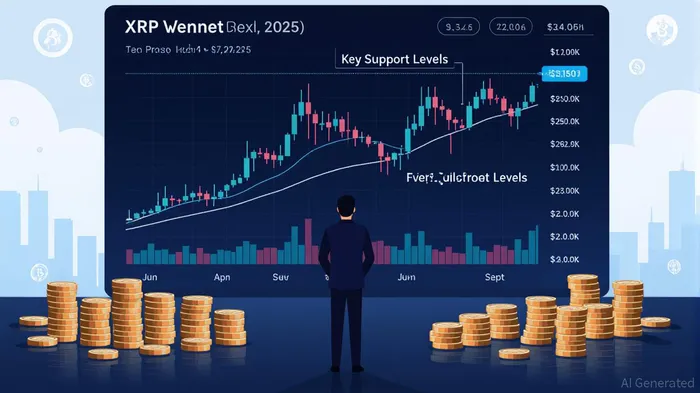
In the volatile world of cryptocurrency, XRPXRPI-- has long been a barometer for institutional sentiment and macroeconomic trends. As of September 2025, the token sits near its 2018 peak of $3.84, yet structural weaknesses are emerging that could undermine its bullish trajectory. Whale selling activity and on-chain divergence metrics—particularly the MVRV (Market Value to Realized Value) and NVT (Network Value to Transaction) ratios—suggest a deep correction is not only possible but increasingly probable.
Whale Selling: A Double-Edged Sword
XRP's whale activity in 2025 has been a mixed bag. While strategic accumulation by large holders—such as the $782 million transfer by a Ripple-affiliated whale on May 9—has signaled long-term confidence[3], recent distribution trends tell a different story. Between July and September, mid-tier whale wallets offloaded 160 million XRP, reducing their holdings from 6.95 billion to 6.79 billion tokens[1]. This equates to nearly $500 million in value, a move that directly correlates with XRP's price slipping below the critical $3 support level[4].
Such selling is not inherently bearish; whales often reposition or take profits during bullish cycles. However, the timing and volume of these transactions raise red flags. Analysts like Ali Martinez have noted that large-scale distribution by whales typically precedes market capitulation, especially when paired with weakening on-chain fundamentals[1]. The fact that XRP's price initially held above $3 despite this selling pressure[1] only underscores the fragility of its current support.
On-Chain Divergence: MVRV and NVT Signal Structural Stress
On-chain metrics provide further cause for concern. The MVRV ratio, a key indicator of market sentiment, recently dipped below its 200-day moving average—a historically bearish crossover[6]. While the ratio had previously flashed a “golden cross” in Q3 2025, suggesting a 630% price surge was imminent[5], its subsequent decline indicates a shift in investor psychology. This divergence between technical optimism and on-chain pessimism is a classic precursor to market corrections.
Meanwhile, the NVT ratio—a measure of network utility relative to market value—has dropped by 46.1% in 24 hours, reaching 95.88[5]. While this might seem like a positive sign (suggesting improved efficiency), it also implies that XRP's valuation is becoming increasingly disconnected from its transactional utility. For context, the XRP Ledger processed $1.4 billion in daily volume in late August[5], but this figure has since declined, reflecting a loss of confidence among both retail and institutional participants[2].
Institutional Sentiment and Macro-Trend Headwinds
The broader macroeconomic context exacerbates these structural weaknesses. Despite bullish projections from analysts—ranging from $8–$9 to as high as $25 by year-end[3]—institutional sentiment remains cautious. The SEC's continued rejection of XRP ETF proposals[2] has created regulatory uncertainty, deterring large-cap investors who typically drive sustained price action. Additionally, the recent sell-off by whales has coincided with a 6.5% decline in XRP's price since early September[2], a trend that could accelerate if macroeconomic conditions worsen.
Retail traders, however, remain a wildcard. XRP's resilience above $3 in some reports[3] suggests that retail demand is still robust, but this alone cannot offset institutional selling. The token's future will likely hinge on whether it can attract new use cases—such as decentralized finance (DeFi) or cross-border remittances—to offset the loss of speculative demand.
Conclusion: A Correction Looms
While XRP's price action has defied expectations in 2025, the confluence of whale selling, on-chain divergence, and regulatory headwinds paints a cautionary picture. The MVRV and NVT ratios, in particular, highlight a growing disconnect between technical indicators and fundamental metrics—a classic setup for a deep correction. Investors should brace for volatility, especially if the SEC's stance on XRP remains unchanged. For now, the $3 support level is a critical watchpoint; a sustained break below this level could trigger a cascade of stop-loss orders and further institutional selling.
In the long term, XRP's utility-driven growth potential remains intact. But in the short term, the structural weaknesses outlined here suggest that the token is at a crossroads.






Comentarios
Aún no hay comentarios