
XRP's Strategic Rise in Global Banking: A Portfolio Allocation Playbook for 2025
Institutional Adoption: The XRP Infrastructure Play
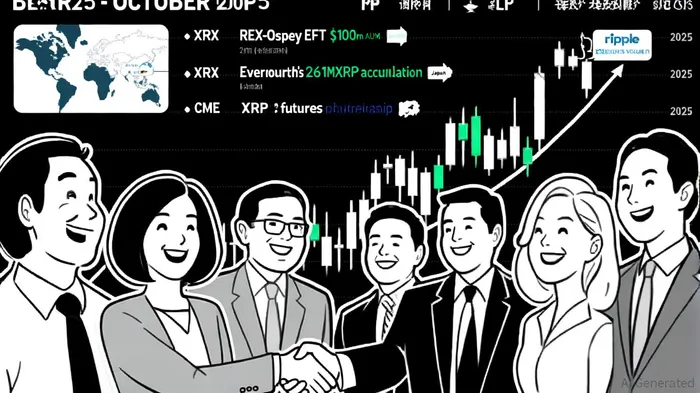
XRP's appeal lies in its role as a bridge between traditional finance and blockchain innovation. By 2025, institutional adoption has surged, driven by regulatory clarity and product innovation. The REX-Osprey XRP ETF, for instance, surpassed $100 million in assets under management, signaling robust demand for regulated exposure, according to a Coinotag report. Meanwhile, CME Group's launch of XRP options and futures has provided institutional investors with advanced tools for hedging and speculation, with notional trading volume hitting $26.9 billion in just five months, per a Coinotag article.
A pivotal development is Evernorth's accumulation of 261 million XRP tokens between October 20–24, 2025, as part of its strategy to build the world's largest institutional XRP treasury. This move, backed by Ripple and SBI Holdings, has already triggered a 6% price surge and a 50% spike in trading volume to $4.05 billion, as Coinotag reported. Evernorth's plan to merge with a SPAC and list on Nasdaq as "XRPN" in early 2026 further institutionalizes XRP, offering traditional investors a regulated pathway to digital assets, Coinotag noted.
Regulatory Clarity and Fintech Synergy
Regulatory progress has been a linchpin for XRP's institutional ascent. The U.S. SEC's reclassification of XRP as a commodity in secondary market transactions has removed a major barrier to adoption, enabling ETFs and futures trading, according to a FinancialContent article. Ripple's push for a U.S. banking license could further legitimize XRP as a reserve asset, allowing traditional banks to hold and transact with the token legally, according to a Currency Analytics report.
Strategic partnerships have amplified XRP's utility. Ripple's collaboration with Bahrain FinTech Bay and SBI Remit has integrated XRP into real-time, low-cost cross-border payment systems, while its rebranded Ripple Prime (formerly Hidden Road) is advancing the "Internet of Value" vision, as Coinotag reported. Additionally, tokenized U.S. Treasury bills on the XRP Ledger, supported by a $10 million Ripple investment, are creating digital representations of short-term government debt, enhancing liquidity and transparency, according to an OnTheNode article.
Strategic Allocation: Risk, Return, and Diversification
XRP's risk-return profile is increasingly attractive for institutional portfolios. While still volatile, its integration into derivatives and ETFs provides tools for managing exposure. CME's XRP futures, for example, have seen open interest reach $1.4 billion by September 2025, outpacing BitcoinBTC-- and EthereumETH-- in hitting key milestones, according to a Coinotag report. This liquidity, combined with XRP's low-cost cross-border utility, positions it as a hedge against traditional asset correlations.
Institutional reports suggest XRP's correlation with stocks and bonds is diverging. As companies like Webus International and VivoPower International raise $300 million and $121 million in XRP treasuries, respectively, the token is increasingly viewed as a strategic asset alongside traditional instruments, as OnTheNode described. This trend aligns with broader fintech shifts, where digital assets are no longer seen as speculative but as infrastructure for modern finance.
Conclusion: A New Era for XRP
James Wynn's bet on XRP is emblematic of a larger narrative: the token's evolution from a regulatory gray area to a cornerstone of global banking infrastructure. With institutional adoption accelerating, regulatory hurdles diminishing, and real-world use cases expanding, XRP is no longer a fringe play. For investors seeking exposure to fintech-driven disruption, XRP offers a compelling blend of utility, liquidity, and diversification benefits. As 2026 approaches, the convergence of XRP's infrastructure role and institutional-grade products may redefine its place in the global financial ecosystem.





Comentarios
Aún no hay comentarios