
XRP's Strategic Rebound Setup: Can Extreme Fear and Institutional Inflows Signal a High-Probability Breakout in Early 2026?
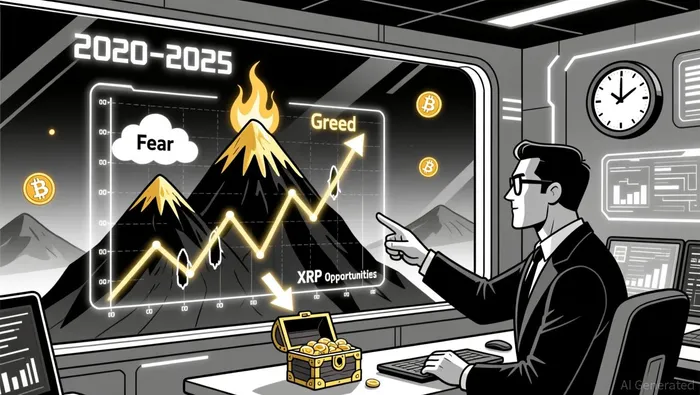
The cryptocurrency market has long been a theater for contrarian investing, where fear and institutional capital often collide to create asymmetric opportunities. XRPXRP--, the native token of Ripple's blockchain network, finds itself in a historically familiar position as of late 2025: a 35.47% price decline in Q4 2025 coincided with extreme fear levels on the Crypto Fear & Greed Index (24) and a surge in institutional investment. This divergence-between retail pessimism and institutional accumulation-has historically signaled high-probability breakouts. But does the current setup justify a bullish thesis for early 2026?
Institutional Inflows: A Contrarian Signal Amid Retail Panic
Despite XRP's sharp Q4 2025 drop, institutional demand remained robust. Over $1 billion flowed into XRP ETFs by late 2025, with December alone seeing a $424 million inflow. This contrasts sharply with the extreme fear gripping retail investors, who saw bearish commentary spike 20–30% above November 2025 averages according to sentiment analysis. Such institutional divergence is not new for XRP. In 2020–2021, the token fell to $0.17 amid the SEC lawsuit panic but later surged 1,053% to $1.96 over four months as reported by financial analysis. Similarly, a 2024–2025 dip to $0.40–$0.60 preceded a 612% rally to $3.56 following the Trump election according to market data. These patterns suggest that institutional buying during retail capitulation often precedes explosive rallies.
The latest data reinforces this trend. By early 2026, XRP ETFs had accumulated over $1.4 billion in assets under management, with inflows peaking at $13.59 million on January 2. Analysts attribute this to the SEC's May 2025 settlement, which reduced regulatory uncertainty and spurred institutional adoption. However, XRP's price remains below $2, raising questions about why ETF inflows haven't translated into immediate gains. According to a report by CryptoSlate, this disconnect may stem from hedging practices, supply mechanisms, and market structure. In other words, institutions may be accumulating XRP for long-term positioning rather than short-term speculation.
Sentiment Divergence: Fear as a Catalyst
The Crypto Fear & Greed Index's extreme fear level of 24 is a critical contrarian signal. Historically, such levels have acted as a "buying opportunity" for XRP. Machine learning models analyzing sentiment data show 70–91% accuracy in predicting price reversals when fear reaches these extremes. This is not mere coincidence; fear-driven capitulation often clears the field for institutional buyers to accumulate at discounted prices.
The technical picture, however, is mixed. XRP is currently trading within a descending channel, with resistance at $1.93–$2.00 and support at $1.82 as noted in market analysis. A death cross-where the 50-day EMA crosses below the 200-day EMA-has formed, historically signaling bearish momentum. A break below $1.85 could push the price toward $1.25, a level last seen during the 2024–2025 dip. Yet, this short-term bearishness may simply be a consolidation phase before a larger breakout.
Historical Precedents and 2026 Outlook
XRP's history is littered with examples of explosive recoveries following extreme fear. The 2020–2021 and 2024–2025 rallies were both preceded by prolonged periods of negativity, only to reverse sharply when institutional demand outpaced retail selling. The current setup mirrors these patterns: XRP trades near $1.90, a level that could serve as a base for a multi-month rally if institutional buying continues.
Bullish scenarios suggest XRP could reach $2.80–$3.20 by March 2026 if regulatory clarity improves or major ETF approvals occur. A base case predicts a more moderate rise to $2.20–$2.50 by late February 2026, driven by steady ETF inflows. However, a bearish case remains if fear persists for over eight weeks without relief.
Conclusion: A Contrarian Case for Caution and Conviction
The interplay between extreme fear and institutional inflows creates a compelling case for a contrarian bullish thesis. While technical indicators like the death cross and descending channel suggest short-term weakness, the historical precedent of XRP surging 612% and 1,053% after similar fear levels cannot be ignored. Institutions appear to be positioning for a long-term play, and retail fear may be the final catalyst needed to trigger a reversal.
For investors willing to navigate the near-term volatility, XRP's current setup offers a high-probability asymmetric opportunity. The key will be monitoring whether institutional inflows continue to outpace bearish sentiment and whether technical indicators begin to align with a bullish bias. If history repeats, the $8 price target cited by Standard Chartered may not be as far-fetched as it seems.






Comentarios
Aún no hay comentarios