
XRP's Strategic Rebound: Legal Clarity, ETF Integration, and Institutional Adoption
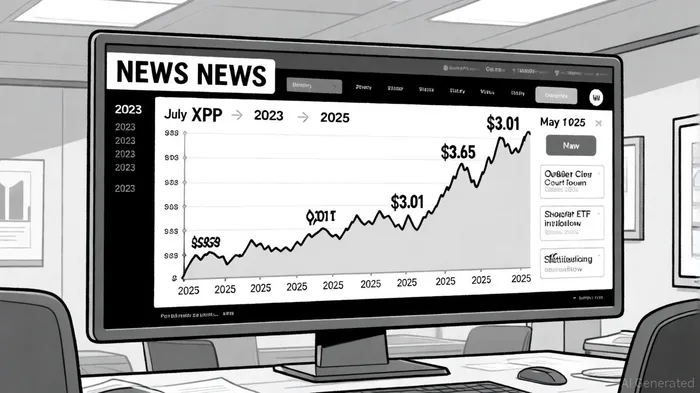
The resolution of the SEC vs. Ripple lawsuit in August 2025 marked a watershed moment for XRPXRP--, transforming it from a regulatory pariah to a potential cornerstone of institutional crypto portfolios. With the legal battle concluded and the token's classification as a non-security in secondary markets affirmed, XRP now stands at the intersection of regulatory clarity, ETF-driven liquidity, and institutional adoption—a trifecta poised to redefine its market dynamics.
Legal Clarity: A Foundation for Institutional Confidence
The U.S. Court of Appeals for the Second Circuit's dismissal of the SEC's appeals in August 2025 finalized a critical legal precedent: XRP sales to retail investors on secondary markets are not securities transactions[1]. This ruling, coupled with Ripple's $50 million settlement in May 2025[2], has effectively neutralized the regulatory uncertainty that once stifled institutional participation. As stated by Ripple's chief legal officer, Stuart Alderoty, the outcome “allows the company to operate under clear terms while reinforcing XRP's utility as a non-security asset”[3]. This clarity has already spurred a surge in XRP's price, with analysts noting a 3.32% increase on the day of the first U.S. spot XRP ETF launch in September 2025[4].
ETF Integration: A Catalyst for Liquidity and Price Discovery
The regulatory green light has accelerated the approval of spot XRP ETFs, with major players like Grayscale, Bitwise, and 21Shares awaiting U.S. SEC decisions by late October 2025[5]. These ETFs, which require physical custody of XRP, are projected to attract $1–2 billion in initial inflows, tightening the token's circulating supply and stabilizing its price[6]. Data from CoinPedia indicates that Grayscale's XRP Trust alone has seen a 40% increase in holdings since January 2025[7], signaling growing institutional confidence.
However, the first XRP ETF, the REX-Osprey XRP ETF (XRPR), faced mixed reception. While its September 18 launch drove a 3.32% price surge, subsequent trading revealed technical weaknesses, including a breakdown below the $3.24 trendline and 100-hour moving average[8]. On-chain analytics further highlight whale activity, with large holders liquidating positions on exchanges—a potential red flag for short-term volatility[9]. Yet, these early hiccups pale against the broader narrative: if approved, XRP ETFs could replicate the success of BitcoinBTC-- and EthereumETH-- ETFs, potentially pushing XRP's price to $10–$15 by late 2025[10].
Institutional Adoption: From Cross-Border Payments to Portfolio Diversification
Beyond ETFs, XRP's institutional adoption is accelerating through its core utility. Ripple's On-Demand Liquidity (ODL) service processed $1.3 trillion in cross-border payments in 2025[11], while partnerships with stablecoin platforms and custody solutions have expanded its use cases. Institutional investors are also accumulating XRP directly, with daily inflows exceeding $25 million[12]. This demand is further amplified by the token's limited supply and the SEC's requirement for ETFs to hold physical XRP, creating a deflationary tailwind.
Analysts project that XRP's inclusion in U.S. ETF baskets could unlock a $3–6 trillion market cap by 2035[13], driven by its potential as a hedge against fiat volatility and a bridge for global remittances. The token's technical indicators—such as rising open interest and implied volatility in derivatives markets—also suggest anticipation of a price breakout above $3.65[14].
Momentum Investing in a Post-Regulatory Clarity Era
For institutional-grade momentum investors, XRP's strategic rebound offers a unique confluence of catalysts:
1. Regulatory Tailwinds: The SEC's retreat from enforcement actions has created a “safe harbor” for XRP, reducing counterparty risk.
2. ETF-Driven Liquidity: Approved ETFs could inject billions into XRP's ecosystem, mirroring Bitcoin's 2024 ETF-driven rally.
3. Institutional Legitimacy: Ripple's $200 million acquisition of a blockchain payment infrastructure firm in 2025[15] underscores its commitment to enterprise adoption.
Conclusion: A New Paradigm for XRP
XRP's journey from legal limbo to institutional asset class is emblematic of the broader crypto market's evolution. While short-term volatility remains a risk—exacerbated by whale activity and ETF launch jitters—the long-term fundamentals are compelling. With regulatory clarity, ETF integration, and institutional adoption aligned, XRP is positioned to capitalize on the next wave of crypto financialization. For momentum investors, the token's price trajectory and macroeconomic signals suggest a high-conviction opportunity in a market increasingly defined by regulated innovation.






Comentarios
Aún no hay comentarios