
XRP's Strategic Rebound: Assessing the Catalysts for Sustainable Growth in a Post-Retail Sell-Off Environment
Institutional Adoption: A New Paradigm
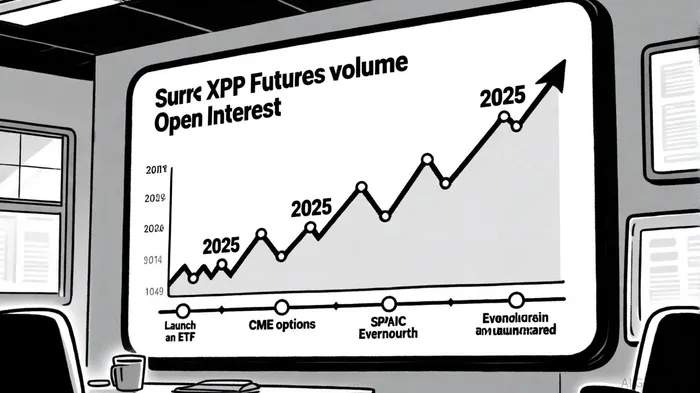
XRP's institutional adoption has accelerated through a suite of regulated financial products. The REX-Osprey XRP ETF (ticker: XRPR), the first U.S. spot XRP fund, surpassed $100 million in assets under management within a month of its September 2025 launch, signaling robust demand for compliant exposure, according to Coinotag coverage. This milestone was preceded by CMECME-- Group's introduction of XRP futures and options contracts, which provided sophisticated hedging tools for institutional investors. By October 2025, CME's XRP futures had traded over 567,000 contracts, with a notional volume of $26.9 billion, while open interest hit $1 billion-a record for the platform, according to a Bitcoin.com report. These products not only enhance liquidity but also mirror the infrastructure seen for BitcoinBTC-- and EthereumETH--, legitimizing XRP as a tradable asset class.
The Evernorth SPAC merger further amplifies institutional confidence. Evernorth, an XRP treasury firm holding 261 million tokens, plans to list on Nasdaq via a SPAC (Armada Acquisition Corp II) in early 2026 under the ticker "XRPN," according to a WRAL article. This move, backed by Ripple and major crypto firms like Pantera Capital, aims to blend traditional treasury management with DeFi yield generation, offering 5-8% annualized returns. Such strategies could attract a new cohort of institutional investors seeking diversified crypto exposure.
Utility Expansion: From Payments to Prime Brokerage
XRP's utility has evolved beyond cross-border payments, now encompassing prime brokerage and DeFi integration. Ripple's acquisition of Hidden Road (rebranded as Ripple Prime) marks a pivotal step, positioning XRP as collateral in multi-asset prime brokerage services, according to a Coinotag report. This integration allows institutions to leverage XRP's speed and low costs for liquidity provision, while RLUSD-a U.S. dollar-pegged stablecoin on XRPL-facilitates stable trading and derivatives. Ripple President Monica Long emphasized that this move "positions XRP as a central asset in the evolving financial landscape," a sentiment echoed by analysts tracking the token's growing role in institutional portfolios, as noted in a Coinotag article.
DeFi adoption has also gained momentum. In June 2025, Ripple integrated an EVM-compatible sidechain into XRPL, enabling Solidity-based dApps with XRP gasGAS-- fees, according to an MLFirstClassMarketing post. This advancement broadens the ledger's capabilities, supporting tokenized assets, stablecoins, and decentralized identity solutions. For instance, Southeast Asian and Latin American fintechs now use XRP for real-time cross-border payments via Ripple's On-Demand Liquidity (ODL) service, reducing costs by up to 70% compared to traditional methods, per a CCN explainer.
Real-World Adoption: Metrics and Partnerships
XRP's real-world utility is underscored by its adoption in high-volume markets. Ripple reported over 300 institutions using its payment infrastructure by mid-2025, with partners like SBI Remit (Japan) and Onafriq (Africa) leveraging XRP for remittance corridors, as noted in an MLFirstClassMarketing post. Regulatory clarity post-SEC lawsuit resolution in August 2025 further boosted legitimacy, with Ripple's legal victories addressing longstanding uncertainties about XRP's classification, as Coinotag reported.
On-chain data also reveals a bullish trend. Large XRP holders accumulated aggressively from July to September 2025, contributing to a market cap recovery to $146 billion, according to an FXLeaders report. Analysts note that this accumulation phase mirrors the 2017 bull market setup, suggesting a potential second wave of growth.
Conclusion: A Sustainable Growth Trajectory
XRP's strategic rebound hinges on its ability to balance speculative momentum with utility-driven fundamentals. The confluence of institutional adoption, regulatory progress, and expanding use cases-from cross-border payments to prime brokerage-positions XRP as a bridge between traditional finance and decentralized ecosystems. While challenges like centralization concerns persist, the token's role in real-world infrastructure and its integration into regulated financial products suggest a path toward sustainable growth.
As institutional investors increasingly prioritize compliance and utility, XRP's ecosystem-anchored by Ripple's strategic acquisitions and DeFi innovations-offers a compelling narrative for long-term value creation.





Comentarios
Aún no hay comentarios