
XRP: The Strategic On-Ramp to Web3 and Institutional DeFi Adoption
The convergence of traditional finance and blockchain technology has reached a pivotal inflection point in 2025, with XRPXRP-- emerging as a linchpin for institutional adoption. As global financial systems grapple with the need for scalability, interoperability, and cost efficiency, XRP's unique positioning-bridging legacy infrastructure with next-generation blockchain utility-has catalyzed a paradigm shift. This analysis explores how XRP's strategic partnerships, regulatory clarity, and technological innovations are reshaping cross-border payments, DeFi, and institutional-grade digital asset ecosystems.
Regulatory Clarity: A Catalyst for Institutional Confidence
The resolution of the SEC-Ripple lawsuit in 2025 marked a watershed moment, with the U.S. regulator granting XRP a clear legal status for public exchange sales while maintaining its classification as a security for institutional offerings, according to Coinpedia. This distinction has unlocked a flood of institutional capital, evidenced by the launch of the first U.S.-listed spot XRP ETF, REX-Osprey XRPR, which attracted over $1.2 billion in trading volume within its first month, a development Coinpedia also documented. The SEC's no-action letter in September 2025 further removed barriers for registered investment advisers and broker-dealers to hold XRP in custody, signaling a green light for large-scale adoption, as reported by CoinCentral.
Strategic Partnerships: Bridging the Gap in Cross-Border Payments
XRP's dominance in cross-border settlements is underscored by its partnerships with global banking giants. Santander, PNC, and SBI Holdings have leveraged Ripple's On-Demand Liquidity (ODL) service to reduce operational costs by up to 90% compared to traditional SWIFT systems, with per-transaction costs dropping to $2–$3, a trend CoinCentral highlighted. Ripple's collaboration with SWIFT via Thunes in August 2025 expanded XRP's reach to 11,000 banks, integrating blockchain liquidity with legacy infrastructure, according to plain reporting from CoinCentral. In Japan, SBI Remit's memorandum of understanding (MOU) with Ripple aims to introduce Ripple USD (RLUSD), a U.S. dollar-pegged stablecoin, to the Japanese market by 2026, as detailed by Coinpedia. These partnerships highlight XRP's role as a bridge currency, enabling real-time, low-cost transactions without pre-funded accounts, a framework laid out by Daily Crypto Insights.
DeFi and Tokenization: XRP Ledger's Institutional-Grade Innovations
The XRP Ledger (XRPL) has evolved into a robust platform for institutional DeFi, driven by innovations such as smart contracts, tokenization of real-world assets (RWAs), and an EVM-compatible sidechain, according to Ripple. The EVM sidechain, launched in Q4 2025, allows developers to deploy Solidity-based DApps, attracting over 1,400 smart contracts in its first week and achieving $120 million in total value locked (TVL), as reported by Daily Crypto Insights. Tokenization of real estate via Ripple's partnership with Dubai's Ctrl Alt and the Dubai Land Department further demonstrates XRPL's versatility in digitizing tangible assets, as Coinpedia described. These advancements position XRP as a scalable solution for institutional-grade DeFi, where compliance with AML/KYC standards is non-negotiable, a point Ripple emphasized.
Institutional Adoption: From Custodians to Capital Deployment
Ripple's strategic alignment with traditional finance is exemplified by BNY Mellon's appointment as the primary custodian for RLUSD in July 2025, according to GlobeNewswire. This partnership, alongside collaborations with CIBC and SBI Holdings, has fortified XRP's infrastructure for cross-border payments and stablecoin adoption, as Ripple has outlined. Reliance Global Group (RELI) further underscored XRP's institutional appeal by adding it to its Digital Asset Treasury, reflecting growing enterprise interest in blockchain-based diversification, per reporting from CoinCentral. The launch of the RLUSD stablecoin, backed by BNY Mellon's custodial expertise, has also positioned XRP as a cornerstone for CBDC interoperability, with Ripple exploring partnerships with central banks, as CoinCentral noted.
Future Implications and Investment Thesis
With XRP trading at $2.89 as of October 2025 and securing the third-largest market capitalization, its valuation is increasingly driven by real-world utility rather than speculative hype, an observation CoinCentral has discussed. The XRP Ledger's focus on energy efficiency, scalability, and regulatory compliance aligns with the priorities of institutional investors seeking sustainable blockchain solutions. As DeFi matures and tokenization gains traction, XRP's role as a bridge between legacy finance and Web3 is poised to expand, supported by its ecosystem of 11,000+ banks and growing institutional capital inflows, a development chronicled by CoinCentral.
Conclusion
XRP's strategic on-ramp to Web3 is not merely a technological innovation but a structural reimagining of global finance. By harmonizing the speed and efficiency of blockchain with the trust and scale of traditional systems, XRP has positioned itself as a critical enabler of institutional DeFi and cross-border interoperability. As regulatory frameworks solidify and partnerships expand, XRP's trajectory underscores its potential to redefine the future of finance-where legacy and blockchain coexist as complementary forces.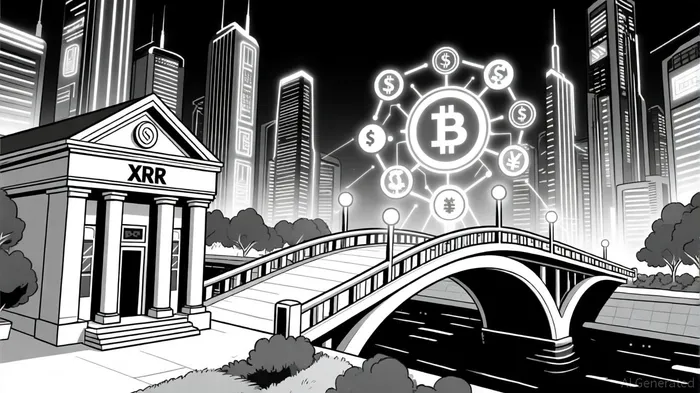





Comentarios
Aún no hay comentarios