
XRP's Strategic Price Reclamation of 21-Week EMA and Its Implications for Institutional Adoption
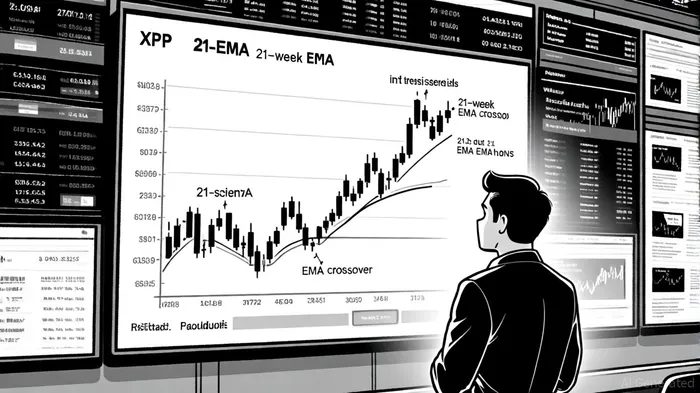
XRP's recent reclamation of its 21-week Exponential Moving Average (EMA) has reignited discussions about its potential for a sustained bullish breakout. As of September 2025, the asset trades at approximately $2.97, consolidating within a $2.94–$3.05 range while maintaining a critical position above the 21-week EMA and the $2.10 support level[4]. This technical development, coupled with macroeconomic catalysts such as regulatory clarity and institutional adoption, positions XRPXRP-- at a pivotal inflection point.
Technical Momentum: A Historical Prelude to Breakouts
The 21-week EMA has historically served as a bellwether for XRP's major price cycles. Analysts like EGRAG Crypto note that retests of this indicator often precede explosive rallies, as seen in 2017 (1,610% surge) and 2021 (414% increase)[3]. Currently, XRP's price action aligns with these patterns: the 5-day EMA (2.908167) and 20-day EMA (2.935410) are converging with the 21-week EMA, signaling a potential consolidation phase before a breakout[1].
Technical indicators, however, remain mixed. The Relative Strength Index (RSI) at 51 suggests neutral momentum, while the MACD hovers slightly negative at –0.04, reflecting short-term bearish pressure[6]. The ADX of 9.5 underscores that the trend is still in its early stages, with institutional accumulation likely to drive directional clarity[6]. A weekly close above $2.25—currently a psychological and technical threshold—is critical to validate a macro bottom[4]. If achieved, this could trigger a test of $3.10 resistance, with mid-term targets at $3.65–$4.50 and long-term projections of $5–$10 by 2030[6].
Macro-Driven Catalysts: Regulatory Clarity and Institutional Infrastructure
The technical narrative is increasingly intertwined with macroeconomic developments. The U.S. Securities and Exchange Commission's (SEC) recent rulings in the SEC v. Ripple case have been a game-changer. Court decisions affirming XRP's status as a commodity on exchanges have paved the way for institutional participation[2]. This regulatory clarity is further reinforced by Ripple's acquisition of a Major Payments Institution (MPI) license in Singapore, enhancing XRP's credibility for enterprise use in Asia[3].
Institutional adoption is accelerating through technological innovation. The XRP Ledger (XRPL) now supports compliance tools like Credentials and Deep Freeze, addressing institutional concerns around regulatory adherence[1]. Upcoming upgrades, including a native lending protocol in XRPL Version 3.0.0, are expected to expand XRP's utility in institutional finance by enabling low-cost, compliant credit markets[1]. Meanwhile, partnerships with global banks like Santander and BNY Mellon highlight XRP's role in cross-border payments, reducing settlement times and fees[2].
The most immediate catalyst, however, is the pending approval of XRP-based ETFs and ETPs. Bloomberg analysts estimate a 95% chance of approval for 11+ applications from firms like Grayscale and Franklin Templeton, with a final SEC decision expected by October 17, 2025[1]. JP Morgan projects these products could generate up to $8.4 billion in inflows during their first year[5]. Such institutional capital would not only deepen liquidity but also legitimize XRP as a mainstream asset, mirroring the impact of BitcoinBTC-- and EthereumETH-- ETFs[4].
The Symbiosis of Technical and Macro Trends
The interplay between technical momentum and macro catalysts is evident in XRP's recent performance. For instance, the 21-week EMA retest in November 2024 coincided with Ripple's expansion into Japan via the Ripple USD (RLUSD) stablecoin, signaling growing institutional confidence[5]. Similarly, the SEC's delay of some ETF approvals until October 2025 has created a period of consolidation, during which XRP's price has remained resilient above key support levels[5].
Historical precedents further validate this synergy. In 2021, XRP's retest of the 21 EMA preceded a 414% rally, driven by increased adoption in cross-border payments[3]. Today, the asset faces a similar juncture, with institutional infrastructure and regulatory progress acting as tailwinds. If XRP sustains its position above the 21-week EMA and secures ETF approvals, it could replicate past success, potentially reaching $10–$27 by late 2025[3].
Risks and Challenges
Despite the bullish case, risks persist. Over 70% of proposed ETF assets are concentrated in CoinbaseCOIN-- Custody, raising concerns about systemic vulnerabilities during market stress[3]. Additionally, XRP's daily trading volume of $5 billion lags behind Bitcoin's $30 billion at its ETF launch, which could amplify volatility during high-demand events[3]. Regulatory uncertainties, such as unresolved sales settlement issues between Ripple and the SEC, also linger[5].
Conclusion: A Confluence of Momentum and Macro
XRP's reclamation of the 21-week EMA is more than a technical milestone—it is a harbinger of broader institutional adoption. The alignment of regulatory clarity, technological innovation, and capital inflows creates a compelling case for a sustained bullish trajectory. While risks remain, the historical correlation between EMA retests and parabolic rallies, combined with the impending ETF approvals, suggests that XRP is on the cusp of a transformative phase. For investors, the key will be monitoring the $2.25 threshold and the October 2025 SEC decisions, which could unlock the next chapter in XRP's evolution.





Comentarios
Aún no hay comentarios