
XRP's Strategic Positioning Amidst the DeFi Evolution and Paydax's Emerging Role
The DeFi Evolution: XRP's Cross-Chain Liquidity and Institutional Adoption
The XRPXRP-- Ledger (XRPL) has emerged as a cornerstone of cross-chain liquidity and institutional-grade DeFi infrastructure in 2025. By leveraging its role as a bridge currency, XRP enables near-instant, low-cost settlements across RippleNet, which connects over 300 financial institutions globally, according to a Paydax press release. This network effect has positioned XRP as a critical tool for fiat conversions and cross-border remittances, eliminating the need for pre-funded accounts and reducing intermediary costs.
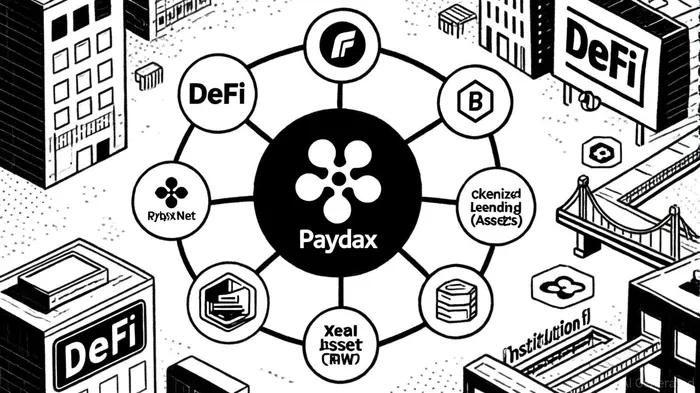
Institutional adoption has further accelerated with the introduction of products like mXRP, a liquid-staking derivative offering projected yields of 6–8%, as described in a CoinDesk article. This innovation allows XRP holders to convert dormant assets into yield-bearing instruments while maintaining interoperability with the XRP Ledger's EVM ecosystem. Complementing this, the XRP Ledger's native AMM (XLS-30) has expanded on-chain liquidity for tokenized assets, while wrapped versions like cbXRP and FXRP are generating 4–7% yields on DeFi platforms, according to a Bit Journal piece.
The ledger's utility has extended beyond payments to include real-world asset (RWA) tokenization, with projects like VERT tokenizing $130 million in agribusiness receivables, as noted in a Technology Innovators article. These developments underscore XRP's transition from a payment-focused blockchain to a comprehensive DeFi infrastructure, supported by regulatory clarity post-SEC case resolution.
Paydax Protocol: Bridging Traditional and DeFi Finance
While XRP solidifies its cross-chain dominance, Paydax Protocol (PDP) is redefining institutional access to DeFi through hybrid collateralization. The platform allows users to borrow stablecoins against both crypto assets and tokenized real-world holdings, offering loan-to-value (LTV) ratios that exceed traditional DeFi benchmarks, according to the Paydax press release cited above. This model expands liquidity access while maintaining a structured risk framework, with real-time data oracles and automated liquidation safeguards.
Paydax's leveraged staking and yield mechanisms further enhance its appeal. The PDP token, its governance asset, grants holders voting rights on protocol updates and liquidity management, per the same Paydax announcement. Institutional investors are drawn to its favorable LTV ratios and the ability to access lower borrowing rates via PDP token ownership, as discussed in the Bit Journal piece referenced earlier.
The protocol's architecture bridges traditional and decentralized finance by enabling users to retain asset ownership while accessing liquidity-a critical differentiator in a market saturated with hype-driven altcoins, as highlighted in the CoinDesk coverage. Recent analyses position Paydax's hybrid model as a "critical shift toward more inclusive and liquid digital economies," echoing the Paydax announcement.
Institutional Adoption and Cross-Chain Synergies
The convergence of XRP's cross-chain capabilities and Paydax's hybrid lending model is reshaping institutional adoption. Ripple's partnerships with R3 Corda and institutions like BlackRock and NVIDIA, noted in the Bit Journal coverage, highlight XRP's role in enabling scalable, interoperable financial infrastructure. Meanwhile, Paydax's focus on tokenized RWAs and real-time risk management aligns with institutional demands for transparency and security, as described in the Paydax release.
This synergy is evident in the growing integration of XRP-based assets into Paydax's ecosystem. For instance, cbXRP and FXRP are already being utilized in Paydax's yield-generating strategies, creating a feedback loop that amplifies liquidity across both platforms, as described in earlier analysis. As institutional capital flows into blockchain-based systems, the combined strengths of XRP and Paydax are likely to drive further adoption, particularly in cross-border settlements and tokenized asset markets, per the Technology Innovators article referenced above.
Investment Implications
For investors, the strategic positioning of XRP and Paydax presents compelling opportunities. XRP's regulatory clarity and institutional-grade DeFi tools (e.g., mXRP, XLS-30) make it a preferred asset for cross-border infrastructure and tokenization, consistent with the Technology Innovators coverage. Meanwhile, Paydax's hybrid collateral model and PDP token utility offer exposure to a rapidly expanding DeFi market, with potential for high ROI as institutional adoption accelerates, as noted in the CoinDesk analysis.
However, risks remain, including regulatory shifts and competition from emerging protocols. Diversifying across both XRP's cross-chain infrastructure and Paydax's hybrid DeFi model could mitigate these risks while capitalizing on complementary growth trajectories.






Comentarios
Aún no hay comentarios