
XRP's Strategic Position in Global Payments and Institutional Adoption: Ripple's November 2025 Catalysts and Institutional Infrastructure Edge
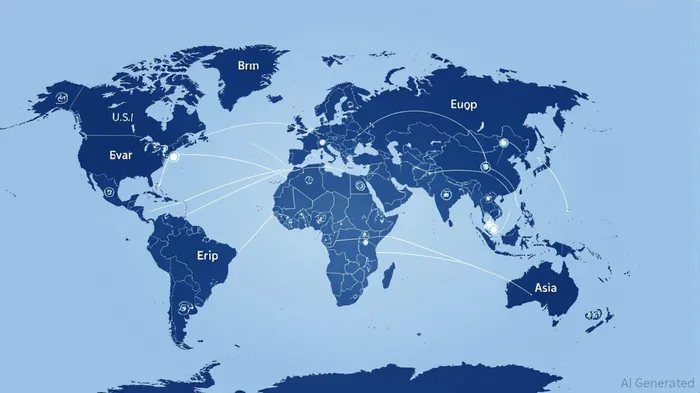
The Infrastructure Edge: RippleNet's Dominance in Cross-Border Payments
Ripple's institutional infrastructure has long positioned XRPXRP-- as a critical player in the $250 billion cross-border payments market[1]. RippleNet, the company's blockchain-based network, connects over 350 financial institutionsFISI-- globally, enabling real-time, low-cost transactions[2]. This infrastructure is not merely a technological feat—it's a strategic moat. By leveraging XRP as a liquidity bridge, institutions avoid the need for pre-funded accounts in foreign currencies, slashing costs by up to 70% compared to traditional SWIFT transfers[3].
The key to Ripple's edge lies in its dual-layer model: RippleNet (the institutional backbone) and XRP (the scalable asset). While competitors like SWIFT and traditional banks grapple with legacy systems, Ripple offers a programmable, on-demand solution. For example, Santander's use of Ripple for instant international payments and MoneyGram's XRP-powered remittance corridors demonstrate the asset's utility in real-world adoption[4].
Institutional Adoption: The Unseen Catalysts of November 2025
Though specific November 2025 milestones remain unannounced, historical trends and Ripple's roadmap suggest three potential catalysts:
Regulatory Clarity in Key Markets
The SEC's ongoing litigation with Ripple has cast a shadow over XRP's institutional adoption. However, whispers of a settlement in late 2025—potentially reclassifying XRP as a non-security—could unlock a flood of institutional capital. According to discussions on RedditRDDT--, XRP's utility-driven narrative gains strength in a post-SEC clarity environment[5].Expansion of On-Demand Liquidity (ODL) Partnerships
Ripple's ODL product, which uses XRP to settle cross-border payments in seconds, has seen renewed interest from emerging-market banks. A hypothetical November 2025 partnership with a major African or Southeast Asian bank could replicate MoneyGram's success, accelerating XRP's role as a reserve asset[6].Integration with Central Bank Digital Currencies (CBDCs)
Ripple's interoperability with CBDCs is a wildcard. If November 2025 sees pilot programs with countries like the UAE or Singapore—both of which are CBDC pioneers—XRP could serve as a bridge between fiat and digital currencies, enhancing its institutional appeal[7].
Why XRP's Infrastructure Edge Matters for Investors
Institutional adoption is not a binary event—it's a spectrum. Ripple's infrastructure already underpins a fraction of global payments, but its true potential lies in scaling this network. For investors, the November 2025 catalysts represent a tipping point:
- Liquidity Efficiency: XRP's role in reducing settlement times from days to seconds creates a flywheel effect for institutional users[8].
- Network Effects: Each new bank added to RippleNet amplifies XRP's utility, creating a self-reinforcing cycle of adoption[9].
- Regulatory Tailwinds: A favorable SEC resolution could trigger a re-rating of XRP from speculative asset to utility token[10].
Conclusion: Positioning for the Next Phase
While concrete November 2025 announcements remain elusive, Ripple's infrastructure and XRP's embedded utility suggest a strong case for optimismOP--. The asset's strategic position in global payments—coupled with potential regulatory and partnership catalysts—makes it a compelling play for investors targeting institutional blockchain adoption. As the lines between traditional finance and Web3 blur, XRP's infrastructure edge could prove irreplaceable.






Comentarios
Aún no hay comentarios