
XRP's Strategic Position in the Future of Global Payments and Institutional Adoption
The global payments landscape is undergoing a seismic shift, driven by the urgent demand for faster, cheaper, and more transparent cross-border transactions. At the forefront of this transformation is XRPXRP--, the digital asset powering the XRP Ledger (XRPL). As institutional adoption accelerates and regulatory clarity emerges, XRP is positioning itself as a critical infrastructure for the future of global finance. For investors seeking exposure to the next phase of financial innovation, XRP offers a compelling case rooted in real-world utility, strategic partnerships, and measurable efficiency gains.
Regulatory Clarity and Institutional Momentum
The resolution of Ripple's long-standing legal battle with the U.S. Securities and Exchange Commission (SEC) in August 2025 marked a turning point. By settling the case for $125 million, Ripple secured regulatory clarity that has since catalyzed institutional interest. This development triggered an 11% price surge in XRP and paved the way for the launch of Ripple Prime, an institutional-grade brokerage offering clearing, financing, and over-the-counter (OTC) trading services. The acquisition of Hidden Road for $1.25 billion further solidified Ripple's position as the first crypto-owned global prime brokerage, injecting $1.3 billion in assets under management through XRP ETFs within 50 days.
Institutional confidence is also bolstered by Ripple's expansion into custody solutions via the acquisition of Palisade and its strategic entry into markets like Singapore, the UAE, and the UK. These moves align with a broader trend of financial institutions seeking regulated, scalable alternatives to traditional systems. By 2026, XRP ETFs managed by firms like Franklin Templeton and Grayscale are projected to attract $5–7 billion in inflows, signaling a maturing institutional ecosystem.
XRP's Efficiency in Cross-Border Payments
The XRP Ledger's technical advantages are reshaping cross-border transactions. Unlike SWIFT, which relies on intermediary banks and batch processing, XRP enables real-time settlements in 3–5 seconds with fees as low as $0.0002 per transaction. This efficiency is achieved by using XRP as a bridge asset, converting fiat to XRP and back without the need for pre-funded nostro/vostro accounts- a practice that ties up $27 trillion in global liquidity.
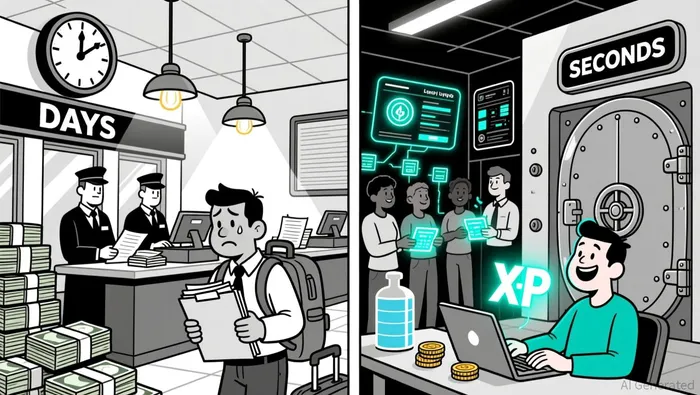
Case studies from major institutions highlight these benefits. Banco Santander's One Pay FX service, powered by Ripple, reduces settlement times from days to seconds while cutting costs by up to 60%. Similarly, SBI Holdings in Japan has integrated XRP into its payment infrastructure, enabling real-time gross settlements and freeing up capital for other uses. MoneyGram reported a 30% cost reduction through Ripple's On-Demand Liquidity (ODL) service by 2025, underscoring XRP's scalability for high-volume transactions.
Strategic Partnerships and Real-World Adoption
Ripple's partnerships with MastercardMA--, WebBank, and Gemini in November 2025 further validate XRP's role in mainstream finance. The collaboration introduced RLUSD, a stablecoin built on the XRP Ledger, to enable on-chain credit card settlements. This innovation bypasses traditional batch processing, offering instant, regulated settlements and expanding XRP's utility beyond remittances.
The XRP Ledger's energy efficiency- consuming 99.99% less energy per transaction than Bitcoin-also aligns with institutional ESG priorities. Over 50 financial institutions now use RippleNet for cross-border payments, processing $40 billion in annualized volume. Pilot programs with Santander, CIBC, and SBI Remit demonstrate XRP's compatibility with central bank digital currencies (CBDCs), positioning it as a bridge between legacy systems and the future of digital finance.
Why XRP Is a Must-Hold for Investors
For investors, XRP's strategic position is underpinned by three pillars: regulatory alignment, technological innovation, and institutional validation. The SEC settlement removed a major overhang, while XRP ETFs and custody solutions have created on-ramps for traditional investors. Technologically, the XRP Ledger's speed, low cost, and energy efficiency address pain points in global payments, with real-world use cases proving its viability. Institutionally, partnerships with Mastercard, Santander, and MoneyGram highlight XRP's role in a hybrid financial ecosystem.
As global trade intensifies and cross-border liquidity demands rise, XRP is uniquely positioned to capture market share. With $27 trillion in dormant liquidity at stake and a growing network of 300+ financial institutions on RippleNet, the asset's utility is not speculative-it is operational. For investors navigating the transition to a faster, more efficient financial system, XRP is not just a digital asset; it is a foundational infrastructure play.







Comentarios
Aún no hay comentarios