
XRP's Strategic Position Amid Crypto Market Recovery: Institutional Adoption and Regulatory Clarity as Catalysts for Long-Term Value
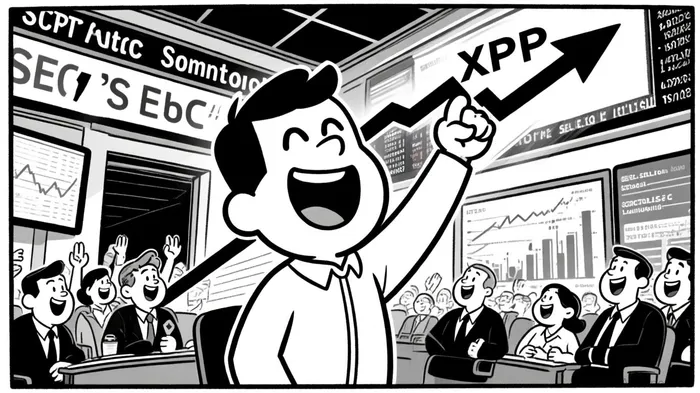
In 2025, XRPXRP-- emerged as a pivotal player in the crypto market's recovery, driven by a historic regulatory resolution and a surge in institutional adoption. The U.S. Securities and Exchange Commission's (SEC) August 2025 settlement with Ripple Labs, which concluded a four-year legal battle, marked a turning point. Ripple agreed to a $125 million fine and an injunction limiting institutional XRP sales, but the ruling clarified that XRP is not a security when traded on secondary markets by retail investors [1]. This regulatory clarity removed a critical barrier to adoption, triggering a 200% price surge in the weeks following the settlement and reigniting institutional interest in the asset.
Regulatory Clarity: A Foundation for Growth
The SEC's decision provided much-needed legal certainty, enabling XRP to transition from a speculative asset to a regulated one. According to a report by Finance Feeds, the settlement “established a framework for institutional participation, with major asset managers swiftly filing XRP ETF applications” [1]. By September 2025, the REX-Osprey XRP ETF (ticker: XRPR), a hybrid product blending spot XRP with Treasuries and derivatives, began trading, signaling a new era of institutional access. Analysts estimate a 95% probability of SEC approval for these ETFs by year-end, potentially unlocking $1–2 billion in inflows [1].
This regulatory shift also spurred broader market confidence. Data from CoinPulse indicates that XRP's trading volume surged to $15 billion in August 2025, a 300% increase from pre-settlement levels [4]. The token's inclusion in institutional portfolios is no longer speculative but strategic, as firms seek exposure to a crypto asset with clear legal boundaries.
Institutional Adoption: Scaling Utility Beyond Payments
Beyond regulatory hurdles, XRP's utility in cross-border payments has solidified its institutional appeal. Ripple's On-Demand Liquidity (ODL) service, which uses XRP to facilitate real-time, low-cost international transactions, processed $1.3 trillion in Q2 2025 alone [2]. Major banks, including Santander and Standard Chartered, have expanded their use of ODL, leveraging XRP's efficiency to reduce settlement times from days to minutes.
Institutional adoption has also extended to asset management. As stated by CoinPulse, “financial institutions are integrating XRP into their remittance and treasury solutions, recognizing its role as a bridge asset between fiat and digital currencies” [4]. This trend is further amplified by XRP Ledger (XRPL) upgrades in 2025, including batch transactions, token escrow, and permissioned decentralized exchange (DEX) features, which enhance scalability and compliance for institutional users [3].
Technological Advancements: Preparing for the Next Phase
Ripple's roadmap for 2025 underscores its commitment to institutional-grade infrastructure. The launch of RLUSD, a USD-backed stablecoin on both XRPL and EthereumETH--, is expected in Q4 2025 [3]. This move could increase XRP's demand as a collateral asset, given RLUSD's reliance on the XRP Ledger for liquidity. Additionally, XRPL's recent updates—such as improved transaction batching and escrow mechanisms—position it as a robust platform for institutional-grade token issuance and trading.
Future Outlook: ETFs and Market Projections
With XRP ETFs nearing approval, the asset is poised for mainstream adoption. Analysts at MarketMinute project that XRP could reach $4.00 by year-end 2025, driven by ETF inflows and institutional demand [2]. If approved, these ETFs would mirror the trajectory of BitcoinBTC-- ETFs in 2024, which catalyzed a 400% price increase for BTCBTC--.
However, challenges remain. The SEC's injunction on institutional XRP sales, while temporary, could delay large-scale fund allocations. Ripple's compliance with the settlement terms will be critical to maintaining momentum.
Conclusion
XRP's strategic position in the crypto market recovery hinges on its dual advantages: regulatory clarity and institutional utility. The SEC settlement has transformed XRP from a legal liability into a regulated asset, while its role in cross-border payments and upcoming stablecoin initiatives reinforce its long-term value proposition. As ETF approvals loom and technological upgrades take effect, XRP is well-positioned to become a cornerstone of institutional crypto portfolios.







Comentarios
Aún no hay comentarios