
XRP's Strategic Move Toward Institutional Adoption: Ripple's BlackRock Partnership and the Future of Tokenized Finance
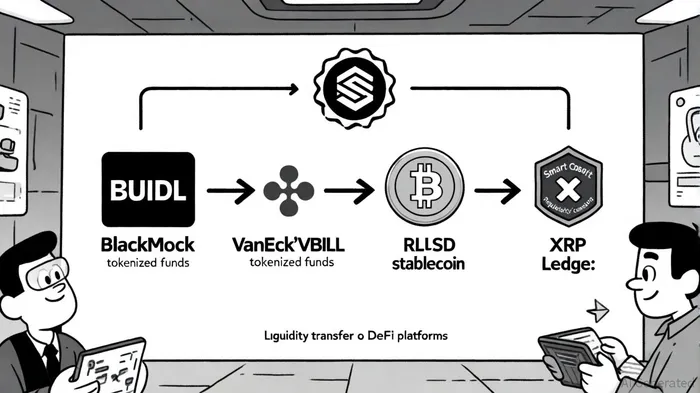
Ripple's recent collaboration with BlackRockBLK-- and VanEck marks a pivotal moment in XRP's journey toward institutional adoption. By enabling tokenized shares of the USD Institutional Digital Liquidity Fund (BUIDL) and Treasury Fund (VBILL) to be exchanged for Ripple's RLUSD stablecoin via a Securitize-developed smart contract, the partnership bridges traditional finance and blockchain-based liquidity[1]. This integration offers institutional investors 24/7 access to instant liquidity, allowing them to convert tokenized treasury holdings into a U.S. dollar-pegged stablecoin for on-chain transfers or DeFi strategies[2].
The Mechanics of the Partnership
RLUSD, Ripple's New York DFS-chartered stablecoin, is backed 1:1 by high-quality liquid assets, ensuring regulatory compliance while addressing institutional concerns about volatility and custody[3]. The smart contract, developed in collaboration with Securitize, automates the exchange process, reducing counterparty risk and operational friction[4]. Notably, this partnership represents a strategic pivot for BlackRock, which had previously avoided XRP-related products, signaling growing institutional confidence in blockchain-based solutions[5].
Securitize's roadmap to expand this integration to the XRPXRP-- Ledger further amplifies the implications. By leveraging XRP's fast, low-cost transactions, the ecosystem gains a scalable infrastructure for tokenized assets, potentially attracting more institutional players seeking efficiency[6].
Strategic Implications for XRP
This development positions XRP as a critical enabler of tokenized finance. While RLUSD itself is not XRP, the XRP Ledger's role in facilitating cross-asset transfers and smart contracts enhances the token's utility beyond its traditional function as a bridge currency. As institutional demand for programmable money grows, XRP's network effects could strengthen, particularly if the CLARITY Act—a regulatory framework for crypto assets—passes in the near term[6].
Moreover, the partnership underscores Ripple's ability to navigate regulatory scrutiny. By aligning with a financial giant like BlackRock and adhering to New York DFS standards, Ripple demonstrates that blockchain innovation can coexist with compliance—a key hurdle for broader institutional adoption[3].
Broader Market Implications
The ripple (pun intended) effects extend beyond XRP. This collaboration could accelerate the tokenization of traditional assets, as institutions seek to replicate the 24/7 liquidity and cost efficiencies demonstrated by BUIDL and VBILL. Competitors may follow suit, but Ripple's first-mover advantage in stablecoin infrastructure and XRP Ledger interoperability gives it a distinct edge[5].
Conclusion
Ripple's partnership with BlackRock is more than a technical upgrade—it's a strategic masterstroke. By embedding XRP-based infrastructure into institutional workflows, Ripple addresses liquidity, compliance, and scalability concerns that have long hindered crypto adoption. For XRP holders, this signals a shift from speculative narratives to tangible utility, with the potential to redefine the token's role in a post-CLARITY Act regulatory landscape[6]. As tokenized finance matures, XRP's position at the intersection of traditional and decentralized systems may prove to be its most valuable asset yet.





Comentarios
Aún no hay comentarios