
XRP's Strategic Investment Potential in the Post-SEC Enforcement Era
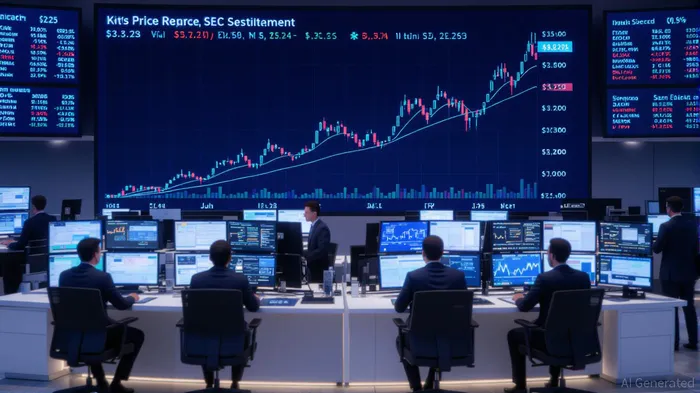
The U.S. Securities and Exchange Commission's (SEC) long-standing legal battle with Ripple Labs reached a definitive resolution in August 2025, marking a watershed moment for XRPXRP-- and the broader cryptocurrency market. By dropping all appeals and agreeing to a $125 million civil penalty—far below the initially sought $2 billion—the settlement not only clarified XRP's regulatory status but also redefined its investment narrative. With institutional sales of XRP classified as unregistered securities while secondary market transactions were deemed non-securities, Ripple's token now operates in a more predictable legal framework[1]. This clarity has catalyzed a surge in institutional interest, relistings on major exchanges, and a renewed focus on XRP's utility in cross-border payments and decentralized finance (DeFi).
Regulatory Clarity: A Catalyst for Institutional Adoption
The SEC's decision to exclude secondary market sales of XRP from securities classification has been a game-changer. As stated by Ripple's leadership, this outcome allows the company to “move back to business” while enabling XRP to function as a non-security in public markets[5]. This distinction has already triggered a wave of institutional activity: trading volumes on XRP surged 208% to $12.4 billion, and open interest in derivatives rose 15% to $5.9 billion in the months following the settlement[1]. The token's newfound legitimacy has also spurred 16 major asset managers—including Grayscale, Bitwise, and WisdomTree—to file applications for XRP ETFs. Bloomberg analysts estimate a 95% approval probability by year-end 2025, with the ProShares Ultra XRP ETF becoming the first XRP-focused fund to secure SEC approval[5].
Market Performance and Analyst Outlooks
XRP's price trajectory since the settlement underscores its growing appeal. The token reached an all-time high above $3.40 in July 2025, driven by speculative positioning and ETF-related optimism[1]. While it has since consolidated around $3.22, on-chain data reveals strong institutional accumulation during market corrections, signaling sustained confidence in XRP's long-term potential[5]. Analysts project a bullish case if ETF approvals materialize, with price targets ranging from $5-10 by 2025 and even $20 in the long term[3]. Key technical levels include a support zone at $3.15-$3.16 and resistance at $3.24-$3.27, with a breakout above $3.22 likely to trigger further upward momentum[1].
Ripple's Strategic Expansion: Utility-Driven Growth
Beyond regulatory tailwinds, XRP's value proposition is anchored in its real-world utility. Ripple's On-Demand Liquidity solution has demonstrated its ability to reduce cross-border payment costs by up to 70%, making it an attractive option for financial institutionsFISI-- seeking efficient remittance solutions[2]. The company's RLUSD stablecoin initiative further diversifies XRP's use cases, offering a regulated, dollar-denominated asset that can serve as an entry point for institutions[2]. Additionally, Ripple's launch of an EVM-compatible sidechain has expanded XRP's ecosystem, enabling Ethereum-based applications to leverage its speed and low costs[2]. These developments position XRP to compete in high-volume payment corridors and DeFi integrations, where liquidity and speed are critical factors[2].
Macro Factors and Risks
While XRP's prospects are robust, challenges remain. Competition from stablecoins and central bank digital currencies (CBDCs) could erode its market share in cross-border payments[2]. Technical challenges in maintaining high-availability infrastructure and regulatory scrutiny for institutional sales also pose execution risks[2]. Furthermore, macroeconomic factors such as inflation, interest rates, and geopolitical uncertainties will continue to influence investor sentiment across the cryptocurrency market[4].
Conclusion: A Bullish Case for XRP
The post-SEC settlement environment has created a favorable outlook for XRP, with regulatory clarity, institutional interest, and real-world utility converging to support its growth. As global remittance markets expand and ETF approvals loom, XRP's ability to reduce costs and improve settlement times could drive adoption in corridors where traditional banking solutions remain inefficient[2]. For investors, the token's unique position in cross-border payments and its expanding ecosystem present a compelling case for strategic allocation—provided risks are carefully managed.






Comentarios
Aún no hay comentarios