
XRP's Strategic Expansion in South Korea: Navigating a Regulated Crypto Ecosystem
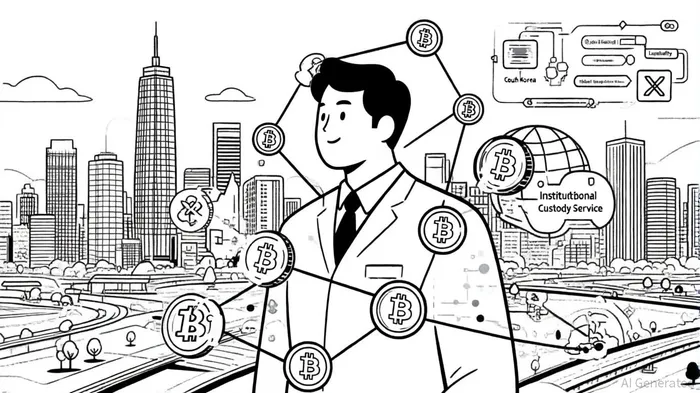
In 2025, South Korea has emerged as a pivotal player in the global cryptocurrency landscape, with its regulatory advancements creating a fertile ground for XRP's market expansion. The country's Financial Services Commission (FSC) has aligned its digital asset framework with the EU's Markets in Crypto-Assets (MiCA) regulations, fostering a transparent environment for institutional adoption. This alignment has directly enabled firms like BDACS, a licensed crypto custodian, to launch institutional-grade XRPXRP-- custody services, addressing critical security concerns and facilitating the management of XRP and Ripple's stablecoin, RLUSD [1].
Regulatory Clarity as a Catalyst
South Korea's regulatory evolution is marked by a dual focus on innovation and investor protection. The government's virtual asset transaction monitoring system, set to activate in late 2025, mandates pre-registration for cross-border crypto businesses and monthly reporting to the Bank of Korea. This system, coordinated with the Financial Intelligence Unit and Korea Customs Service, aims to curb financial crimes while maintaining market integrity [2]. Additionally, the FSC's two-track approach—distinguishing between security-type and non-security-type tokens—provides a nuanced framework that accommodates XRP's utility-driven model [3].
The introduction of a Korean won (KRW)-backed stablecoin, coupled with the suspension of the retail Central Bank Digital Currency (CBDK) program, underscores the government's prioritization of private-sector innovation. Major financial institutions are already preparing for this shift by integrating stablecoins into real-world commerce, a development that bodes well for XRP's adoption in cross-border payments [4].
XRP's Market Position and Institutional Adoption
South Korea's regulatory clarity has translated into tangible market outcomes for XRP. Local exchanges now handle 30% of Asia-Pacific XRP trading volume, with Korean investors holding $29 billion in XRP—25% of the circulating supply—creating significant global liquidity effects [1]. This dominance is further amplified by the FSC's approval of institutional-grade custody solutions, which have addressed prior concerns about asset security. For instance, BDACS's expansion into XRP custody has enabled institutional investors, including nonprofit organizations and professional firms, to participate in the market with confidence [5].
The FSC's roadmap also includes the launch of spot cryptocurrency ETFs by late 2025, a move that will integrate XRP into traditional investment portfolios. This development mirrors trends in the U.S. and U.K., where ETF approvals have driven institutional inflows into digital assets. South Korea's delayed taxation of crypto profits until 2028 further incentivizes long-term investment, reducing volatility risks for XRP holders [2].
Strategic Infrastructure and Global Implications
South Korea's proactive regulatory environment is supported by its technological infrastructure and blockchain innovation ecosystem. The Democratic Party's General Act on Digital Assets, introduced in June 2025, legalizes KRW-denominated stablecoins and sets licensing standards for Virtual Asset Service Providers (VASPs). This legislation notNOT-- only legitimizes XRP's role in the digital economy but also positions South Korea as a regional hub for cross-border transactions [6].
Moreover, anti-speculation measures targeting highly volatile tokens like memeMEME-- coins have enhanced market transparency, indirectly benefiting XRP's stable use case. The FSC's mandate requiring exchanges to store 80% of user funds in cold wallets has further bolstered trust in the ecosystem, a critical factor for XRP's institutional adoption [3].
Future Outlook
As South Korea continues to refine its regulatory approach, XRP's strategic positioning appears robust. The FSC's 2027 target for full implementation of the General Act on Digital Assets, including spot ETFs and stablecoin integration, will likely deepen XRP's role in both retail and institutional markets. Additionally, Ripple's partnerships with Korean financial institutions—such as the use of RLUSD for real-time settlements—highlight the token's utility in a regulated environment [4].
However, challenges remain. The FSC's anti-speculation measures and ongoing scrutiny of stablecoins could introduce friction, particularly if global regulatory standards diverge. Investors must also monitor the delayed tax policy's long-term implications, as infrastructure readiness by 2028 will determine its effectiveness.
Conclusion
South Korea's regulatory framework has created a unique confluence of innovation and oversight, positioning XRP as a strategic asset in the region. By leveraging institutional custody solutions, global liquidity, and a favorable policy environment, XRP is well-placed to capitalize on South Korea's ambition to lead the digital asset space. For investors, the country's regulatory clarity and infrastructure development offer a compelling case for long-term exposure to XRP, provided they remain attuned to evolving policy dynamics.






Comentarios
Aún no hay comentarios