
XRP's Strategic Expansion into Solana DeFi and Tokenized Securities: A Catalyst for Long-Term Value
The XRPXRP-- Ledger (XRPL) is undergoing a transformative phase in 2025, marked by strategic cross-chain integrations and institutional-grade tokenization initiatives. These developments are redefining XRP's utility beyond its traditional role in cross-border payments, positioning it as a linchpin in decentralized finance (DeFi) and real-world asset (RWA) ecosystems. By leveraging partnerships with Solana's DeFi infrastructure and advancing tokenized securities projects, XRP is carving a path toward mainstream institutional adoption and decentralized financial innovation.
Cross-Chain Integration: XRP on Solana's DeFi Ecosystem
Ripple's collaboration with SolanaSOL-- represents a pivotal step in XRP's multichain strategy. The launch of wrapped XRP (wXRP) on Solana, facilitated by Hex Trust and LayerZero's cross-chain infrastructure, enables XRP holders to access Solana's DeFi platforms-including decentralized exchanges (DEXes), lending protocols, and yield-generating tools-without converting their native XRP according to Ripple executives. This integration, announced at the Solana Breakpoint event in Abu Dhabi, underscores Ripple's vision of distributing XRP across multiple chains to maximize its utility according to Ripple's official announcement.
The wXRP token operates as a 1:1 representation of XRP, with Hex Trust managing custody and issuance. At launch, wXRP offered access to over $100 million in TVL, signaling robust institutional and retail confidence. Solana's DeFi ecosystem, already processing $3.9 billion in 24-hour DEX volume, provides a fertile ground for XRP's expanded utility. 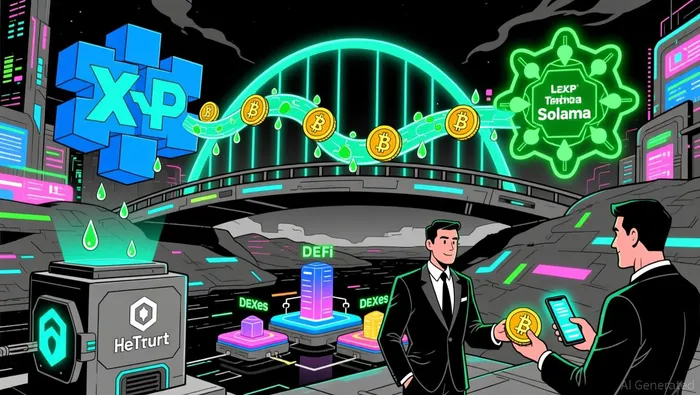 By bridging Solana's high-speed, low-cost infrastructure with XRP's liquidity, Ripple is creating a seamless on-ramp for traders and developers to leverage XRP in decentralized financial systems according to market analysts.
Tokenized Securities and Institutional Adoption: XRP's New Frontier
Beyond DeFi, XRP's role in tokenized securities is gaining momentum. Ripple's partnership with Archax aims to onboard $1 billion in tokenized assets on the XRPL by mid-2026, building on earlier commitments to tokenize treasuries, real estate, and private credit according to industry reports. This initiative aligns with broader trends in asset tokenization, where institutions are seeking faster, more transparent settlement mechanisms. For instance, tokenized U.S. Treasuries have surged to $33 billion in value by October 2025, with platforms like OndoONDO-- Finance and Guggenheim Treasury Services leveraging the XRPL for real-time, cost-effective transactions according to market analysis.
Regulatory clarity has been a critical enabler. Ripple's August 2025 settlement with the U.S. SEC removed long-standing uncertainty, allowing secondary market sales of XRP to proceed as non-securities according to legal analysts. This development catalyzed a 11% price surge and spurred nine asset managers to file spot XRP ETF applications, with analysts projecting $5–7 billion in inflows by 2026 according to financial forecasts. Additionally, Ripple's acquisition of Hidden Road and the creation of Ripple Prime, the first crypto-owned global prime brokerage, have added institutional-grade liquidity and settlement capabilities according to industry reports. These moves position XRP as a backbone for cross-border financial flows and tokenized asset trading.
Institutional Partnerships and Real-World Use Cases
XRP's institutional adoption is further reinforced by its integration into stablecoins like RLUSD, a dollar-backed stablecoin now used as a bridge asset for on-chain transactions according to stablecoin documentation. Ripple's On-Demand Liquidity (ODL) service, rebranded as Ripple Payments, processed $1.3 billion in payments in Q2 2025, demonstrating growing adoption among 300+ financial institutions. Meanwhile, the XRP Ledger's low fees ($0.0002 per transaction) and 3–5 second settlement times make it ideal for tokenizing high-volume assets such as infrastructure, renewable energy, and private credit according to market analysts.
Notable case studies include Obligate and Realiz, two startups in the XRPL Accelerator Batch VII, which are tokenizing non-bankable assets like real estate and renewable energy projects according to startup reports. In Dubai, Ripple Custody and Ctrl Alt have collaborated on the DLD Real Estate Tokenization Project, enabling secure and scalable property deed tokenization according to official project documentation. These projects highlight XRP's role in democratizing access to institutional-grade assets while reducing friction in global capital markets.
Market Dynamics and Future Outlook
While XRP's price has faced short-term volatility-marked by a bearish death cross pattern-long-term fundamentals remain bullish. Analysts project XRP could reach $6 by late 2026, driven by institutional inflows, tokenized asset growth, and regulatory tailwinds. However, sustained adoption will depend on institutions transitioning from interest-only usage to direct on-chain settlements according to financial analysts.
The XRP Tundra ecosystem, with its dual-chain staking and yield mechanisms, is also emerging as a key driver of value. By offering revenue-backed liquidity and cross-chain interoperability, Tundra could unlock new pricing dynamics for XRP in 2026 according to market projections. Meanwhile, Ripple's focus on expanding wXRP to EthereumETH-- and HyperEVM underscores its ambition to create a multichain future where XRP operates as a universal liquidity asset according to Ripple executives.
Conclusion
XRP's strategic expansion into Solana DeFi and tokenized securities is reshaping its narrative from a speculative token to a functional infrastructure asset. By bridging traditional finance with blockchain through cross-chain integrations, stablecoins, and institutional-grade tokenization, XRP is unlocking new avenues for liquidity, efficiency, and global accessibility. As regulatory frameworks mature and institutional adoption accelerates, XRP's role in decentralized and traditional financial systems is poised to become increasingly indelible.







Comentarios
Aún no hay comentarios