
XRP as a Strategic Buy During the Shakeout Before the Storm
Market Cycle Analysis: Accumulation Amidst Distribution
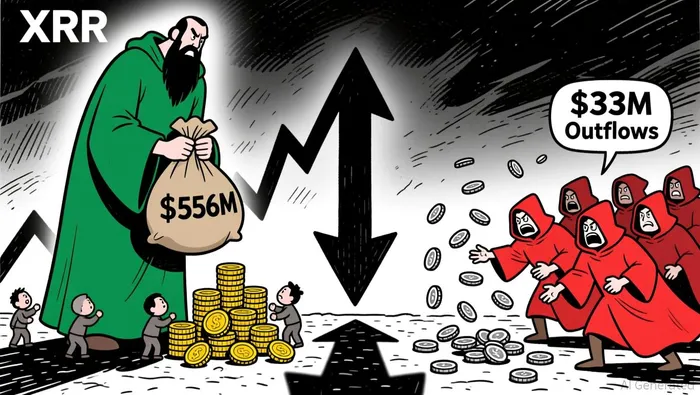 XRP's current phase is a hybrid of accumulation and distribution, a normal but critical stage in a bullish cycle. While on-chain data reveals 41.5% of XRP is held at a loss and recent net outflows of $33 million, these metrics mask deeper structural shifts. Institutional trading desks are prioritizing XRP's liquidity depth, regulatory alignment, and role in cross-border infrastructure over short-term momentum. Notably, the XRP Tundra project's implementation of Meteora's DAMM V2 liquidity system-featuring exponential fee scheduling and permanent liquidity locks-has stabilized early market phases and attracted analyst attention.
Whale activity further underscores this duality. A $556 million withdrawal of XRP from exchanges in recent weeks signals strong accumulation, supporting a 12% price rally. Meanwhile, retail investors have followed suit post-ETF approvals, indicating a broader reaccumulation phase. Analysts maintain price targets between $10 and $30, suggesting confidence in XRP's long-term trajectory despite short-term volatility.
ETF-Driven Institutional Demand: A Double-Edged Sword
The launch of XRP ETFs in Q3-Q4 2025 has injected $245 million in institutional inflows, with Canary Capital's XRPC ETF alone generating $268 million in cumulative inflows within 72 hours. However, this demand has clashed with whale selling, as 200 million XRP were offloaded in two days post-ETF debut, triggering a "sell-the-news" price dislocation.
This tension highlights the unique mechanics of ETF-driven demand. Unlike traditional spot trading, ETF inflows are delayed by T+1 settlement cycles and often masked by over-the-counter (OTC) channels. While this creates short-term price distortions, historical precedents-such as Bitcoin's 2024 ETF rollout-show that institutional adoption can reduce volatility and stabilize price discovery. Bitcoin's daily volatility dropped from 4.2% to 1.8% post-ETF, as institutional-grade liquidity smoothed price adjustments over 3–4 days.
For XRP, the entry of Bitwise, 21Shares, Grayscale, and WisdomTree into the ETF space could drive $7.2 billion in inflows over the next 12 months. This influx, combined with XRP's dual-token system (TUNDRA-S and TUNDRA-X) and GlacierChain's Layer-2 enhancements, positions it to capture institutional demand beyond speculative flows.
Pre-Bear Market Dynamics: Shakeout as Opportunity
The current shakeout mirrors pre-bear market patterns observed in Bitcoin's 2024 cycle. ETFs act as both stabilizers and catalysts, with institutional demand smoothing volatility while non-fundamental price shocks amplify short-term dislocations. Historical data from Bitcoin's ETF rollout shows that institutional ownership of crypto assets can surge from 19% to 31% in a single year. XRP's role in settlement architecture and its growing institutional exposure via ETFs suggest a similar trajectory. The key difference lies in XRP's functional utility-its integration into cross-border infrastructure and the Ripple USD (RLUSD) ecosystem provides a cash-flow-driven narrative absent in many speculative assets.
Strategic Buy Thesis: Navigating the Storm
Investors should view the current volatility as a buying opportunity. XRP's structural advantages-liquidity innovation, regulatory progress, and institutional-grade infrastructure-position it to outperform in the next market cycle. While ETF inflows may take weeks to reflect in on-chain metrics, the long-term fundamentals remain intact.
The "shakeout before the storm" is not a warning but a signal. As Fabio Marzella of the XRPL Foundation notes, the delayed impact of ETF flows will eventually manifest in stronger on-chain metrics. For those with a multi-quarter horizon, XRP's current price dislocation offers a chance to accumulate at a discount to its intrinsic value.
Conclusion
XRP's market cycle phase and ETF-driven institutional demand create a compelling case for strategic entry. While short-term volatility persists, the interplay of accumulation, regulatory clarity, and infrastructure innovation suggests a resilient asset poised for growth. In a market where shakeouts precede storms, XRP's current challenges may prove to be its greatest opportunity.






Comentarios
Aún no hay comentarios