
XRP as a Strategic Bridge Asset in a Tokenized Global Economy
In the evolving landscape of global finance, XRPXRP-- has emerged as a critical bridge asset, connecting traditional financial systems with the tokenized future. As institutions increasingly prioritize efficiency, transparency, and scalability, XRP's real-world utility in cross-border payments, stablecoin ecosystems, and institutional treasuries positions it as a linchpin in the transition to a digital economy.
Cross-Border Payments: Disrupting Legacy Systems
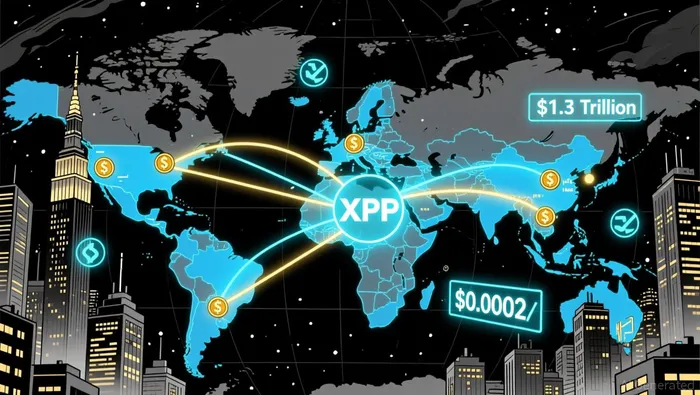
Ripple's On-Demand Liquidity (ODL) service has redefined cross-border transactions by leveraging XRP as a bridge currency. In Q2 2025 alone, ODL processed $1.3 trillion in transactions, slashing settlement times from days to seconds and reducing costs to as little as $0.0002. This efficiency is particularly transformative in high-frequency corridors, where businesses have reported 85% cost savings. Over 300 financial institutions now use RippleNet, with 40% adopting ODL by 2025. Institutions like AMINA Bank and SBI Remit have integrated Ripple's technology to eliminate the need for pre-funded nostro/vostro accounts, unlocking up to $27 trillion in dormant liquidity globally.
While SWIFT remains dominant, handling $150 trillion annually, its multi-day settlement cycles and intermediary-heavy structure create inefficiencies. Ripple's solution complements SWIFT by addressing the liquidity layer. CEO Brad Garlinghouse projects XRP could capture 14% of SWIFT's volume by 2030-equating to $21 trillion annually. However, regulatory hurdles and SWIFT's entrenched trust remain challenges.
Stablecoin Ecosystems: A New Liquidity Layer
The XRP Ledger's scalability- processing 1,500 transactions per second with 3–5 second finality-has made it a preferred infrastructure for stablecoins. Ripple's RLUSD stablecoin, a collaboration with MastercardMA--, WebBank, and Gemini, now boasts a market cap exceeding $1 billion, enabling instant on-chain credit card settlements. Additionally, OndoONDO-- Finance's tokenized U.S. Treasuries (OUSG) have integrated the XRP Ledger, allowing Qualified Purchasers to access institutional-grade assets.
Entities like Ondo Finance and Mercado BitcoinBTC-- are leveraging the XRP Ledger for real-world asset issuance, further cementing its role as a stablecoin backbone. The ledger's energy efficiency-99.99% less per transaction than Bitcoin also appeals to ESG-conscious investors.
Institutional Treasuries: Unlocking Trillion-Dollar Opportunities
XRP's adoption in institutional treasuries is accelerating. HSBC's exploration of blockchain for tokenization highlights the growing appetite for XRP-based solutions. Ripple's ODL has been adopted by major banks like CIBC, Santander, and UnionBank, demonstrating its utility in solving trillion-dollar liquidity challenges. The XRP Ledger's fixed supply of 100 billion tokens and escrow-managed release model provide institutional investors with predictability and transparency.
Scalability, Regulatory Clarity, and Long-Term Viability
The XRP Ledger's technical advantages- low energy consumption, high throughput, and rapid finality-position it as a scalable solution for global settlements. Regulatory clarity in the U.S., following the SEC lawsuit resolution in 2025, has further boosted institutional confidence. This alignment with regulatory frameworks is critical for long-term adoption, as it reduces legal ambiguity and fosters trust.
Conclusion: A Compelling Long-Term Investment
XRP's real-world utility in cross-border payments, stablecoin ecosystems, and institutional treasuries, combined with the XRP Ledger's scalability and regulatory progress, makes it a strategic bridge asset. As tokenization reshapes finance, XRP is not just a currency but a foundational infrastructure layer. For investors, this represents a unique opportunity to participate in a system that addresses trillion-dollar inefficiencies while aligning with the future of digital finance.







Comentarios
Aún no hay comentarios