
XRP and Solana ETF Inflows: A New Paradigm for Altcoin Institutional Adoption?
The institutional crypto landscape is undergoing a seismic shift. While BitcoinBTC-- and EthereumETH-- ETFs dominated headlines in 2024, 2025–2026 has seen a surge in demand for XRPXRP-- and SolanaSOL-- (SOL) investment products, signaling a maturation of altcoin adoption. This article analyzes the interplay between ETF inflows, price action, and institutional strategies, asking: Are XRP and Solana redefining the rules of institutional crypto allocation?
The ETF Surge: XRP and Solana Outpace Bitcoin and Ethereum
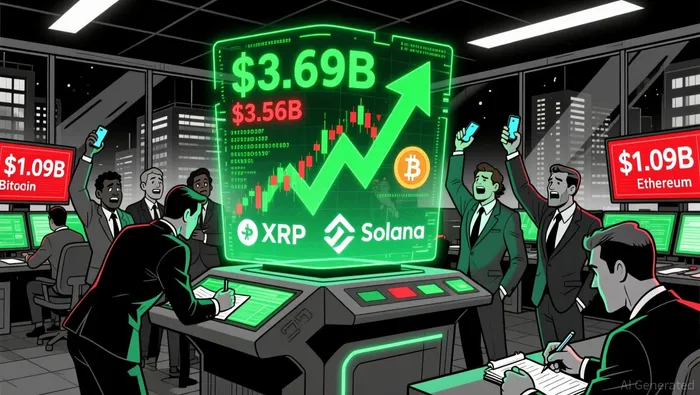
By 2025, XRP ETFs had absorbed $3.69 billion in inflows, a fivefold increase from 2024, while Solana's inflows surged to $3.56 billion, a tenfold jump. This growth was catalyzed by U.S. spot ETF approvals, including Canary Capital's XRPC, which recorded $58 million in day-one trading volume- a stark contrast to Solana's ETF debut.
The momentum continued into 2026, with XRP ETFs accumulating $1.3 billion in 50 days despite retail fear indices hitting extreme levels. Meanwhile, Solana's ETFs attracted $476 million in inflows by November 2025, with expectations of U.S. approvals driving speculative buying. Notably, XRP ETFs outperformed Bitcoin and Ethereum ETFs in late 2025, with $483 million in inflows versus Bitcoin's $1.09 billion in outflows according to analysis.
Price Action: Divergence Between Retail Fear and Institutional Demand
XRP's price action in early 2026 reflected a tug-of-war between retail capitulation and institutional accumulation. Despite the Crypto Fear & Greed Index hitting 24 (extreme fear) in late 2025, XRP spot ETFs continued to amass capital. Historical patterns suggest such divergence often precedes reversals, with machine learning models predicting price movements with 70–91% accuracy under these conditions. XRP traded near $1.90 in January 2026, consolidating at key support levels while institutional inflows outpaced Bitcoin's outflows.
Solana, meanwhile, entered Q1 2026 with a bullish technical setup. Its price consolidated between $118 and $165, with bulls eyeing a break above $165 for a sustained uptrend. Institutional adoption of Solana's real-world asset (RWA) tokenization- reaching $873 million in 2025-fueled demand. Network upgrades like Alpenglow (sub-150ms finality) and Firedancer (validator decentralization) further solidified Solana's appeal as an institutional-grade infrastructure.
The institutional embrace of XRP and Solana is driven by tangible use cases. XRP's role in cross-border payments and its ETF-driven liquidity have made it a strategic asset for diversified portfolios. Solana's RWA tokenization- spanning U.S. Treasury securities and private credit-has positioned it as a scalable solution for institutional-grade tokenization.
Regulatory clarity has accelerated this shift. The SEC's streamlined approval process for altcoin ETFs in late 2025 reduced barriers to entry, enabling products like Bitwise's Solana Staking ETF to attract $12.47 million in single-day inflows. Analysts argue that while Bitcoin and Ethereum remain core holdings, altcoin ETFs are now seen as tools to hedge against fiat debasement and enhance risk-adjusted returns.
Contrasting Bitcoin and Ethereum: A New Era of Competition
Bitcoin and Ethereum ETFs, once the gold standard of institutional crypto adoption, faced headwinds in late 2025. Combined outflows exceeded $500 million in two days, with Ethereum ETFs seeing $224 million in single-day redemptions. By contrast, XRP and Solana ETFs demonstrated resilience, with XRP ETFs attracting $1.01 billion in a month and Solana ETFs posting $3.6 million in net inflows amid market weakness.
This divergence reflects a broader reallocation of capital toward altcoins with clear utility. While Bitcoin and Ethereum ETFs remain dominant with 65% market share, XRP and Solana's institutional adoption is reshaping the narrative-from speculative bets to strategic allocations.
Conclusion: A Paradigm Shift in Altcoin Adoption
The 2025–2026 ETF inflows for XRP and Solana mark a pivotal moment in institutional crypto adoption. These assets are no longer outliers but integral components of diversified portfolios, driven by regulatory progress, technological innovation, and real-world use cases. As XRP navigates macroeconomic pressures and Solana scales its RWA ecosystem, the coming months will test whether this paradigm shift is a fleeting trend or the dawn of a new era for altcoin institutionalization.






Comentarios
Aún no hay comentarios