
Are XRP and Solana Still the Best Altcoins for 20x Gains in 2026? An Institutional Adoption and Risk-Adjusted Returns Analysis
The crypto market's evolution in 2025-2026 has been defined by a seismic shift toward institutional adoption, with XRPXRP-- and SolanaSOL-- (SOL) emerging as two of the most compelling altcoin narratives. As traditional finance increasingly allocates capital to digital assets, the question of whether these tokens can deliver 20x gains hinges on their ability to balance institutional demand with risk-adjusted returns. This analysis evaluates their trajectories through the lens of ETF inflows, volatility management, and structural market dynamics.
XRP: Regulatory Clarity and ETF-Driven Supply Crunch
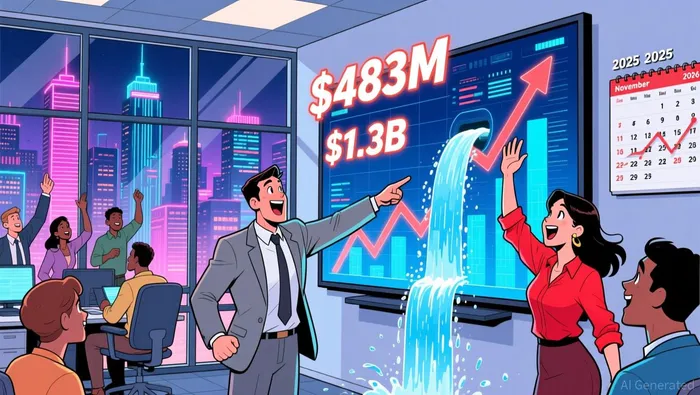
XRP's institutional adoption in 2025-2026 has been nothing short of explosive. The SEC's August 2025 ruling that XRP is a commodity, not a security, removed a critical compliance barrier, enabling the launch of XRP ETFs in November 2025. These products absorbed $483 million in December 2025 alone, with cumulative inflows reaching $1.3 billion in just 50 days-a pace second only to BitcoinBTC-- ETFs. This demand has triggered a structural supply crunch: exchange-held XRP balances have plummeted to multi-year lows, with holdings on Binance and other platforms dropping by 57% from 4 billion to 1.7 billion tokens. Such a reduction in circulating supply creates a self-reinforcing dynamic, where institutional HODLing and self-custody practices drive upward price pressure.
From a risk-adjusted returns perspective, XRP's volatility has been tempered by sophisticated institutional strategies. Covered call options, which generate yield by capping upside potential, have become a staple for XRP portfolios. These strategies capitalize on the token's higher volatility compared to Bitcoin, producing premium income that enhances risk-adjusted returns. Additionally, XRP's real-world utility in cross-border payments via Ripple's On-Demand Liquidity (ODL) service provides a floor for demand, even as speculative trading wanes. Analysts like Standard Chartered's Geoffrey Kendrick project XRP could reach $8 by year-end 2026, assuming $10 billion in ETF inflows and sustained institutional support.
Solana: High-Beta Appeal and the Need for a Killer App
Solana's institutional adoption has been driven by its high throughput and scalability, which position it as a challenger to Ethereum's DeFi dominance. Its spot ETFs, launched in late October 2025, attracted $765 million in cumulative inflows by early 2026, despite a 130% volatility rate. Institutions are drawn to Solana's high-beta nature, which allows for robust options strategies such as covered calls and collars. For example, staking SOL to lock in yields while maintaining exposure through derivatives has become a popular approach.
However, Solana's long-term viability depends on its ability to develop a "killer application" that differentiates it from EthereumETH-- and other blockchains. While its ecosystem has seen surging application revenue and daily active wallets, the lack of a breakthrough use case remains a risk. From a risk-adjusted returns standpoint, Solana's Sharpe ratio has shown mixed results: a 1-year ratio of -0.34 indicates underperformance, but a 5-year ratio of 0.99 suggests a more favorable risk-return profile. Studies also show that a 5% allocation to Solana in a diversified portfolio can boost annualized returns to 19.87% and Sharpe ratios to 1.412, outperforming Bitcoin and Ethereum in concentrated positions.
Comparative Analysis: Institutional Traction vs. Volatility Risks
Both XRP and Solana have benefited from institutional adoption, but their risk profiles differ. XRP's regulatory clarity and supply-side dynamics create a more stable foundation, with ETF inflows and shrinking exchange reserves reinforcing its value proposition. In contrast, Solana's reliance on speculative growth and technological innovation introduces higher volatility. For instance, a 10% price movement in SOL could trigger $400 million in liquidations, underscoring the fragility of its market structure.
Institutional strategies have mitigated some of this volatility. Covered calls on XRP generate higher premiums due to its greater volatility, while Solana's staking yields and derivatives provide downside protection. However, both tokens face liquidity challenges in spot markets, where large orders can cause erratic price swings.
Conclusion: 20x Gains Within Reach?
For XRP, the combination of regulatory clarity, ETF-driven supply removal, and real-world utility positions it as a strong candidate for 20x gains. If institutional inflows continue at current rates and the token's on-chain activity improves, a price target of $8 by year-end 2026 is plausible. Solana, while more speculative, offers compelling risk-adjusted returns for investors willing to tolerate its volatility. A breakthrough application or further institutional adoption could propel SOL to $280–$340, a 200% gain from its late 2025 price of $140.
Ultimately, both tokens exemplify the shift toward institutional-grade altcoins in 2026. However, their success will depend on overcoming structural weaknesses-XRP's weak DEX volumes and TVL, and Solana's need for a killer app-while maintaining the institutional confidence that has driven their recent surges.







Comentarios
Aún no hay comentarios